
Peine del Viento XV
Peine del Viento XV is a sculptural ensemble by Eduardo Chillida set within an architectural work by Basque architect Luis Peña Ganchegui. It is considered probably Chillida’s most important and best-known work. Located at the edge of La Concha Bay, at the end of Ondarreta Beach in San Sebastián, Basque Country, it consists of three steel sculptures, each weighing 10 tons, embedded in the rocks facing the Cantabrian Sea. Waves strike the sculptures directly, and the surrounding area includes air and water outlets fed by the sea. The work was completed in 1976.
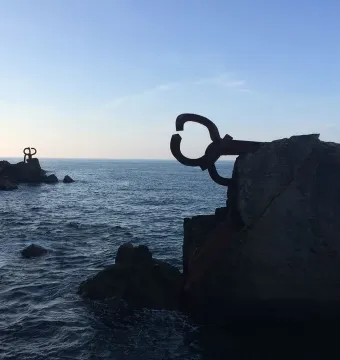
September 2014 © Pablo Alejandro Araujo Granda · CC BY-SA 2.0
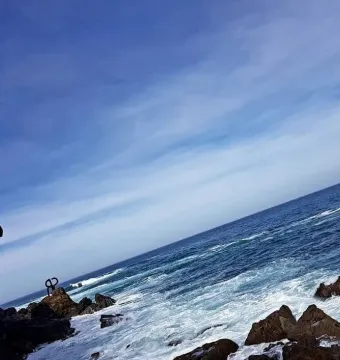
February 2023 © Mery46 · CC BY-SA 4.0
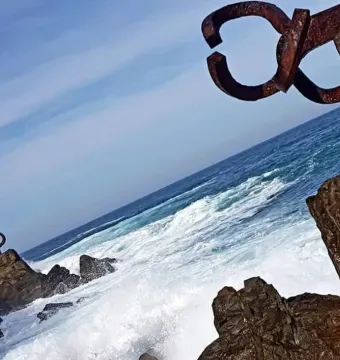
February 2023 © Mery46 · CC BY-SA 4.0
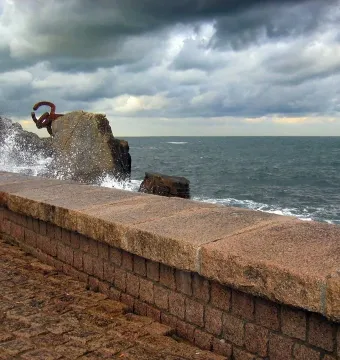
© hansbrinker · CC BY-SA 2.0
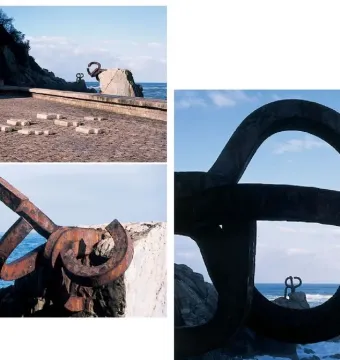
© Unknown authorUnknown author · CC BY-SA 3.0
Identification | |
| Title | Peine del Viento XV |
| Names | The Comb of the Wind; Haizearen orrazia; O Pente do Vento; Pettine del Vento; Peine del viento |
| Incorrect name | Peine de los Vientos |
| Type | Set of three sculptures and architectural work |
Historical context | |
| Completion year | 1976; completed on 3 September 1977 |
Creator | |
| Artist | Eduardo Chillida |
| Architect | Luis Peña Ganchegui |
Discovery and provenance | |
| Series | Peine del Viento series |
| Series dates | 1952–1999 |
| Number of works in series | 23 |
| Related works | Works dedicated to Pablo Picasso, Salvador Allende, and Pablo Neruda |
| Original plan | Originally intended as a single sculpture on a huge rock; later changed to three sculptures |
Location and ownership | |
| Associated architect's work | The plaza and architectural setting were designed by Luis Peña Ganchegui |
| Location | Western end of La Concha Bay, at the end of Ondarreta Beach, San Sebastián, Gipuzkoa, Basque Country, Spain |
| Associated installation | A plaza and nearby viewing area were created around the sculptures |
| Setting | Embedded in natural rocks rising from the Cantabrian Sea, outdoors |
| Associated features | Air and water outlets / blow-holes driven by waves striking the rocks and sculptures; seven holes in the plaza symbolize the seven Basque provinces |
Physical characteristics | |
| Number of sculptures | Three |
| Weight | About 10 tons each |
| Form | Monumental steel structures with four intersecting arms, extending like claws |
Materials | |
| Material | Steel |
| Surface condition | The steel is weathered and rusted from exposure to water, wind, and waves |
Technique | |
| Construction technique | Each sculpture was made in two curled steel pieces tied together |
| Installation method | The rocks were reinforced and holes were cut to embed the sculptures; rails and a walkway over the water were built to move, position, and anchor them; some accounts say they were transported by helicopter |
Appearance | |
| Spatial arrangement | Two sculptures face each other horizontally on the same rock block; the third rises vertically toward the horizon and sits farther from the viewer |
| Viewing context | From the square, only the sea is visible on the horizon |
| Landscape integration | The work is tightly integrated with the surrounding landscape and forms a single whole with it |
Iconography and meaning | |
| Symbolism | The first two sculptures represent dialogue and the bond between present and past; the third represents the future |
| Interpretation | An open work that invites each viewer to form their own interpretation |
| Theme | Reflection on the unknown horizon and the future that awaits |
| Artist's intention | He wanted the wind to 'comb itself before entering the city' |
History and restoration | |
| Public reception | Initially disliked by some local residents, later embraced and became the emblem of San Sebastián |
| Official inauguration | 16 September 2007, for the 30th anniversary of the installation |
| Opening | No true inauguration at completion; a small event with 9 participants was held |
| Plaza sounds | Breaking waves and wind passing through the holes |
Significance | |
| Importance | Probably one of Chillida's most important and best-known works; also among the best known works of Luis Peña Ganchegui |
| Cultural significance | A cultural symbol of San Sebastián |
| Dedication | A tribute to the sea, the waves, the wind, and the artist's city |
| Style | Minimalism, abstractionism, and land art |
Other | |
| Associated people mentioned | Luis Chillida; Fernando Otazu; Federico Lários |
| References | https://web.archive.org/web/20180924181058/http://peinedelviento.info/; https://www.mascontext.com/issues/8-public-winter-10/el-peine-del-viento/; https://www.plataformaarquitectura.cl/2009/03/12/peine-del-viento-en-san-sebastian/; https://web.archive.org/web/20080908051308/http://www.elpais.com/especiales/2001/25aniversario/especial/05/peine/p1.html |
| Categories | Sculptures in Spain; Sculptures in various metals |