
Fountain of Diana
Fountain of Diana is a marble sculpture showing Diana de Poitiers as the Roman goddess of the hunt, Diana. It was long attributed to Jean Goujon or Benvenuto Cellini, but is now more likely credited to the French sculptor Germain Pilon. The figure holds a bow with one hand and embraces a deer with the other, while standing with two dogs. It once formed the upper part of a monumental fountain in the courtyard of the Château d’Anet, built for Diana de Poitiers by Philibert Delorme. The work is considered the first depiction of a nude figure in French sculpture and the first large-scale French garden sculpture. The original marble is now in the Louvre in Paris.
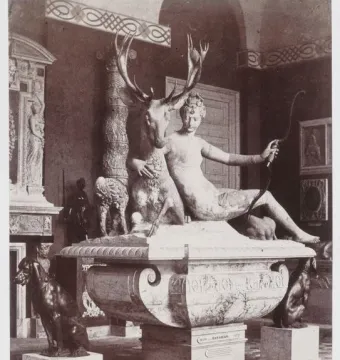
© Marville, Charles (Charles-François Bossu, dit) (17–07–1813 - 01–06–1879), photographe · CC0
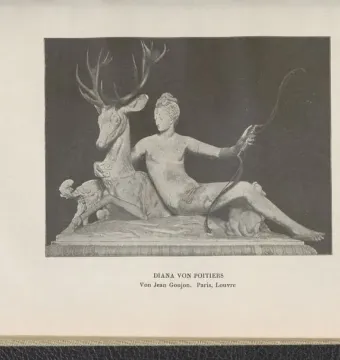
© Kazimierz Chłędowski · Public domain
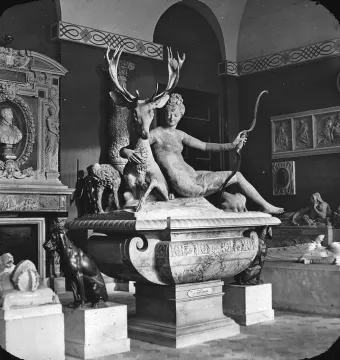
© William Henry Goodyear · Public domain
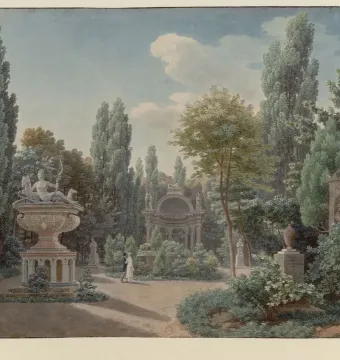
© Vauzelle, Jean-Lubin (1776-1837). Dessinateur · Public domain
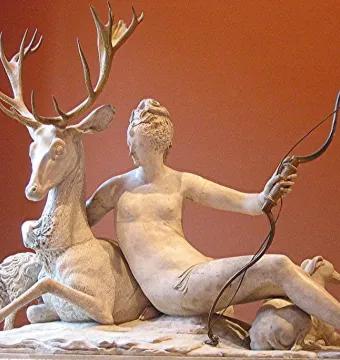
© Urban · CC BY-SA 3.0
Identification | |
| Title | Fountain of Diana |
| Alternative names | Diane d'Anet; Diana of Anet; Diana with a deer; Diana with a stag; Diane au cerf; Diane appuyée sur un cerf; Fontaine de Diane |
| Type | Marble Mannerist sculpture |
Historical context | |
| Date | Mid-16th century |
Creator | |
| Attribution | The sculptor is uncertain; former attributions include Jean Goujon, Benvenuto Cellini, and Germain Pilon, with Germain Pilon often proposed as the most likely artist. Ponce Jacquiot has also been suggested. |
| Associated architect | Philibert de L'Orme |
Discovery and provenance | |
| Related drawing | The Louvre preserves a drawing of the original fountain by an unknown 16th-century artist; Jacques Androuet du Cerceau also engraved it in its original setting |
| Patron/owner | Diane de Poitiers |
| Original location | The upper part of a monumental fountain in the courtyard of the Château d'Anet, built for Diane de Poitiers |
Physical characteristics | |
| Subject | Diane de Poitiers depicted as the goddess Diana |
| Pose | Seated |
| Main figures | Diana, a large stag, and two dogs |
| Dogs | Phrocyon, a greyhound, and Cyrius (or Kiriy), a barbet |
| Attributes | Diana holds a bow and embraces the stag's neck |
| Pedestal monograms | H and D, referring to Henry II of France and Diane de Poitiers |
Materials | |
| Main material | Marble |
| Later additions | A gilded bronze bow and gilding on the stag's antlers were added in the 19th century |
Appearance | |
| Style | Nude classical goddess figure |
| Original fountain features | Water jets came from the mouths and penises of the two dogs on the pedestal |
Iconography and meaning | |
| Interpretation | An allegorical figure of Diane de Poitiers in the guise of Diana, not a true portrait |
| Symbolic meaning | The stag is understood to represent Henry II, Diane de Poitiers's lover |
| Context | A work situated between Italian Mannerism and French Classicism |
Location and ownership | |
| Current location | Louvre Museum, Paris, Richelieu Wing, ground floor, Room 214 (formerly 15b) |
| Current title in museum | Diane appuyée sur un cerf |
| Inventory number | MR 1581 MR sup 123 |
History and restoration | |
| Restoration | Heavily restored by Pierre-Nicolas Beauvallet in 1799–1800 before installation in the Louvre |
| Previous condition | The original ensemble differed from the present form, with the stag's head and the left dog positioned differently |
| Later modifications | In the 19th century, Pierre-Maximilien Delafontaine added the gilded bronze bow and gilding to the stag's antlers |
| Related later drawing | A drawing by Jacques Gentilhâtre in the Library of the Royal Institute of British Architects shows the sculpture much as it appears today |
Significance | |
| Art-historical importance | Considered one of the first large nude figures in French sculpture and one of the first major French garden sculptures |
| Artistic significance | One of the most famous works of the French Renaissance and a witness to mid-16th-century artistic tensions |
Other | |
| Copies and reproductions | Marble copies survive in the courtyard of the Château d'Anet, the park of the Château de Rambouillet, and at the entrance to the Hunting Museum in Senlis; a bronze replica was installed in Nobel Park, Stockholm, in 1964 |
| Related works | Diana the Huntress by a member of the School of Fontainebleau; Le Bain de Diane by François Clouet |
| Notes on attribution | The traditional attribution to Jean Goujon is now generally rejected, and the authorship remains contested |