
Transparente
Transparente is a Baroque altarpiece in the ambulatory of the Cathedral of Toledo, Spain. Created between 1729 and 1732 by Narciso Tomé and his four sons, it combines marble, bronze, paint, and stucco in a dramatic design centered on light. Its name comes from the oculus cut high in the wall and the opening behind the altarpiece, which allow sunlight to reach the tabernacle and make it seem “transparent.” Commissioned by Archbishop Diego de Astorga y Céspedes to honor the Holy Sacrament, the monument cost 200,000 ducats and was celebrated as the “Eighth Wonder of the World.”
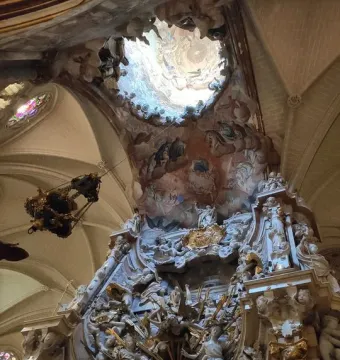
© Mentxuwiki · CC BY-SA 4.0
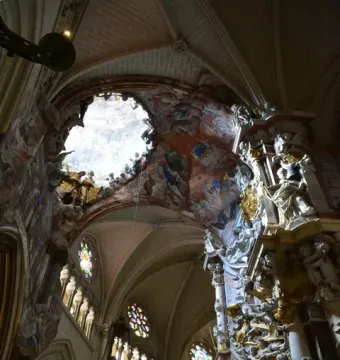
August 2014 © Jesusccastillo · CC BY-SA 4.0
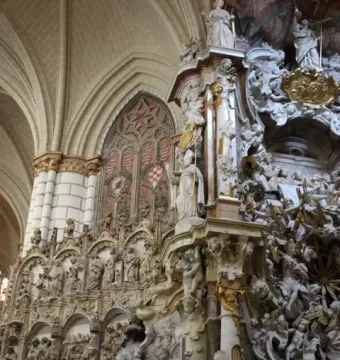
April 2014 © Miguel Hermoso Cuesta · CC BY-SA 4.0
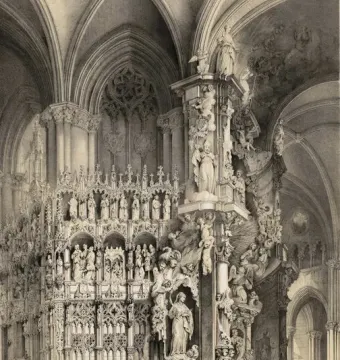
1842 © Bachelier, Charles Claude (fl. 1834-1836) Escosura, Patricio de la (1807-1878) Pérez Villaamil, Jenaro (1807-1854) Adam, Victor Vicent (1801-1866) Imprimerie Lemercier et Cie. · Public domain
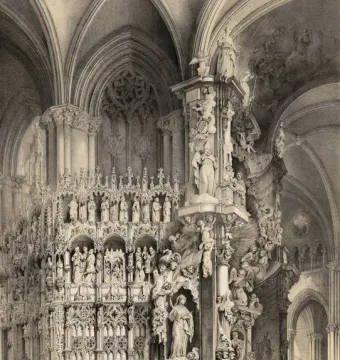
1842 © Bachelier, Charles Claude (fl. 1834-1836) Escosura, Patricio de la (1807-1878) Pérez Villaamil, Jenaro (1807-1854) Adam, Victor Vicent (1801-1866) Imprimerie Lemercier et Cie. · Public domain
Identification | |
| Title | Transparente |
| Type | Baroque altarpiece-like sculptural ensemble |
| Full name | Transparente of Toledo Cathedral |
Historical context | |
| Commissioned by | Diego de Astorga y Céspedes, Archbishop of Toledo |
| Notable epithet | Called "the Eighth Wonder of the World" in a celebratory poem |
| Commissioning purpose | To mark the presence of the Holy Sacrament with a glorious monument and illuminate the tabernacle |
| Patron's tenure | 1720–1734 |
| Cost | 200,000 ducats |
| Inauguration date | 9 June 1732 |
| Style | Late Spanish Baroque |
| Date of creation | 1729–1732 |
Creator | |
| Nationality of creator | Spanish |
| Roles of creators | Two architects, one painter, and one sculptor |
| Creator | Narciso Tomé and his four sons |
Location and ownership | |
| Inscription | A Latin inscription in the lower right corner identifies the author |
| Burial association | Diego de Astorga y Céspedes is buried at the foot of the altar |
| Location | Ambulatory of Toledo Cathedral, Toledo, Spain, directly behind the main altar |
| Associated objects | Red hats of cardinals buried there |
Discovery and provenance | |
| Name origin | The name refers to the illumination effect and the view through the altarpiece to the tabernacle |
Materials | |
| Materials | Marble, alabaster, bronze, paint, stucco, stained glass, jasper, and white Carrara marble |
Technique | |
| Lighting system | Natural light is directed through skylights and an oculus to illuminate the Transparente and the tabernacle |
| Construction method | Created by breaking through the apse wall and cutting openings for light |
| Surface and ornament | Rich ornamentation in marble and alabaster, with paint and bronze details |
Physical characteristics | |
| Other figural elements | Carved clouds, golden rays, and many moving angels |
| Iconographic reliefs | Abigail offering David bread and wine, and Ahimelech giving David Goliath's sword and consecrated bread |
| Decorative figures | Angels, saints, prophets, cardinals, archangels, and biblical figures arranged around the oculus and along the edges |
| Decorative motifs | Abstract forms suggesting flowing robes and foliage |
| Upper body | The Last Supper, slightly larger than life-size |
| Side figures | Saint Eugene and Saint Leocadia on the left; Saint Ildefonso and Saint Casilda on the right |
| Upper sculptures | Faith, Hope, and Charity |
| Virgin statue | Statue of the Virgin of the Good Milk in white Carrara marble, framed by richly ornamented columns |
| Central motif | A transparent oculus symbolizing the sun with its rays |
| Back side treatment | The reverse was converted into a tower of marble reaching from floor to ceiling |
| Structural form | An ensemble with a transparent oculus and two vertical sections, set over the high altar reredos/tabernacle arrangement |
| Main architectural feature | A large oculus opened high in the apse wall across the ambulatory |
Appearance | |
| Visual effect | Designed to appear transparent, with shafts of sunlight striking the tabernacle and highlighting the ensemble |
| Overall effect | A grand mystical and spiritual effect |
| Stylistic character | Features flowing lines and exuberant ornamentation |
| Architectural influence | May reflect Bernini's Cathedra Petri in St Peter's Basilica, Rome |
Iconography and meaning | |
| Associated scriptural subjects | The Virgin, archangels, prophets, Gideon, the Last Supper, and the theological virtues |
| Last Supper meaning | Eucharistic meaning |
| Meaning | Eucharistic and biblical imagery, emphasizing the Eucharist and the Holy Sacrament |
History and restoration | |
| Initial reception | Initially controversial because of its exuberance |
| Historical reception | It aroused great enthusiasm |
Significance | |
| Assessment | Considered the masterpiece of Narciso Tomé and one of the most spectacular works of Spanish late Baroque |
| Artistic interpretation | More highly valued as an architectural composition than as a sculptural work |
| Cultural significance | Alejo Carpentier considered it the authentic miracle of Toledo Cathedral and the apex of European Baroque |
| Comparative significance | Carpentier placed it on the same level as St. Peter's Basilica in Rome and St. Basil's Cathedral in Moscow |
| Literary influence | Its conceptual qualities reportedly influenced Carpentier's El Siglo de las luces and Concierto barroco |
| Related concept | Linked to Carpentier's idea of "lo real maravilloso" |