
Veiled Christ
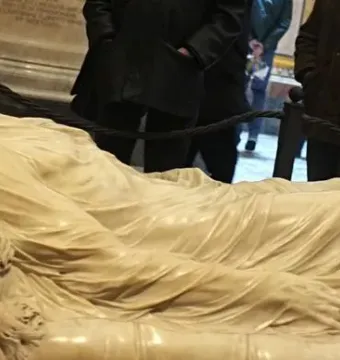
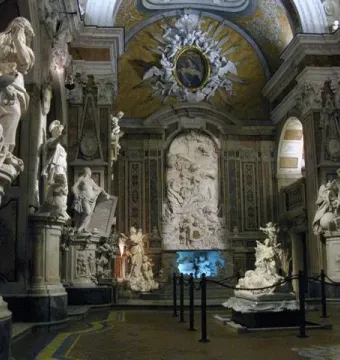
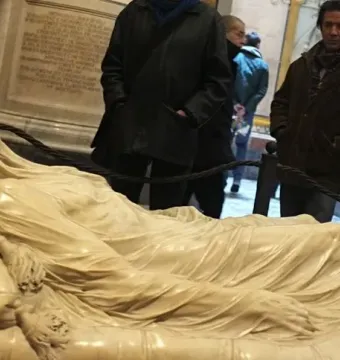
Veiled Christ, also known as Cristo velato, is a marble tomb effigy completed in 1753 by the Neapolitan artist Giuseppe Sanmartino. Carved from a single block of white marble, it depicts the body of Christ beneath a revealing translucent shroud or veil. The sculpture was commissioned by Raimondo di Sangro, prince of Sansevero, to serve as the centrepiece of the Cappella Sansevero in Naples, Italy. Its exceptional quality was later praised by the 18th-century sculptor Antonio Canova, who said he would willingly give ten years of his life to have produced something of similar quality.
September 2014 © David Sivyer · CC BY-SA 2.0
November 2015 © David Sivyer · CC BY-SA 2.0
September 2014 © David Sivyer · CC BY-SA 2.0
May 2014 © E. della Morte · CC BY-SA 3.0
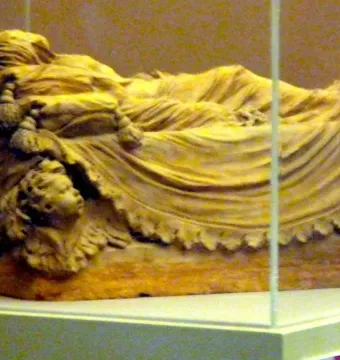
May 2014 © E. della Morte · CC BY-SA 3.0
Identification | |
| Title | Veiled Christ |
| Type | Marble tomb effigy |
| Original title | Cristo velato |
| Original language | Italian |
Historical context | |
| Completion date | 1753 |
Creator | |
| Artist | Giuseppe Sanmartino |
| Artist nationality | Neapolitan |
Discovery and provenance | |
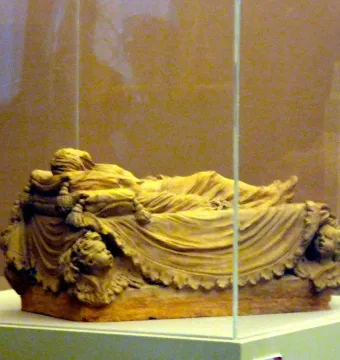
| Corradini's contribution | A terracotta bozzetto, now in the National Museum of San Martino |
| Payment record | On 16 December 1752, Sanmartino was paid fifty ducats for the statue of Our Lord dead, covered with a veil equally in marble; the receipt is preserved in the Historical Archives of the Banco di Napoli |
| Commission context | Commissioned in 1753 |
| First commissioned sculptor | Antonio Corradini |
| Commission purpose | Centrepiece of the Cappella Sansevero in Naples |
| Original intended location | The family mausoleum below the Cappella Sansevero, in the space now housing the Anatomical Machines |
| Commissioned by | Raimondo di Sangro, Prince of Sansevero |
| Subsequent sculptor | Giuseppe Sanmartino |
Physical characteristics | |
| Dimensions | 50 × 80 × 180 cm |
| Size | Life-size |
| Pose | The dead Christ lying down on a mattress or couch |
Materials | |
| Material | Marble |
| Model material | Terracotta |
| Copy material at Potenza | Wood (Pinus cembra), plastered and treated to look like marble |
| Veil material | Marble, carved from the same block as the statue |
Technique | |
| Technique | Carved statue |
Appearance | |
| Base objects | Instruments of the Passion, including the crown of thorns, pincers, and nails |
| Depicted subject | Christ in death |
| Veil description | A transparent, very fine shroud that adheres to the body's forms and creates the illusion of wet, transparent marble |
| Visible details | The wounds and marks of Christ's suffering are visible on the face and body beneath the veil |
Iconography and meaning | |
| Iconographic theme | A reclining effigy of Christ covered by a shroud, referring to the Holy Shroud (Saint-Suaire) |
| Meaning | The veil emphasizes Christ's suffering in the moments before and during the crucifixion |
Location and ownership | |
| Current location | Centre of the nave of the Cappella Sansevero, Naples, Italy |
| Corradini's model location | National Museum of San Martino |
| Payment archive | Historical Archives of the Banco di Napoli |
| Copy locations | Church and Convent of Santa Maria del Sepolcro, Potenza; Abbey of San Giovanni Evangelista, Parma |
History and restoration | |
| Documentary evidence | Letters from the period state that the veil was made from the same block as the statue |
| Scholarly conclusion | The work was made entirely in marble |
| Legend about the veil | For centuries, many visitors believed the veil was produced by an alchemical process that transformed a real cloth into marble |
| Signature | "Joseph Sanmartino, Neap., fecit, 1753" on the back of the pedestal, under the mattress |
Significance | |
| Artistic status | Considered one of the masterpieces of world sculpture |
| Reception | Highly praised; visitors, including Antonio Canova, were astonished by the veil and its realism |
| Canova's reaction | He tried in vain to buy the sculpture and said he would willingly give ten years of his life to have produced something of similar quality |
| Other admirers | Matilde Serao, Marchese de Sade, Héctor Bianciotti, Adonis, Riccardo Muti |
| Career impact | Helped launch Sanmartino's career |
Other | |
| 2010 copy | Cristo RiVelato, a blind sculptor's itinerant accessible copy made in 2010 by Felice Tagliaferri |
| Copy at Potenza | 1914 wooden statue by Helmut Perathoner from Val Gardena, generally exhibited only during Lent |
| Copy at Parma display period | 16 October 2020 to December 2021 |
| 2021 event | Abel Ferrara read texts by Gabriele Tinti before the sculpture on International Museum Day during the 250th anniversary of Raimondo di Sangro's death |
| Public legend | For nearly three centuries, many chapel visitors believed the veil was the result of an alchemical petrification attributed to Raimondo di Sangro |