
St. Peter's Baldachin
St. Peter's Baldachin is one of Bernini’s most famous works and was created in collaboration with his colleague and rival Francesco Borromini. This monumental Baroque ciborium stands inside St. Peter’s Basilica in Vatican City and was conceived in the 17th century to mark the site of the saint’s tomb. Set over the semicircular space of the confession, it rises above the basilica’s crypt, now known as the Vatican Grottoes. Measuring 28.5 meters in height, it is remarkable for its scale yet remains in perfect harmony with the surrounding architecture. In the Christian Catholic tradition, the baldachin serves as a liturgical furnishing that directs attention toward the main altar, the focal point of the religious celebration.
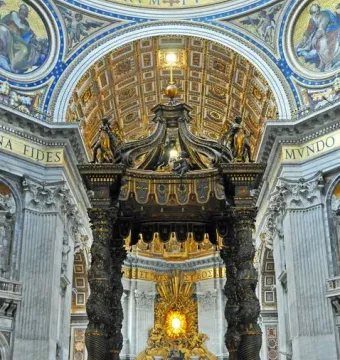
October 2010 © Dennis G. Jarvis · CC BY-SA 2.0
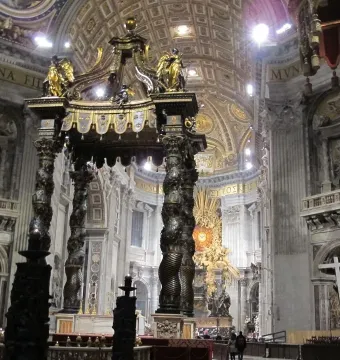
© sailko · CC BY-SA 3.0
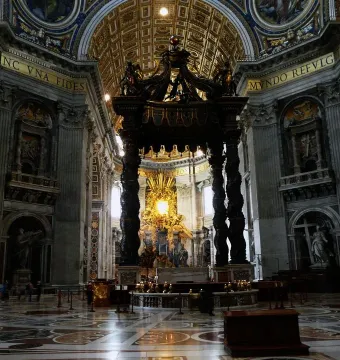
October 2015 © Михаил Бернгардт · CC BY-SA 4.0
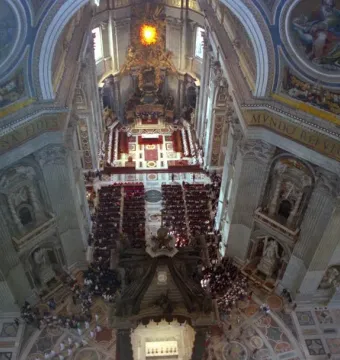
April 2003 © Ericd · CC BY-SA 3.0
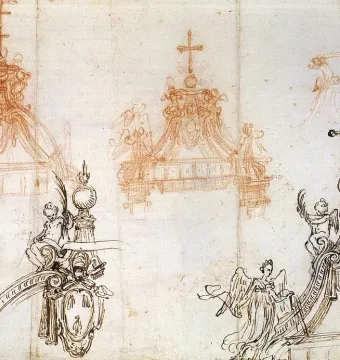
© Gian Lorenzo Bernini · Public domain
Identification | |
| Title | St. Peter's Baldachin |
| Alternative name | The Baldachin |
| Spanish title | El baldaquino de San Pedro |
| Type | Monumental Baroque ciborium or baldachin; large sculpted bronze canopy over an altar |
| Original name | Baldacchino di San Pietro |
Historical context | |
| Style | Baroque |
| Period | 17th century |
Creator | |
| Artist | Gian Lorenzo Bernini |
| Nationality of artist | Italian |
| Collaborators | Francesco Borromini; Pietro Bernini; Luigi Bernini; Stefano Maderno; François Duquesnoy; Andrea Bolgi; Giuliano Finelli |
| Workshop | Bernini's workshop |
Discovery and provenance | |
| Commission significance | Bernini's first major public commission after Urban VIII's election in 1623 |
| Age of artist at commission | 25 years old |
| Inauguration date | 28 June 1633 |
| Construction period | 1623–1634 |
| Commissioned by | Pope Urban VIII, then Cardinal Maffeo Barberini |
Physical characteristics | |
| Height | 28.5 m |
| Scale | Monumental; very large structure |
| Structural form | Canopy resting on four helical columns on marble plinths, topped with angels, volutes, a cross, and a sphere |
Materials | |
| Primary material | Bronze, including gilded bronze |
| Base material | Marble plinths |
| Column height | 20 m (66 ft) |
| Bronze source | The bronze source was controversial; it was believed to have come from the Pantheon, though Urban VIII's accounts say the baldachin bronze came from Venice |
Technique | |
| Casting | Column bases and capitals were cast separately, and each shaft was cast in three sections |
Appearance | |
| Decorative motifs | Barberini heraldry with bees and laurel leaves; radiant sun; scalloped and tasselled bronze border |
| Plinth decoration | Eight nearly identical Barberini coats of arms with three bees, framed by a female head at the top and a satyr's head at the bottom, with the papal tiara and crossed keys above |
| Plinth iconographic variation | The shield changes progressively from the left front plinth onward; on the eighth shield the female head is replaced by a putto head |
Iconography and meaning | |
| Solomonic columns | The design incorporates twisted Solomonic columns associated with the Temple of Solomon and the Old St. Peter's Basilica |
| Carrying tradition | The name and prestige of the Solomonic column form derive from the ancient columns of the Old St. Peter's Basilica |
| Function | Covers the high altar and marks the tomb of Saint Peter beneath it |
| Traditional precedent | A renewal of the traditional ciborium and the early Christian custom of placing altars over martyrs' tombs beneath canopies |
| Purpose | To make the papal altar prominent and frame the sacred place above Saint Peter's tomb |
| Symbolism | Connects the dome, papal authority, and Saint Peter's tomb on one vertical axis; alludes to the Temple of Solomon, funerary catafalques, and the papal baldacchino carried over the pope on Holy Days |
Location and ownership | |
| Location | Center of the crossing, directly under Michelangelo's dome, in St. Peter's Basilica, Vatican City |
| Building | St. Peter's Basilica |
| Site relation | Above the high altar and over the tomb of Saint Peter |
| Architectural setting | Integrated into the basilica's interior architecture and serves as its visual focal point |
| Associated site | The crypt below is now called the Vatican Grottoes |
| Associated remains | The Vatican Grottoes contain the remains of popes, with some exceptions |
History and restoration | |
| Column tradition | According to tradition, the columns were brought from Greece by Constantine I and in the Middle Ages were believed to come from the Temple of Jerusalem |
| Catafalque and papal symbolism | The design may allude to a funerary catafalque and to the pope as successor of Saint Peter |
| Satirical inscription | Quod non fecerunt barbari, fecerunt Barberini ('What the barbarians did not do, the Barberini did') |
| Bronze controversy | A rumour claimed bronze was taken from the Pantheon; satirical verses blamed the Barberini family, while Louise Rice judged the story papal propaganda |
| Construction of the work | Bernini executed the work with his workshop, including founders and stonecutters |
| Old St. Peter's precedent | The Old St. Peter's Basilica had a screen before the altar supported by twelve 2nd-century Solomonic columns of Greek marble |
| Named surviving column | Colonna degli ossessi ('column of the possessed') |
| Surviving original columns | Eight of the original twelve columns survive and are arranged in pairs halfway up the piers on both sides of the baldachin; two are in the Chapel of the Blessed Sacrament, one is lost, and one is in the Treasury near the Sacristy |
| Predecessor design | Carlo Maderno had been commissioned in the 1610s to design a permanent baldachin for St. Peter's and had already used Solomonic columns |
| Historical context | Temporary baldachins were used in St. Peter's during Lent and other celebrations; permanent baldachins already existed in many major Roman basilicas |
| Construction background | Bernini worked with Francesco Borromini early in their careers, before their later rivalry |
Significance | |
| Artistic significance | Bernini's first work to fuse sculpture and architecture into a single allegorical object; a major development in Baroque church interior design |
| Artistic character | A masterpiece with strong scenographic character and vivid movement |
| Spatial role | Creates a visual mediation between the vast scale of the basilica and the human scale of the officiants at the papal altar |
| Critical reception | Praised by Sergei Eisenstein as one of Bernini's most spectacular compositions |