
Paduka
Paduka is the oldest form of Indian footwear: a simple sole with a small knob that fits between the first and second toe. It appears in many shapes and materials, including wood, ivory, silver, teak, ebony, and sandalwood, and some examples are highly decorated. The most elaborate pairs could form part of a bride’s wedding trousseau, serve as religious offerings, or even be objects of veneration. Simpler versions were worn by ordinary people, while finely made pairs signaled the wearer’s status. Today, padukas are usually worn by Hindu and Jain mendicants and ascetics. In Hindu mythology, they are linked to the Ramayana and to the veneration of sacred footprints of saints and deities.
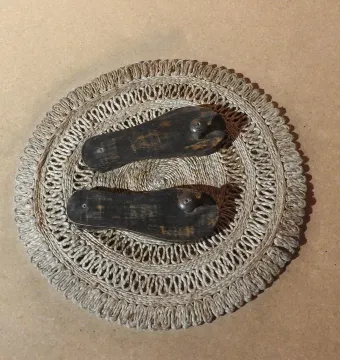
July 2018 © Yercaud-elango · CC BY-SA 4.0
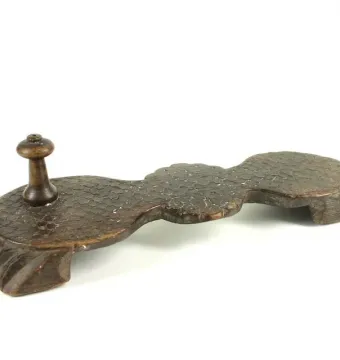
October 2013 © Shoe Museum of Villa Foscarini Rossi · CC BY-SA 3.0
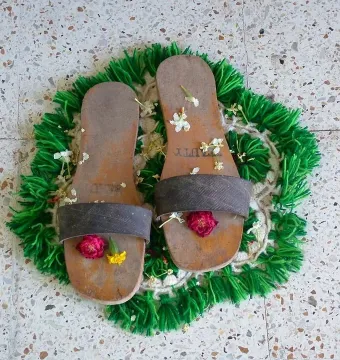
September 2009 © User:જીતેન્દ્રસિંહ · CC BY-SA 3.0
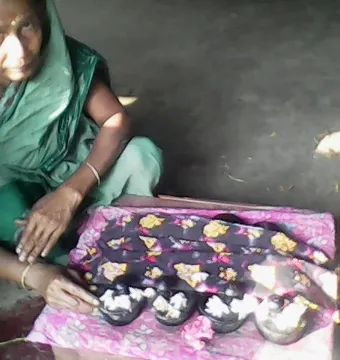
December 2017 © বিমল বাউল · CC BY-SA 4.0

June 2009 © Abhishek Singh · CC BY 2.0
Identification | |
| Title | Paduka |
| Alternative names | khadau, karrow, kharawan, karom |
| Original-language names | Bengali: খড়ম; Malayalam: മെതിയടി |
| Type | Ancient Indian footwear; symbolic footprint object used in religious veneration |
Historical context | |
| Origin | Ancient India |
| Region of use | India; later spread across South Asia and Southeast Asia |
| Age | Among the oldest footwear in India; claimed by some sources to be more than 5,000 years old |
| Historical dating | Symbolism in India dates back to the 4th–5th centuries; one ritual footwear example is dated to the 18th century |
Creator | |
| Creator | Vedanta Desika (Paduka Sahasram); Adi Shankaracharya (Guru Paduka Stotram) |
Physical characteristics | |
| Supports | Some examples have two narrow, curved supports under the sole |
| Special ceremonial example | Some ritual pairs had a bed of sharp iron spikes |
| Decoration | May be elaborately decorated; sometimes fitted with bells, reliefs, pendants, or painted ornament; a unique pair had ivory lotus flowers with a mechanism that opened them from bud to blossom |
| Structure | Usually has no straps; the wearer grips the toe-post to keep it in place |
| Shape | May be shaped like actual feet, footprints, fish, or an hourglass; some examples have carved toes |
| Form | A sole with a post or stub and a knob that fits between the big toe and second toe; often a foot-shaped or footprint-shaped open sandal |
Materials | |
| Materials | Wood, ivory, silver, bronze, brass, gold, teak, ebony, sandalwood; sometimes inlaid with ivory, wire, or precious metals; some examples are silver-plated or covered with silver plates |
| Luxury materials | Fine teak, ebony, and sandalwood with ivory or wire inlay; ivory, silver, or gold for luxury versions |
| Historical examples in collections | Bronze padukas are the oldest preserved examples; silver padukas survive in private and museum collections |
Technique | |
| Construction | Usually carved from a wooden plank roughly shaped like a foot |
| Special construction | Some silver padukas are made of silver, while others are dense wood with silver inlay |
Appearance | |
| Fertility symbolism | Fish-shaped padukas are used in India and symbolize fertility, wealth, and freedom |
| Number of forms | Very wide variety of shapes |
Iconography and meaning | |
| Lakshmi footprints | On Deepavali, symbolic footprints of Lakshmi are drawn or painted to invite her into the house and bring good fortune |
| Associated rituals | Used in rituals honoring elders, teachers, saints, deities, and in processions carrying saints' padukas in silver palanquins |
| Religious function | Used as objects of worship, offerings, and veneration in Hinduism, Buddhism, and Jainism |
| Social symbolism | Simple versions were worn by common people, while elaborate versions indicated high status; fine versions were associated with kings, saints, and high officials |
| Malay royal symbolism | In Malaysia, paduka is a royal symbol and part of honorific titles and forms of address; seri paduka is roughly analogous to 'His Majesty' |
| Literary and mythological associations | Associated with Hindu tradition, the Ramayana, and the Rigveda; also linked to Vishnu, Rama, Bharata, Lakshmana, Sita, Dasharatha, Kaikeyi, Lakshmi, Buddha, and Adi Shankaracharya's guru |
| Buddhist veneration | Buddha's footprints are venerated at Bodh Gaya, under the Bodhi tree, near an empty throne and footrest |
| Fish symbolism | The fish form is linked to Vishnu's avatar Matsya and to the water deity Varuna |
| Ramayana significance | Rama's padukas symbolize Bharata's obedience and his rule of Kosala as Rama's regent during Rama's 14-year exile |
| Rigvedic meaning | The word 'paduka' or 'pada' means 'foot'; in the Rigveda context it can represent the universe, including Prithvi, Vayu, Akasha, and the realm beyond the sky |
| General meaning | A symbolic foot-based object associated with footprints of deities, saints, elders, and gurus |
| Footprint veneration | Can refer to the footprints of deities and saints, which are venerated in houses and purpose-built temples |
Location and ownership | |
| Wearers | Common people, mendicants, saints, Hindu and Jain ascetics; in some modern contexts also Buddhist ascetics |
| Regional popularity | One of the most popular footwear models in South India; also has strong demand from foreign tourists |
| Current use | Still used as everyday footwear, especially by mendicants, ascetics, and some commoners; also used in ceremonies, weddings, and processions |
| Example temples and sites | Vishnupad Mandir in Gaya, Bihar; Bodh Gaya under the Bodhi tree; Sri Ranganathaswamy Temple in Srirangam, Tamil Nadu; Pandharpur temple; Alandi; Dehu |
History and restoration | |
| Use in ceremonies | Simple wooden padukas were worn by common people, while bronze or brass examples were mainly used for ritual and ceremonial use |
| Wedding use | Elaborate padukas could be part of a bride's trousseau or bridal costume and distinguish the bride during the wedding ceremony |
| Processional use | Padukas of saints such as Dnyaneshwar and Tukaram are carried in silver palanquins during the annual Vithoba festival to Pandharpur |
| Worship traditions | Padukas may be offered as religious offerings or venerated as sacred objects, including in houses and temple shrines |
| Ethical rationale | Some curved-support designs are intended to avoid crushing insects or vegetation, reflecting the principle of non-violence |
| Ivory sourcing | Hindu religious ethics required ivory to come from naturally dead or domesticated elephants, without cruelty |
Significance | |
| Cultural role | A cultural and religious symbol of South and Southeast Asia, especially in Hindu devotional practice |
| Literary works | Paduka Sahasram: a 1,008-verse, 32-chapter devotional work by Vedanta Desika praising Vishnu's padukas at Sri Ranganathaswamy Temple; Guru Paduka Stotram: nine devotional verses by Adi Shankaracharya in praise of his guru's padukas |