
Princesses Monument
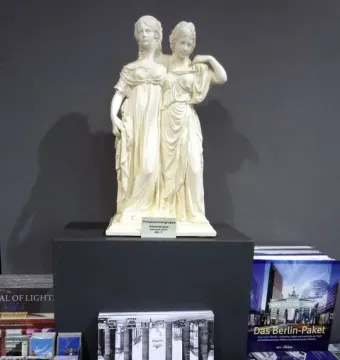
The Princesses Monument, also called the Princesses Group, is a sculpture by Johann Gottfried Schadow. It depicts the Prussian crown princess and later Queen Louise together with her younger sister Friederike. Schadow first made portrait busts of the sisters, then created the life-size group between 1795 and 1797, first in plaster and later in marble. The plaster version is now on display in the Friedrichswerdersche Church, which has been repurposed as the Schinkel Museum, while the original marble group is shown on the entrance axis of the Alte Nationalgalerie. The double statue was celebrated by experts and the public, though it was little valued by Louise’s husband and was largely forgotten for about 90 years. Today it is regarded as a major work of Berlin early classicism.
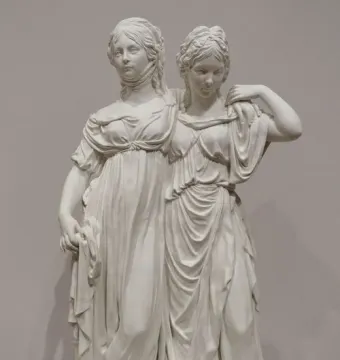
April 2015 © Daderot · Public domain
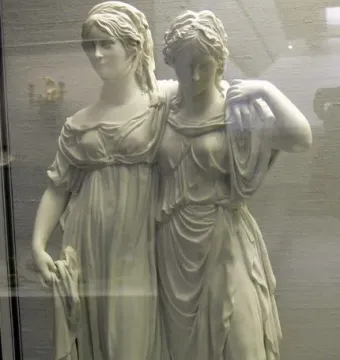
2009 © Johann Gottfried Schadow · Public domain
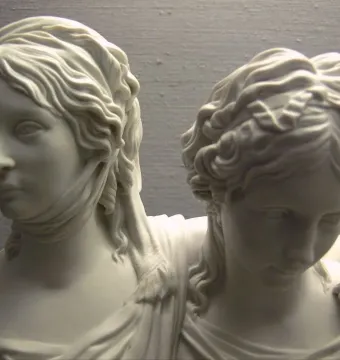
2009 © Johann Gottfried Schadow · Public domain
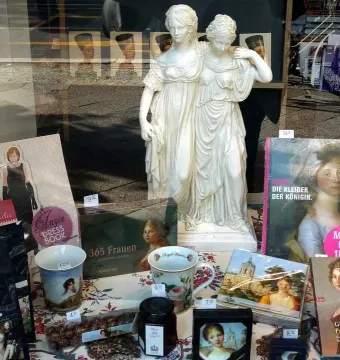
2010 © Manfred Brückels · CC BY-SA 3.0
2010 © Manfred Brückels · CC BY-SA 3.0
Identification | |
| Title | Princesses Monument |
| Type | Life-size double sculptural portrait group |
| Alternative names | Prinzessinnengruppe; Prinzessinnen-Denkmal; The Princesses; Princesses Group; «Принцессы» |
Creator | |
| Artist | Johann Gottfried Schadow |
| Artist nationality | German |
Historical context | |
| Reason for commission | Friedrich Wilhelm II was impressed by the beauty and youthful charm of the two princesses and asked Schadow to portray them |
| Historical setting | Late 18th-century Prussian court culture in Berlin |
| Models' ages | 17 and 15 years old |
| Commissioned by | King Friedrich Wilhelm II of Prussia, on the recommendation of Friedrich Anton von Heynitz |
| Commission context | Commissioned after the double wedding of 24 December 1793 in Berlin, when Crown Prince Friedrich Wilhelm (III.) married Princess Luise and two days later Prince Louis married Princess Friederike |
| Date | 1795–1797 |
Discovery and provenance | |
| Initial works | Portrait busts of the sisters were made first |
| Original design | Intended first as a pair of portrait busts in clay/terracotta, then as a life-size group |
| Creation location | The Crown Princes' Palace / Kronprinzenpalais in Berlin |
| Modeling sessions | Friederike often posed in person from a neighboring building; Luise’s sittings were more formal and often took place during official audiences |
| Original material | Plaster for the first group version; terracotta for the original busts; later versions in marble |
| Planning note | Schadow said he worked 'in quiet enthusiasm' and took the measurements from life |
Physical characteristics | |
| Costume | Contemporary clothing and drapery were based on garments selected from the princesses’ wardrobes |
| Design | The sisters are shown leaning against and embracing each other like sisters; the back side was also carefully designed |
| Composition | Luise stands on the heraldic right and Friederike slightly behind her |
| Form | Full-length life-size group |
| Subjects | Princess Luise of Mecklenburg-Strelitz and her younger sister Princess Friederike of Prussia |
Materials | |
| Marble version | White Carrara marble |
| Pedestal | Grey marble with two octagonal white inscription plaques and two white marble wreaths |
Technique | |
| Style | Early Berlin Neoclassicism, moving toward an idealized 'Greek style' while retaining a natural, lifelike character |
| Artistic aim | A portrait group combining likeness with an idealized representation of perfect human beauty |
| Variant history | The 1798 Luise bust variant changed the head position, gaze, and neckline to function as a pendant to the crown prince’s portrait bust of 1797 |
Location and ownership | |
| Current location of plaster version | Friedrichswerdersche Kirche, now the Schinkel Museum, Berlin |
| Current location of marble version | Alte Nationalgalerie, Berlin |
| Exhibition history | Shown at the Academy exhibition in 1795 and again in 1797; briefly shown at the Berlin Academy of Arts jubilee exhibition in 1886 and at the centennial exhibition of the National Gallery in 1906 |
History and restoration | |
| Reception | Praised by experts and the public, but disliked by Luise’s husband Friedrich Wilhelm III, who objected to its lack of a majestic pose and its lifelike naturalism |
| Survival | The double statue survived the Second World War in the cellar vault of Berlin Cathedral |
| Neglect | Almost forgotten for about 90 years and little involved in 19th-century legend-building around Queen Luise |
| Initial completion | The plaster version was completed in 1795; the marble group was completed on 12 July 1797, with Schadow finishing until early August 1797 |
| Relocation and display history | After Friedrich Wilhelm III rejected it, the sculpture was stored in Schadow’s workshop, later moved to a guest room in the Berlin Palace, then displayed in the Bildergalerie in 1893 and in front of a transverse wall of the Parolesaal in 1921; the museum room later became known as the Schadowsaal |
| Marble execution | The marble version was entrusted to Claude Goussaut, a court sculptor in the royal sculptor workshop, for 1300 Reichstalers, with a 100 Reichstalers bonus from Schadow |
| Contract and payment | A contract was signed on 16 January 1796 for 1500 thalers in January 1796, 1500 in October 1796, and 2000 after completion; Schadow had requested 5000 Reichstalers plus the Carrara marble |
Significance | |
| Art historical importance | Considered a major work and masterpiece of early Berlin Neoclassicism |
| Comparative significance | Regarded as one of Schadow’s major works, along with his Quadriga on the Brandenburg Gate (1793) |
Other | |
| Copies | Widely circulated in copies of varying size and quality, sold and used as art objects, decorative objects, and Berlin souvenirs |
| Associated institutions | Academy of the Arts; Royal Porcelain Manufactory (KPM); Accademia di San Luca |