
Euro-Skulptur
Euro-Skulptur is a two-copy artwork by Ottmar Hörl. The 14-meter-high, 50-ton illuminated sculpture shows a monumental blue euro symbol surrounded by twelve yellow stars, the colors of the European Union. It is a frequently photographed object in central Frankfurt and has also appeared as an illustration in reports about the euro. Created in the late 1990s, one copy was placed at Frankfurt Airport and the other was installed on Willy-Brandt-Platz beside the Eurotower. The sculpture was renovated in 2015, when its lighting was converted to LED. In recent years, its future and maintenance costs have been the subject of public discussion.
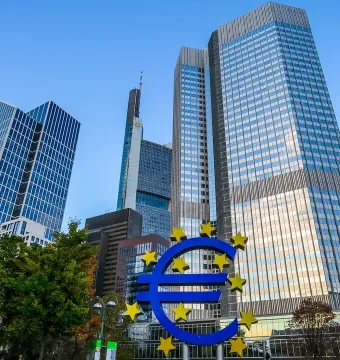
November 2014 © Kiefer. · CC BY-SA 2.0
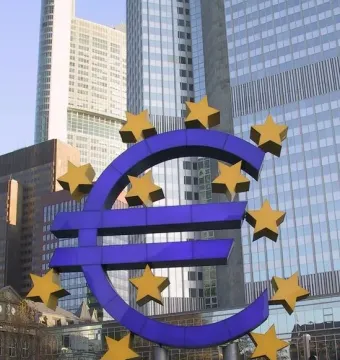
© Khardan · CC BY-SA 3.0
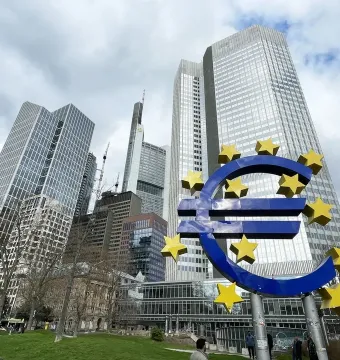
February 2024 © News Oresund · CC BY 2.0
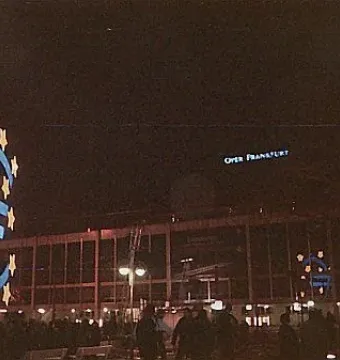
© Benutzer:Melkom · CC BY-SA 3.0
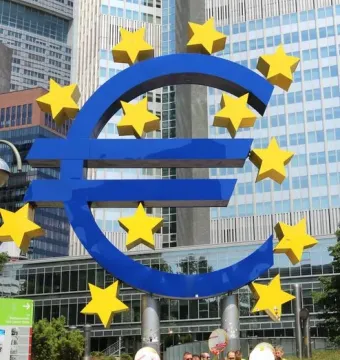
June 2017 © Colling-architektur · CC BY-SA 3.0
Identification | |
| Title | Euro-Skulptur |
| Alternative name | Euroscultura |
| Original-language name meaning | Euro sculpture |
Creator | |
| Artist | Ottmar Hörl |
Historical context | |
| Date designed | Late 1990s |
| Date created | 2001 |
| Number of copies made | Two |
| First display date | New Year's Day 2002 |
| Previous object at site | A Euro clock |
Discovery and provenance | |
| Donated to | Frankfurter Kultur Komitee |
| Copy locations | Frankfurt Airport; Willy-Brandt-Platz, Frankfurt am Main |
Location and ownership | |
| Associated institution at site | European Central Bank (then headquartered in the Eurotower) |
| Public display status | One of two copies of the work on public display |
| Current location | Willy-Brandt-Platz, Frankfurt am Main, Germany, in front of the Eurotower |
Physical characteristics | |
| Type | Electronic sculpture |
| Form | Tall electronic sign |
| Height | 14 meters |
| Weight | 50 tons |
| Internal lighting | Yes |
| Number of copies at public display | Two |
Appearance | |
| Colors | Blue and yellow, the colors of the European Union |
| Depicted symbol | A monumental blue euro sign |
| Decorative elements | Twelve yellow stars around the euro sign |
History and restoration | |
| City funding position | The City of Frankfurt refused to provide funding |
| Vandalism | Since 2020, the sculpture has increasingly been damaged by people climbing on it, kicking it, and breaking the glass |
| 2025 cost sharing | The City of Frankfurt will contribute €30,000 per year; costs will be shared by both parties |
| 2025 maintenance cost | About €50,000 per year |
| 2025 maintenance agreement | In December 2025, the City of Frankfurt and the ECB publicly agreed to maintain the sculpture in the future |
| Lighting first activated | New Year's Day 2002, when the euro was introduced in physical form |
| September 2022 maintenance arrangement | The sculpture was to be preserved in its original location, with Caiz Development covering maintenance costs for the next five years |
| 2022 estimated maintenance cost | About €200,000 per year |
| 2022 maintenance issue | The committee considered auctioning it because maintenance was too expensive |
| Maintenance responsibility | Frankfurter Kultur Komitee |
| Relocation outcome | It remained in its original location |
| Relocation discussions | After the ECB moved to its new headquarters in Frankfurt Ostend in 2014, there were discussions about moving the sculpture as well, either to the new site, to a museum, or to a central location in Paris |
| Restoration and lighting update | July 2015; renovated and the light-emitting elements were replaced with LED |
Significance | |
| Media use | Frequently used to illustrate reports about the euro |
| Photographic popularity | Among the most photographed objects in Frankfurt's city center |
| Reception by Frankfurter Allgemeine Zeitung | Described as never popular with the people of Frankfurt; too plain, too crude, a work of art with too little art |
| FAZ view on preservation | The newspaper argued it would be wrong to give up what exists and that wealthy Frankfurt should be able to extend its life |
| Symbolic meaning | A symbol of the euro system |