
Ribchester Helmet
The Ribchester Helmet is a Roman helmet from the late 1st or early 2nd century, discovered in 1796 by the son of a clog maker in Ribchester, north-west England. It is now displayed at the British Museum in London. Made of bronze, it is a parade helmet with a full facial mask. It was probably topped by a sphinx figurine found at the same time, though this was later lost. Its elaborate design suggests it was not meant for battle, but for hippika gymnasia, cavalry tournaments described by Arrian.
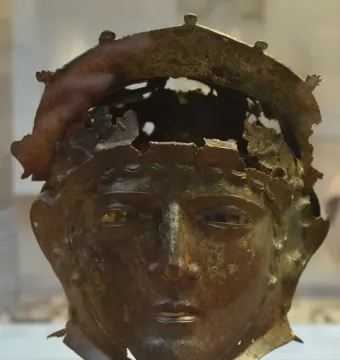
May 2014 © Carole Raddato · CC BY-SA 2.0
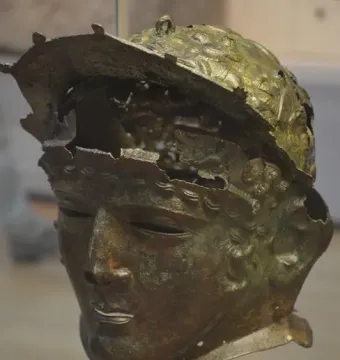
May 2014 © Carole Raddato · CC BY-SA 2.0
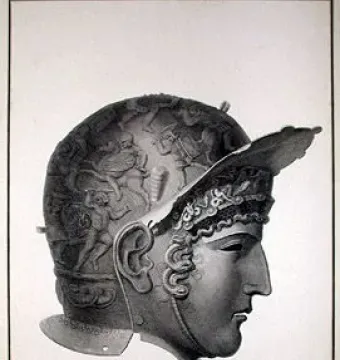
© James Basire · Public domain
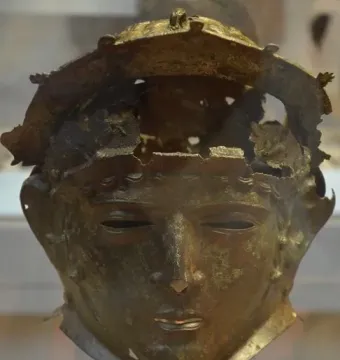
May 2014 © Carole Raddato · CC BY-SA 2.0
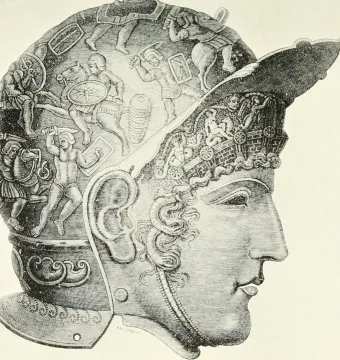
1912 © Internet Archive Book Images · No restrictions
Identification | |
| Title | Ribchester Helmet |
| Type | Roman bronze ceremonial helmet with a mask |
Historical context | |
| Date | Late 1st century to early 2nd century AD |
| Cultural context | Roman |
Creator | |
| Use | Ceremonial; probably used for display in hippika gymnasia (cavalry tournaments), not combat |
Discovery and provenance | |
| Associated object | A bronze sphinx figurine believed to have crowned the helmet |
| Museum acquisition | Sold to the British Museum in 1814 |
| Later owner | Peregrine Edward Towneley, Townley's cousin and heir |
| Townley documentation | Described the find in a detailed letter to the secretary of the Society of Antiquaries intended for publication in the Society's Proceedings; his only publication |
| Townley residence | Towneley Hall |
| Collector/buyer | Charles Townley |
| Associated object fate | Lost after Walton gave it to the children of one of his brothers to play with |
| Associated objects in hoard | Paterae, pieces of a vase, a bust of Minerva, fragments of two bowls, several plates, and other items |
| Largest object in hoard | The helmet was the largest object in the hoard |
| Original storage | Thought to have been stored in a wooden box and preserved because it was covered in sand |
| Discovery condition | Found corroded among the remains of several items, but largely complete |
| Part of | The Ribchester Hoard |
| Findspot | Ribchester, Lancashire, England; found about three metres below the surface on waste ground beside a road leading to Ribchester church, near a river bed |
| Discoverer | The son of Joseph Walton, a clog maker |
| Discovery date | Summer 1796 |
Location and ownership | |
| Current location | British Museum, London |
| Display status | On display at the British Museum |
Physical characteristics | |
| Construction | Two-part; helmet bowl and mask were made separately |
| Completeness | Largely complete |
| Mask attachment | Mask inserted into the helmet bowl and fixed with leather straps |
| Height | 276 mm |
| Features | Neck guard and a large shield over the eyes |
| Weight | 1305.6 grams |
| Helmet bowl | Round-shaped |
Materials | |
| Material | Bronze |
| Mask material | Usually bronze or white metal (Britannia metal) |
Appearance | |
| Preserved features | The supposed sphinx-shaped crest is not preserved |
| Lost feature | Probably originally topped with a sphinx figurine |
| Form | Parade helmet with a complete face mask |
| Design | Elaborate |
| Decoration | Hair arrangement at the upper edge and figural depictions of riders and infantry in combat on the helmet bowl |
Iconography and meaning | |
| Function of associated items | Charles Townley thought some of the other objects in the hoard had religious uses |
| Use evidence | Accounts by Arrian of Nicomedia, governor under Emperor Hadrian, indicate these helmets were used for display in cavalry tournaments or hippika gymnasia and worn by high-ranking or specially skilled soldiers |
Comparative note | |
| Classification | One of the mask helmets |
| Rarity in Britain | One of only three Roman helmets with a face covering found in Britain |
| Relative assessment | Before the discoveries of the Newstead Helmet in 1905 and the Crosby Garrett Helmet in 2010, it was described as the highest-quality helmet found |
| Recognition | Voted Britain's "second best Roman find" in a Channel 4 Time Team web poll, behind the Vindolanda tablets |
Other | |
| Depicted in | An oil painting by Johann Zoffany |
| Comparison support | The discovery of the Crosby Garrett Helmet in 2010, with a winged griffin attached, made the hypothesis that the sphinx belonged on the Ribchester Helmet more plausible |