
Vegreville egg
Vegreville egg is a large sculpture in the Canadian town of Vegreville, Alberta, shaped like a giant Ukrainian pysanka. It was unveiled in 1975 by the town’s chamber of commerce to mark the centennial of the Royal Canadian Mounted Police. The work by Paul Maksym Semeniuk is made from a complex arrangement of two-dimensional anodized aluminum plates forming congruent equilateral triangles and star-shaped hexagons over an aluminum frame. The egg is 31 feet long, 3.5 feet high, and weighs 2.5 tons. It is the second-largest pysanka in the world and a major tourist attraction along Yellowhead Highway, located in Elk Park on the north side of Highway 16A.
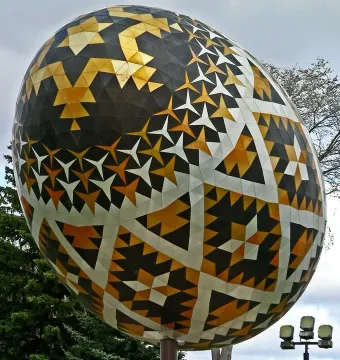
June 2007 © Striatic · CC BY 2.0
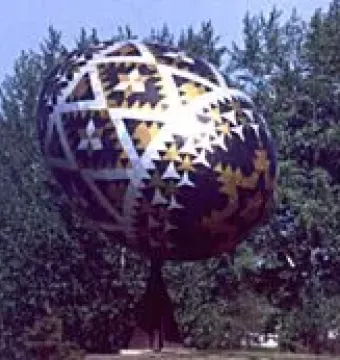
© Dwindrim · CC SA 1.0
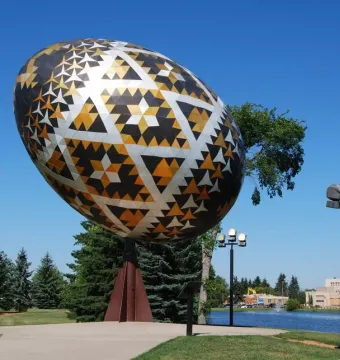
© Myke2020 · Public domain
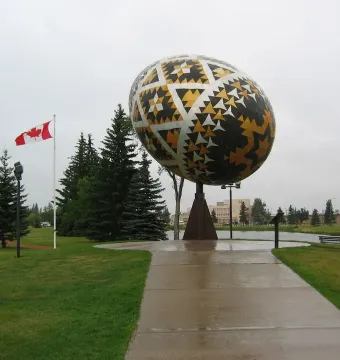
August 2004 © Kevstan · CC BY-SA 4.0
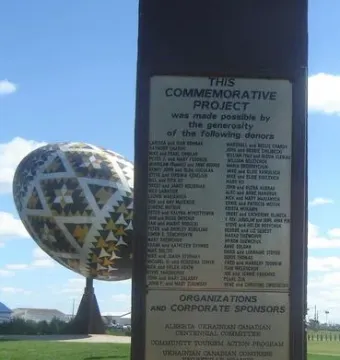
© SriMesh · CC BY-SA 3.0
Identification | |
| Title | Vegreville Egg |
| Also known as | Pysanka |
| Type | Sculpture of a Ukrainian pysanka (decorated Easter egg) |
| Original-language name | Вегревільська писанка |
Historical context | |
| Commissioned by | The town of Vegreville, Alberta, Canada |
| Commission purpose | To celebrate and represent Ukrainian culture in Canada and early Ukrainian settlements east of Edmonton, Alberta |
| Local cultural context | Vegreville had a significant Ukrainian Canadian population |
| Funding | The town applied for a federal government grant and obtained some funding; the amount was not enough to fund construction |
| Funding condition | The sculpture had to be dedicated to the 1975 centennial of the Royal Canadian Mounted Police |
Creator | |
| Technical collaborator role | Computer science professor and computer scientist at the University of Utah |
| Additional contributors | Robert McDermott wrote an algorithm for a periodic B-spline curve used to define and manufacture the egg; students were involved in the project |
| Artistic design by | Pavlo Tsymbalyuk, a local artist of Ukrainian descent |
| Technical collaborator | Ronald Resch |
| Designer background | Canadian artist of Ukrainian descent, born and raised in the Willingdon and Vegreville area |
| Designer | Paul Maxym Sembaliuk (1929–2019) |
Discovery and provenance | |
| Associated people | Paul Maxim Sembaluk |
Materials | |
| Material | Two-dimensional anodized aluminum plates on an aluminum frame |
| Alternative material description | Two-dimensional anodized aluminum tiles; aluminum framework |
| Early materials considered | Concrete and wood, among other materials |
| Chosen material | Anodized aluminum |
| Material donation | Permaloy coatings division in Alberta donated money and anodized aluminum |
Technique | |
| Design method | Computer-aided geometric modeling |
| Technical solution | A computer was used to execute the technical drawings |
| Laser-cutting software | Software was created to guide the lasers that cut the Pysanka's tiles |
| Construction method | The sculpture was assembled from two-dimensional tiles onto a three-dimensional egg shape using an internal framework of radiating spokes |
Physical characteristics | |
| Tile thickness | The tiles range in thickness from unspecified values |
| Movement | Turns with the wind like a weather vane |
| Orientation | Leans at a 30° angle relative to the base |
| Components | 1,108 congruent equilateral triangles and 524 concave hexagons (3-pointed stars); 3,512 visible facets; 6,978 nuts and bolts; 177 internal struts |
| Weight | 2.5 tons (5,512 lb) |
| Dimensions | 31 feet (9 m) long and 3.5 feet high, about three and a half storeys |
| Shape elements | Congruent equilateral triangles and star-shaped hexagons |
Location and ownership | |
| Location | North side of Alberta Highway 16A in Elk Park, Vegreville, Alberta, Canada |
| Country | Canada |
| Province | Alberta |
| Town | Vegreville |
History and restoration | |
| Unveiled | 1975 |
| Unveiled by | Vegreville Chamber of Commerce |
| Commemorated event | The centennial of the Royal Canadian Mounted Police |
Significance | |
| Annual visitors | Thousands of tourists visit it every year |
| Cultural significance | It became a recognizable symbol of Ukrainian culture in Canada; since 2016 the Canadian government has issued special commemorative coins in the shape of a pysanka every year |
| Computer-aided design significance | It was the first physical structure designed entirely with computer-aided geometric modeling software |
| Tourist significance | One of the main tourist attractions along the Yellowhead Highway |
| Largest comparable work | The largest was built into part of the Pysanka Museum in Kolomyia, Ukraine, in 2000 |
| Relative size | Second-largest pysanka in the world |
Other | |
| Town name origin | The town is named after the Catholic monk-missionary Valentin Veґrevil |
| Paul's occupation at the time | Graphic artist working for the Alberta government |
| Previous related project | A few years earlier, Paul had managed the design and production of a $25 million province-wide anodized aluminum signage project |
| Previous project contractor | Permaloy coatings division in Alberta |
| Material donation reason | As a favour to the Ukrainian immigrants of Canada |
| Donor response | Permaloy readily agreed |
| John Ruptash background | Paul's first cousin; grew up in the Vegreville area; dean of engineering at Carleton University in Ottawa; aeronautical engineer |
| Recommended technical expert | Dr. Ron Resch and his team of mathematicians at the University of Utah |
| Algorithm contributor | Robert McDermott |
| Support structure | Held together by an internal framework of radiating spokes that connect the egg's shell |
| Help with realization | The sculpture was realized with the help of computer scientist Ronald Resch |
| Concept and planning features | The concept and planning used 9 innovations in mathematics, engineering, and architecture |
| Methods used in the project | Modern computer graphics methods |