
Pompeii Lakshmi
Pompeii Lakshmi is an Indian ivory statuette discovered in Pompeii in 1938 by Amedeo Maiuri in the Casa della Statuetta Indiana. The figure was found in fragments in the remains of a wooden box with other toiletry items and is now in the Secret Cabinet of the National Museum in Naples. It is about 25 cm high and dates probably to the first half of the 1st century BC. The statuette shows a naked, ornamented woman with two small attendant figures holding cosmetic and jewelry containers. Its identification is debated: Maiuri linked it to Lakshmi, though its iconography is also considered typical of a yakshi. The object is an important witness to Roman-Indian trade connections.
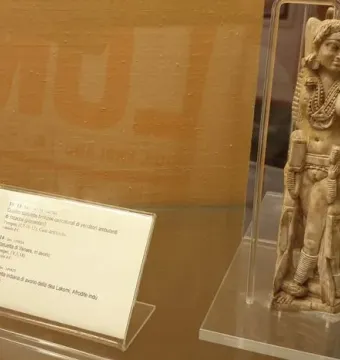
October 2019 © Jamie Heath · CC BY-SA 2.0
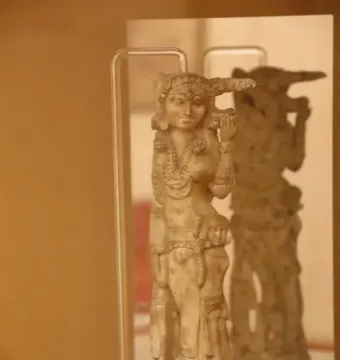
August 2019 © Gary Todd · Public domain
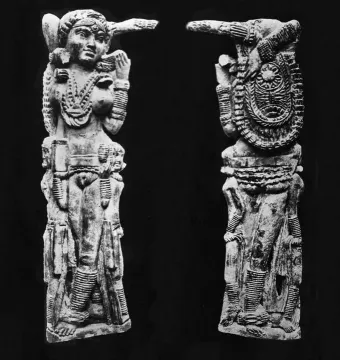
August 2017 © Public.Resource.Org · Public domain
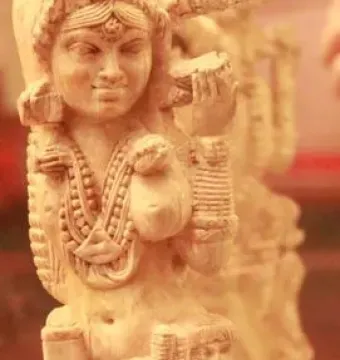
June 2014 © Xinstalker · CC BY 3.0
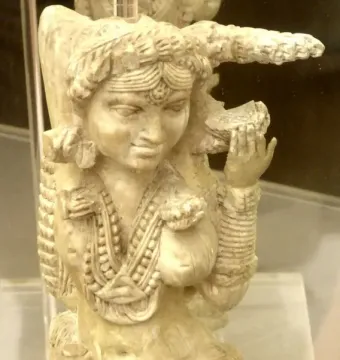
September 2017 © Hyspaosines · CC BY-SA 2.0
Identification | |
| Title | Pompeii Lakshmi |
| Type | ivory statuette |
| Alternative names | Lakshmi of Pompeii; Lakṣmī pompeiana |
Historical context | |
| Associated site | Casa dei Quattro Stili ('House of the Four Styles'), now believed to have belonged to a successful merchant and to have been crammed with luxurious Indian commodities |
| Preservation context | The statuette was in Pompeii by 79 CE, when the city was buried by the eruption of Mount Vesuvius |
| Date | probably first half of the 1st century CE |
Creator | |
| Attribution of manufacture | The National Archaeological Museum of Naples dated it as made in India in the first half of the 1st century CE |
| Place of manufacture | India |
Discovery and provenance | |
| Discovery date | October 1938; some sources say between 1930 and 1935 |
| Discovery place | Pompeii, near the Casa dei Quattro Stili / Casa della Statuetta Indiana on Via dell'Abbondanza |
| Discoverer | Amedeo Maiuri |
| Discovery context | Found during archaeological excavations in the remains of a wooden box, together with other toilet and cosmetic items |
Location and ownership | |
| Inventory number | 149425 |
| Current location | Secret Cabinet (Gabinetto Segreto / Museo Secreto) of the National Archaeological Museum of Naples |
Physical characteristics | |
| Form | Flat statuette |
| Height | 24.5-25 cm |
Materials | |
| Material | Ivory |
Appearance | |
| Depicted figure | A nearly naked woman, ornamented with rich jewelry and an elaborate hairstyle |
| Pose | Standing, with head slightly turned to the side and legs crossed; the right arm reaches behind the head into the braided hairstyle |
| Attendants | Two smaller female attendants, one on each side, holding vessels/containers for cosmetics and jewelry |
| Feature | A hole bored down from the top of the head |
| Attribute in hand | One hand holds either a heavy earring or a lock of hair |
| Exposed feature | Exposed genitals |
Technique | |
| Carving | Carved ivory |
| Possible original function | Probably the handle of a mirror; possibly part of a piece of furniture |
Iconography and meaning | |
| Later identification | More probably a yakshi; possibly a syncretic Venus-Śrī-Lakshmi figure |
| Iconographic basis for deity interpretation | Rich jewelry, especially the belt, indicate a goddess figure |
| Theme | Fertility and feminine beauty; in the Lakshmi interpretation, also wealth |
| Inscription on base | Amedeo Maiuri identified the sign as the Kharoshthi letter ši, which also begins Shiva |
| Initial identification | Initially identified as the goddess Lakshmi |
| Identification problem | The iconography does not match other depictions of Lakshmi, so the deity identification is problematic |
Significance | |
| Related trade details | Possible route west during the rule of the Western Satrap Nahapana via Barigaza |
| Pliny on trade value | Pliny stated that 100 million sesterces were sent each year to India, China, and Arabia |
| Roman eastern trade | Rome imported many goods from India and established trading stations there; maritime routes across the Red Sea and Indian Ocean were especially important |
| Trade goods | Nard, ivory, and textiles |
| Comparable find | A similar statuette was found in Ter (Roman name: Tagara) in Maharashtra |
| Trade routes and sources | Land routes are documented by Isidore of Charax in Parthian Stations; sea routes by the Periplus Maris Erythraei |
| Trade context | Roman-Indian trade is well documented archaeologically and in literary sources; trade took place by land and sea routes, with the peak in the 1st and 2nd centuries AD |
| Possible intermediary traders | Nabataeans attested in nearby Pozzuoli may have served as intermediaries |
| Possible production place | Possibly Vidisha, a center of ivory work |
| Historical significance | Evidence of Indo-Roman trade relations and long-distance exchange between India and Italy in antiquity |
| Interpretive note | The figure is discussed mainly in terms of its uncertain provenance and possible trade routes |