
Angelic Salutation
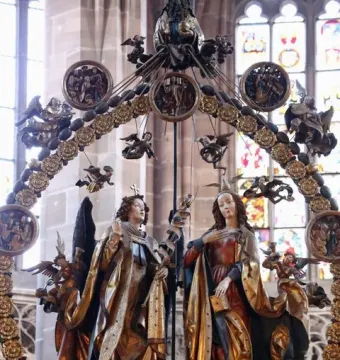
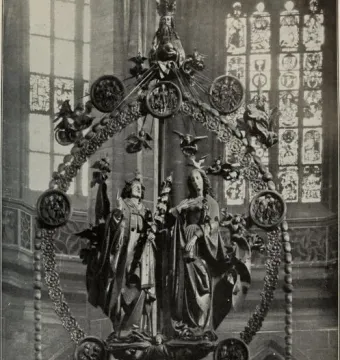
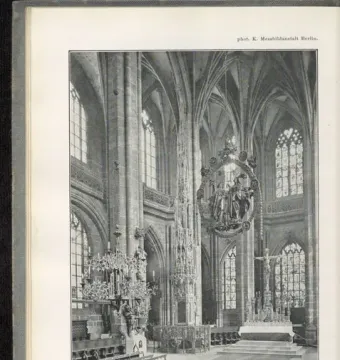
Angelic Salutation is a life-sized assemblage of limewood sculptures by the late-Gothic German artist Veit Stoss, celebrating the Annunciation. It was commissioned in 1517 by Anton II Tucher, completed the following year, and donated to the medieval church of St. Lorenz in Nuremberg. The ensemble was made as a devotional centerpiece for Marian devotions and was reviewed by Albrecht Dürer before final payment. After the Reformation, part of the work was covered and only the crown was dismantled, but it largely survived. It is still freely suspended on a metal chain in the centre of the choir, facing the high altar.
October 2014 © Rufus46 · CC BY-SA 3.0
1909 © Sauerlandt, Max, 1880-1934 · No restrictions
© Georg Vitzthum von Eckstädt · Public domain
March 2019 © Liuthalas · CC BY-SA 4.0
1847 © Friedrich Mayer, J G Wolff · Public domain
Identification | |
| Title | Angelic Salutation |
| Alternative names | Engelsgruß; Englischer Gruß; Pozdrowienie Anielskie |
| Type | assemblage of sculptures |
Historical context | |
| Religious context | A devotional work centered on the rosary and Marian devotion |
| Historical setting | Completed on the eve of the German Reformation, just as Lutheran reformers were introducing iconoclastic ideas |
| Subject | The Annunciation |
Creator | |
| Artist | Veit Stoss |
| Style | Late Gothic |
| Commissioned by | Anton II Tucher, a Nuremberg councilman and high-ranking official |
| Commission year | 1517 |
| Completion year | 1517–1518 |
| Associated craftsman | Jakob Pulmann |
| Review before final payment | Albrecht Dürer reviewed the work on behalf of Anton Tucher before final payment was determined |
Discovery and provenance | |
| Installation date | 17 July 1518 |
| Dedicated to | the Church of St. Lorenz (St. Lawrence) in Nuremberg |
| Payment | 550 guilders for the sculpture and the Marian chandelier |
| Commission context | Commissioned for the Church of St. Lawrence in Nuremberg; Tucher was familiar with Stoss's work and was thought to have wanted to donate a work of art himself |
Location and ownership | |
| Original location | Suspended in the choir/presbytery of St. Lorenz Church, Nuremberg |
| Current location | St. Lorenz Church, Nuremberg, southern Germany |
| Current display method | Freely suspended on a chain and winch |
| Placement | In the centre of the choir, facing the high altar |
| Ownership after the Reformation | In 1525 Nuremberg and Tucher converted to Lutheranism; the work was treated as private property of the Tucher family and mostly escaped destruction |
History and restoration | |
| Restoration | 1825–1826 by Lorenz Rotermundt and Johann Michael Rotermundt; the work was reassembled and received new polychromy |
| Return to church | Returned to St. Lorenz Church in 1952 after war damage in the church had been repaired |
| Museum storage and wartime protection | Displayed at the Germanic National Museum in 1933 and protected in the Kunstbunker under the castle from 4 September 1939 |
| Later restorations | Restored several times in the 20th century; further restored in 1970–1971 |
| Damage event | On 2 April 1817 the rope tore, the sculpture fell to the ground, and it was badly damaged |
| Covering | Covered with a green fabric from 1519; uncovered only on holy days until 1529, and later permanently uncovered at the end of the 19th century |
| Moved to Frauenkirche | 1815; it was dismantled a few weeks later and stored in the town hall because it was too large for the church |
| Later alterations | A large bronze candlestick decorated with a figure of Mary, a crown over the composition, and a veil covering the sculptures on weekdays were associated with the work |
| Reason for covering | A 1756 record attributed the covering to Andreas Osiander's criticism of the image; a later document suggests the cloth was part of the original design |
| Removal from church | Removed in 1806 |
| Display in Nuremberg Castle | Placed in an exhibition room of Nuremberg Castle on 4 July 1811 |
Physical characteristics | |
| Material | Carved from limewood |
| Scale | Life-sized figures |
| Weight | Approximately 1000 kg |
Appearance | |
| Composition | The main figures are suspended within an oval wreath of roses |
| Decorative elements | Each section of the wreath consists of eight roses or rosary beads |
| Frame decoration | The wreath has eight medallions, seven smaller painted reliefs, side bead strands, upper angels, and two top medallions |
| Surrounding figures | Numerous smaller angels, many ringing bells or playing musical instruments |
| Clothing | Courtly clothing; Mary wears an ornate patterned dress and Gabriel holds a scepter |
| Pose | The figures stand on a rock held by an angel and are slightly turned toward one another |
| Figure heights | Gabriel: 2.20 metres; Mary: 2.17 metres |
| Main figures | The Virgin Mary and Archangel Gabriel |
Iconography and meaning | |
| Analogies and influences | Influenced by the medieval tradition of the Holy Rosary and related to Gothic architectural sculpture and sculpted scenes placed by church pillars |
| Purpose | A devotional centerpiece for those reciting the rosary or other Marian devotions |
| Interpretive emphasis | The work celebrates Mary rather than Jesus and was associated with the rosary tradition, which fell out of favor with Lutherans |
| Iconographic type | An unprecedented medieval type, synthesizing traditional Annunciation iconography and Gothic statues of Mary in rays |
| Gabriel's speech | Gabriel speaks the Angelic Salutation |
| Meaning of roses | They represent the rosary of the Annunciation |
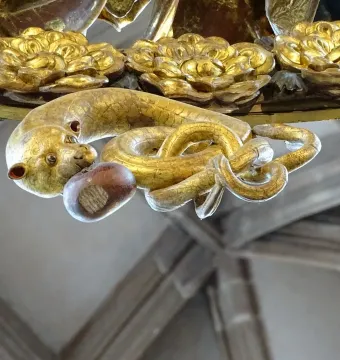
| Lower figure | The serpent of paradise |
| Top figure | God the Father in coronation attire |
| Medallion scenes | Scenes from the lives of Jesus and Mary, including the Nativity, Presentation of Jesus, Resurrection, Ascension, Descent of the Holy Spirit, Dormition of the Blessed Virgin Mary, and Coronation of Mary |
Significance | |
| Critical assessment | Widely regarded as Stoss's masterpiece |
Other | |
| Associated monument | Sebaldus Tomb (Sebaldusgrab) |
| Associated artwork | Marian chandelier by Jakob Pulmann; a miniature statue of Mary was intended to illuminate the work |
| Lost elements | The large gilded crown created by Stoss to hang over the frame is now lost; some parts of the sculpture have not survived |