
Varvakeion Athena
Varvakeion Athena is a Roman-period statue of Athena Parthenos in the collection of the National Archaeological Museum of Athens. It is generally considered the most faithful reproduction of the chryselephantine statue made by Phidias and his assistants for the Parthenon. Carved in Pentelic marble and dated to around 200–250, the figure stands 1.05 meters tall, about one-twelfth the height of the original. Traces of red and yellow paint remain visible. Athena wears a peplos, aegis, and Attic helmet, and rests one hand near a shield bearing the gorgoneion. A small winged Nike stands beside a column at her right. The statue was discovered in 1880 near the original site of the Varvakeion School.
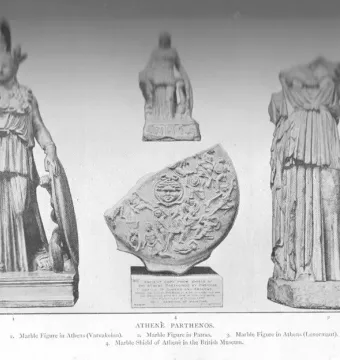
1903 © Unknown authorUnknown author · Public domain
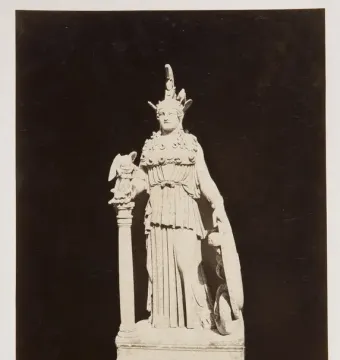
© Unknown authorUnknown author · Public domain
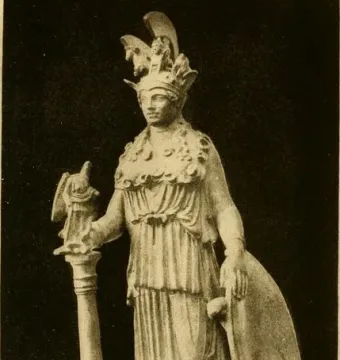
1913 © Internet Archive Book Images · No restrictions
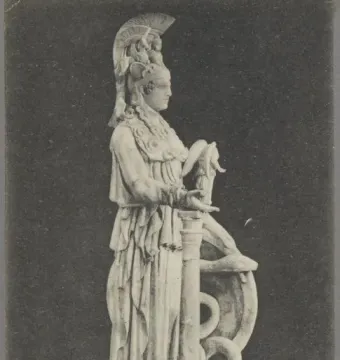
© Rijksmuseum · CC0
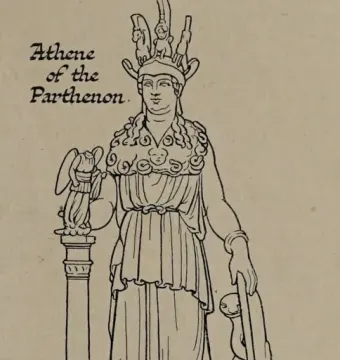
1923 © J. F. Horrabin (Illustrator) · Public domain
Identification | |
| Title | Varvakeion Athena |
| Alternative name | Atenea Varvakeion; Atena Varvakeion; Athena of the Varvakeion |
| Type | Roman-period statue, a copy of Phidias's Athena Parthenos |
| Depicted figure | Athena Parthenos |
Historical context | |
| Date | c. 200–250 CE |
Creator | |
| Original sculptor | Phidias and his assistants |
Discovery and provenance | |
| Discovery date | 1880 |
| Discovery location | Near the site of the Varvakeion School headquarters, in the ruins of a Roman house |
| Name origin | Named after the place where it was discovered, the Varvakeion |
| Eponym | Ioannis Varvakis |
| Original location | The Parthenon, in the naos |
| Museum collection | National Archaeological Museum of Athens |
| Current location | National Archaeological Museum of Athens |
Significance | |
| Artistic significance | Generally considered the most faithful reproduction of the chryselephantine Athena Parthenos |
Physical characteristics | |
| Base | Rectangular, plain base |
| Height | 1.05 m |
| Relative scale | About one-twelfth of the estimated height of the original |
Materials | |
| Material | Pentelic marble |
| Original statue material | Chryselephantine |
| Surface color | Visible traces of red and yellow paint |
Appearance | |
| Shield decoration | Gorgoneion on the shield |
| Nike figure | Winged, headless, smaller than Athena, dressed in a peplos, and turned slightly toward her |
| Right hand | Extended and supported by a column; holding a winged figure of Nike |
| Shield support | The shield rests on the oikouros ophis, identified with Erichthonius |
| Helmet | Attic helmet with raised cheek pieces |
| Left hand | Resting on the edge of a shield |
| Helmet crest | Three crests: a sphinx on the central crest and pegasi on the lateral crests |
| Aegis | Worn over the peplos; decorated with serpents and a Gorgoneion in the center |
| Waist ornament | Belt in the form of two serpents |
| Garment | Peplos |
History and restoration | |
| Differences from the original | The copy lacks the original base frieze showing the birth of Pandora, the spear described by Pausanias, and the Amazonomachy on the front of the shield described by Pliny the Elder |
| Support column debate | The presence of the column is debated as evidence for whether the original required a similar support; many reconstructions omit it, including the Nashville Parthenon reconstruction |