
Raherka and Meresankh
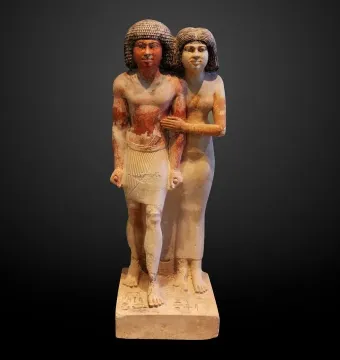
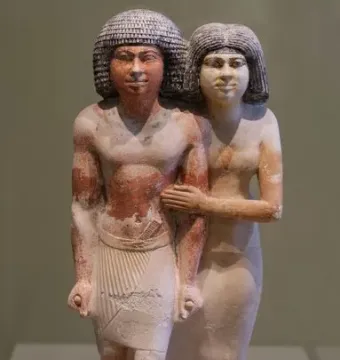
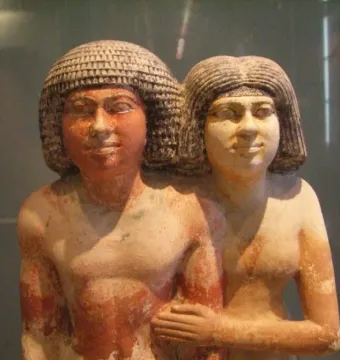
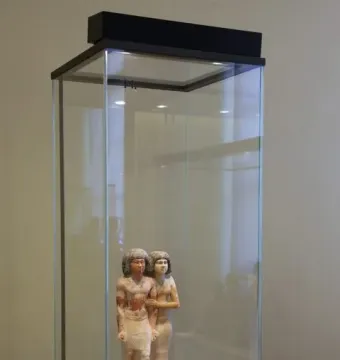
Raherka and Meresankh is a group statue of an ancient Egyptian couple from the 4th or 5th Dynasty. The pair is known from a limestone statue now in the Louvre (E 15592), noted as an example of portraiture in Ancient Egypt. Raherka is shown with modeled musculature and traditional red male skin tones, while Meresankh is painted with the yellow-toned skin color standard for the time. Their wigs and eyeliners are black, and the wife warmly embraces her husband, a pose compared to the statue of Seneb and his family. The work was found in 1902 by Montague Ballard and probably comes from tomb D 37 in the Steindorff cemetery at Giza.
© Rama · CC BY-SA 3.0 fr
April 2024 © Shonagon · CC0
© Neithsabes · Public domain
© Rama · CC BY-SA 3.0 fr
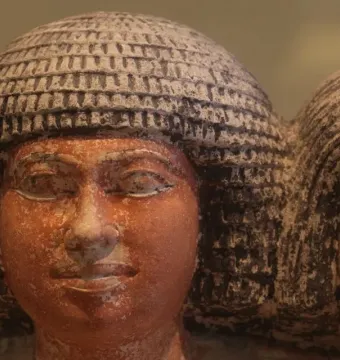
© Rama · CC BY-SA 3.0 fr
Identification | |
| Title | Raherka and Meresankh |
| Original-language name | Raherka y Meresankh |
| Type | double statue of a married couple |
| Subjects | Raherka and his wife Meresankh |
Historical context | |
| Cultural origin | Ancient Egyptian |
| Date | 4th or 5th Dynasty of ancient Egypt |
Creator | |
| Meresankh's status | Court lady; noblewoman with access to the royal palace |
| Meresankh's title | Known to the king |
| Raherka's role | Held high administrative responsibilities |
| Raherka's title | Inspector of scribes of the jackal |
| Names meaning | Raherka: "Ra = the Sun god"; Meresankh: "she loves life" |
Discovery and provenance | |
| Discovery date | 1902 |
| Discoverer | Montague Ballard |
| Probable provenance | Probably from tomb D 37 in the western cemetery of the Khufu funerary complex at Giza (Steindorff cemetery) |
| Associated finds | Fragments of another statue depicting a woman carrying a child were found just north of the tomb |
| Associated fragments current location | Museum of Leipzig |
| Associated fragments inventory number | Inv. 2446 |
Physical characteristics | |
| Condition | Preserves its polychromy |
| Height | 52.8 cm |
Materials | |
| Material | Limestone |
Technique | |
| Surface treatment | Painted in multiple colors |
Appearance | |
| Stylistic convention | Uses ancient artistic conventions to indicate gender and social function through skin color |
| Shared pose with comparison work | In both statues, the wife warmly embraces her husband |
| Comparison | Compared with the statue of the dwarf Seneb and his family |
| Interpretation of male skin tone | Suggests men worked outdoors and were depicted as tanned |
| Interpretation of female skin tone | Suggests women were associated with indoor domestic duties and therefore depicted with lighter skin |
| Hair and eye treatment | Wigs and outlined eyes painted black |
| Female figure skin color | Yellowish skin tone standard for female figures |
| Female figure depiction | Meresankh is shown warmly embracing her husband |
| Male figure skin color | Traditional reddish skin tone used for men |
| Male figure depiction | Raherka is shown with carefully modeled musculature |
Location and ownership | |
| Current location | Louvre |
| Inventory number | E 15592 |
Significance | |
| Art historical significance | Notable example of Old Kingdom portraiture in ancient Egypt |
History and restoration | |
| Dating by Hermann Junker | End of the Old Kingdom |
| Suggested date | Possibly the Fifth Dynasty |
| Alternative date hypothesis | Possibly the Fourth Dynasty, based on the wife's pose and the names |