
Dupont Circle Fountain
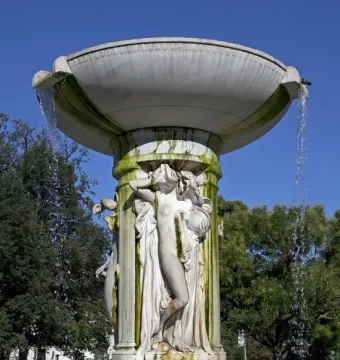
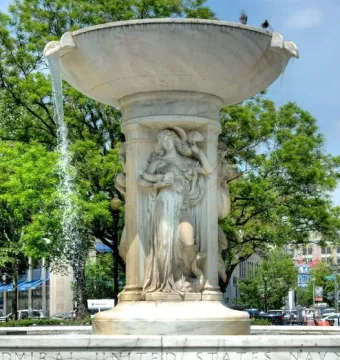
Dupont Circle Fountain, officially the Memorial Fountain to Rear Admiral Samuel Francis Dupont, stands at the center of Dupont Circle in Washington, D.C. It honors Rear Admiral Samuel Francis Du Pont, a notable U.S. naval officer and member of the Du Pont family. The fountain replaced a statue of Du Pont installed in 1884 and was designed by Henry Bacon and sculpted by Daniel Chester French. Unveiled in 1921, it was attended by First Lady Florence Harding, Secretary of War John W. Weeks, and Secretary of the Navy Edwin Denby. The marble fountain features three allegorical sculptures, rests on a concrete base, and is surrounded by an open plaza.
© Carol M. Highsmith · Public domain
May 2015 © Bestbudbrian · CC BY-SA 4.0
May 2009 © Kas Hayes · CC BY-SA 4.0
April 2026 © ajay_suresh · CC BY 4.0
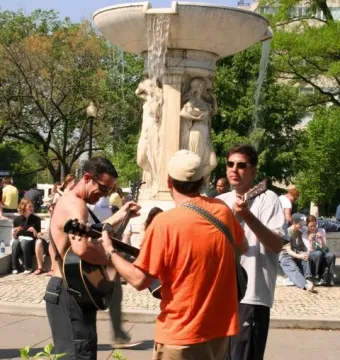
April 2006 © Elvert Barnes · CC BY 2.0
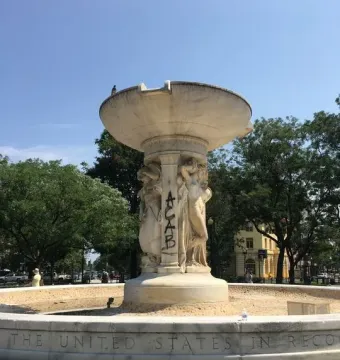
© NPS staff · Public domain
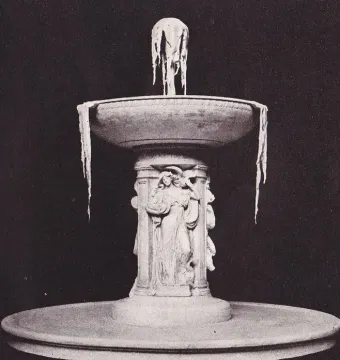
1918 © Unknown authorUnknown author · Public domain
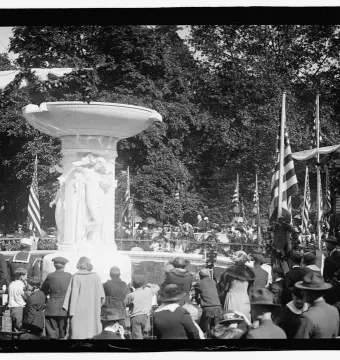
May 1921 © National Photo Company Collection · Public domain
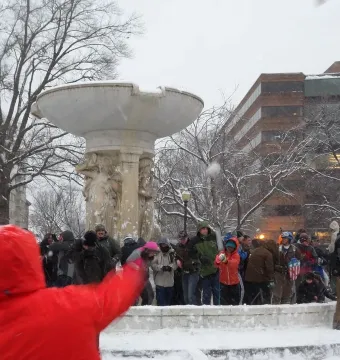
© Sksolaris00 · CC BY-SA 4.0
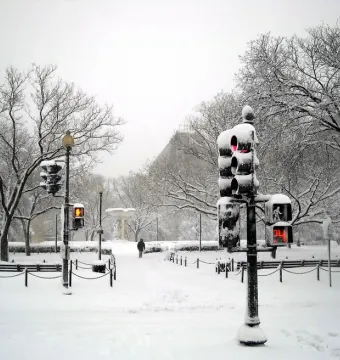
February 2010 © AgnosticPreachersKid · CC BY-SA 3.0
Identification | |
| Title | Dupont Circle Fountain |
| Formal name | Memorial Fountain to Rear Admiral Samuel Francis Dupont; Rear Admiral Samuel Francis Dupont Memorial Fountain; La fontaine du rond-point Dupont |
| Inscription | "This memorial fountain replaces a statue erected by the Congress of the United States in recognition of his distinguished services. Samuel Francis Dupont United States Navy 1803-1865" |
| Type | Fountain; memorial sculpture; monument; two-tier white marble fountain |
Historical context | |
| Honoree / subject | Rear Admiral Samuel Francis Du Pont; Samuel Francis Du Pont (1803–1865) |
| Dedicated to | Memorial to honor Du Pont's services during the Mexican–American War and the Civil War |
| Original circle name | Pacific Circle |
| Circle renamed | February 25, 1882 |
| Historic designations | One of the eighteen Civil War monuments collectively listed in the National Register of Historic Places in 1978; listed on the District of Columbia Inventory of Historic Sites on March 3, 1979; contributing property to the Massachusetts Avenue Historic District (NRHP, October 22, 1974) and the Dupont Circle Historic District (NRHP, July 21, 1978) |
| Honoree description | An outstanding U.S. naval officer and a member of the Du Pont family; a prominent American naval officer and member of the Du Pont family |
Creator | |
| Contractor | George A. Fuller Company |
| Original statue sculptor | Launt Thompson; an unnamed Irish-American sculptor is said to have made the original statue |
| Carved by | The Piccirilli Brothers |
| Sculptor | Daniel Chester French |
| Designer / architect | Henry Bacon |
Discovery and provenance | |
| Replacement installation | A fountain was installed in the same place in 1920 using pipes placed in 1877 for a potential fountain that had never been built |
| Dedication ceremony description | Simple, yet impressive; a temporary stand decorated with flags and shields was built; chairs were placed along the walkways; sailors served as ushers; the Navy Band performed and ended with "Columbia, the Gem of the Ocean"; members of the public were allowed to enter after the concert and filled the surrounding park |
| Family donors | The Du Pont family |
| Government recipient of gift | The Secretary of War, on behalf of the government |
| Dedication participants | Lieutenant Colonel Clarence O. Sherrill; Episcopal Bishop Alfred Harding; Rear Admiral Purnell Frederick Harrington; Sophie Du Pont Ford; Ann Andrews; Emily Du Pont; Mary Harvey |
| Dedication / inauguration guests | Florence Harding, First Lady of the United States; John W. Weeks, Secretary of War / Secretary of War John W. Weeks; Edwin Denby, Secretary of the Navy |
| Dedication / unveiling date | May 17, 1921 |
| Installation date | 1920 |
| Dedication of original statue | A monument representing the officer was erected at the location in 1884 as a tribute to him |
| Initial design feature not used | An early model included a fountain that would have emitted water from the top, but it was not incorporated into the final design |
| Original statue cost | $20,500 |
| Source of water pipes | Pipes installed in 1877 for a fountain project that was never built |
| Original monument on the site | A statue/bronze statue of Du Pont installed in 1884 |
| Original statue dedication date | December 20, 1884 |
| Dedication speech sentiment | Edwin Denby praised Du Pont's service, heredity, career, attitude toward fellow sailors, and willingness to put the country's needs above his own |
| Original statue relocation | Moved to Rockford Park in Wilmington, Delaware in 1920 |
| Replacement campaign | Led by the Du Pont family and Senator Willard Saulsbury, Jr.'s wife, a niece of Du Pont |
| Replacement reason | The family wanted a memorial of greater artistic value and disliked the original statue; by 1909 the base had begun to sink and tilt |
| Replacement authorization | Replacement authorized by Congress on February 26, 1917; construction had to begin within three years; no government funds were to be used for the new memorial; the Commission of Fine Arts had to approve the design |
| Original memorial inscription requirement | Congress wanted the fountain inscription to include that a statue erected by Congress was replaced |
Physical characteristics | |
| Dimensions / weight | Upper basin: approximately unspecified height and width, weighs 15 tons; shaft: 8 tons; allegorical figures: approximately unspecified height and width, total weight 12 tons; lower basin: approximately unspecified height |
Materials | |
| Materials | White marble; concrete; bronze for the original statue |
Technique | |
| Restoration | Restored in the late 1990s by sculptor Constantine Seferlis |
Appearance | |
| Stars figure | Nude female figure with long hair, holding a globe in her left hand and looking downward |
| Captioned figures | Sea; Stars; Wind; Mar (Sea) |
| Decorative elements | Adorned with three allegorical sculptures |
| Wind figure | Nude male figure draped with a ship's sail, holding a conch shell in his left hand to use as a horn and looking to the right |
| Sea figure | Female figure with long hair, holding a boat in her right hand, caressing a seagull on her shoulder with her left hand, and resting her left foot on a dolphin |
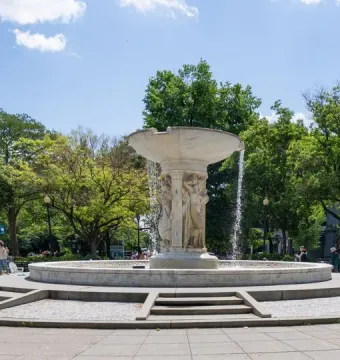
| Water feature | Water pours over the upper basin into a large lower basin |
| Upper basin | Supported on a shaft adorned with three allegorical figures |
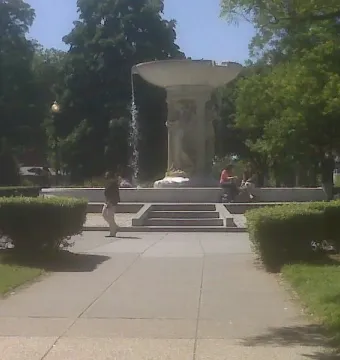
| Base | Circular concrete base with four sets of three steps leading to the surrounding plaza |
| Structure | Double-tiered white marble fountain on a concrete base |
| Allegorical figures | Three figures representing the arts of ocean navigation; the Sea, the Stars, and the Wind |
Iconography and meaning | |
| Stars figure symbolism | Symbolizes the stars |
| Figurative subject | Three figures representing the arts of navigation |
| Wind figure symbolism | Symbolizes the wind and presides over the fate of sailors and admirals |
| Sea figure symbolism | Symbolizes the sea |
Location and ownership | |
| Location | Center of Dupont Circle, Washington, D.C., United States; in the northwest quadrant of Washington, D.C., at the convergence of 19th Street, P Street, Connecticut Avenue, Massachusetts Avenue, and New Hampshire Avenue NW |
| Site description | Dupont Circle is a park, traffic circle, and neighborhood |
| Access paths | Six radial paths corresponding to the surrounding streets lead from the plaza to the edges of the park |
| Ownership and maintenance | Owned and maintained by the National Park Service, a federal agency of the Department of the Interior |
| Setting | Surrounded by an open plaza; mature trees and dense vegetation were planted around the park; the circle was landscaped with exotic plants and hundreds of trees |
History and restoration | |
| Vandalism history | Frequently targeted by vandals who repeatedly broke the fingers or hands of the sculptures; replacement hands were later carved and attached |
| Temporary removal | Removed temporarily in 1948 during construction of a trolley/streetcar underpass beneath Dupont Circle |
| Return to site | Returned to its original location in 1950 |
| Pump system replacement | The pumping system was replaced when the fountain returned in 1950 |
| Operational issue | Workers forgot to connect the pipes after the new pumping system was installed; it was corrected the following year and the fountain began operating |
Significance | |
| Notable classification | One of the few Civil War monuments in Washington, D.C. that is not an equestrian sculpture |
| Other non-equestrian Civil War monuments mentioned | Stephenson Grand Army of the Republic Memorial; the Battle of the Monuments; Nuns of the Battlefield; the Peace Monument; statues of Admiral David G. Farragut, Albert Pike, and General John A. Rawlins |