
The Partisans
The Partisans is an outdoor sculpture created by Andrzej Pityński and unveiled in Boston, Massachusetts, in 1983. Dedicated to Polish anti-communist partisans, it was originally meant to stand for six months at Beacon and Charles on Boston Common, but remained there for 23 years. The monument was inspired by the artist’s memories of meeting anti-communist partisans in December 1959. It was financed by the Sculpture Foundation and cast in aluminum at Johnson Atelier in Princeton. In 2006, it was moved to a new location near World Trade Center Station on the MBTA Silver Line. Pityński later created another sculpture called Partisans in Hamilton.
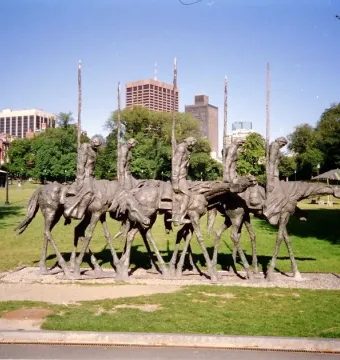
September 1998 © Rob Glover · CC BY-SA 2.0
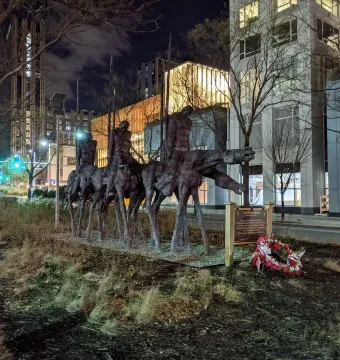
November 2020 © Kraktraffic · CC BY-SA 4.0
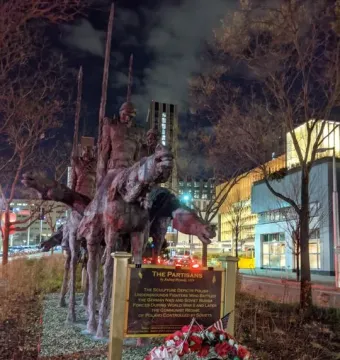
November 2020 © Kraktraffic · CC BY-SA 4.0
Identification | |
| Title | The Partisans |
| Alternative title | Partyzanci – I |
| Type | Outdoor sculpture |
| Original Polish name | Partyzanci |
Historical context | |
| Date created | 1979–1983 |
| Year unveiled | 1983 |
| Style | Modern |
Creator | |
| Dedication | Specifically to his relative Michał Krupa, commanders Franciszek Przysiężniak and Józef Zadzierski, their subordinates in the National Military Organization and the National Military Union, and all other anti-communist partisans; in a wider sense, to all freedom fighters around the world |
| Artist's description of the work | Five armed riders in marching formation, tattered, mortally tired, bleeding from endless battles and escapes, riding horses and immersed in thoughts about the tragedy of their nation |
| Inspiration | Memories of a December 1959 meeting with anti-communist partisans, when he visited them as a 12-year-old boy with his father Aleksander and brought them supplies |
| Artist description | Sculptor who lived and worked in the United States |
| Artist nationality | Polish-American |
| Artist | Andrzej Pityński |
Discovery and provenance | |
| Relocation decision date | 18 January 2006 |
| Permanent location | Center median of D Street at its intersection with Congress Street, Boston, Massachusetts |
| Permanent relocation date | 17 November 2018 |
| Moved to temporary new location | July 2006 |
| Stored after removal | In a warehouse |
| Removed from Boston Common | January 2006 |
| Relocation ordered by | Boston Mayor Thomas M. Menino |
| Temporary new location in 2006 | South Boston waterfront near the Boston Institute of Contemporary Art and the MBTA's World Trade Center Station on the Silver Line |
| Time at original location | 23 years |
| Original display location | Boston Common, at the corner of Beacon Street and Charles Street, Boston, Massachusetts |
| Original planned display duration | Six months |
| Material used for casting | Aluminum |
| Foundry / casting site | Johnson Atelier (Technical Institute of Sculpture) in Princeton |
| Designed for | Johnson Atelier – The Technical Institute of Sculpture |
| Funding source | Sculpture Foundation |
| Displayed in Boston since | 1983 |
Physical characteristics | |
| Number of horses | 5 |
| Pose and appearance | The horsemen ride with bowed heads, carrying spears on their backs, and are shown as tired and exhausted |
| Dimensions | 7 m high, 10 m long, 4 m wide |
| Number of figures | 5 |
| Figures depicted | Five mounted armed horsemen |
| Sculpture type | Sculptural group |
Materials | |
| Material | Aluminum |
Iconography and meaning | |
| Intended themes | Crucifixion and sacrifice |
| Clarification | Not World War II-era anti-Nazi Polish partisans |
| Dedication theme | A monument to all fighters for freedom in the whole world |
| Depicted subject | Polish anti-communist partisans, the "Cursed Soldiers" |
| Symbolic meaning | A symbolic representation of the Cursed Soldiers |
| Specific identification of depicted figures | Aleksander Pityński ("Kula") - the artist's father; Adam Kusz ("Garbaty") - second commander of the unit; Stanisław Pelczar ("Majka"); Michał Krupa ("Pułkownik") - the artist's uncle; Józef Zadzierski ("Wołyniak") - first commander |
| Historical reference | Anti-communist Polish partisans who fought against the Polish communist regime after the communist takeover of Poland after World War II |
Location and ownership | |
| Exhibited in | Boston, Massachusetts, United States |
| Later status in Boston | Became a permanent monument |
History and restoration | |
| Reception | Met with controversy |
| Threats received by sculptor | Pityński received threats from sympathizers of the communist People's Republic of Poland |
| Reason for removal from Boston Common | City officials said the statue lacked a proper pedestal |
| Public reaction to removal | Triggered protests from the Polish-American community and the sculptor himself |
| Rededication | The statue was rededicated in the presence of the area's Polish American community and local officials, endorsed by Pityński and the Polish Consulate in Boston |
Significance | |
| Claimed historical significance | Described as the world's first monument to the Cursed Soldiers |