
Madonna and Child
Madonna and Child is a painted terracotta relief attributed to Donatello. The work depicts the Madonna and Child and is now in the Louvre. Its attribution has been questioned by Ludwig Goldscheider, who wrote that there are no Madonna reliefs that can be accepted with perfect confidence as having been chiselled by Donatello. The source also notes that chisels would not have been used to make a terracotta relief.
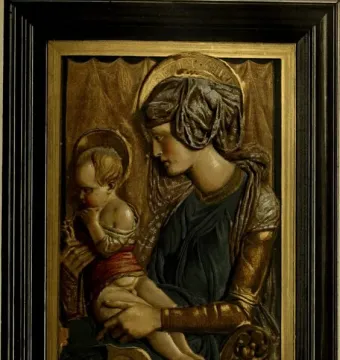
1889 © Müntz, Eugène, 1845-1902 · No restrictions
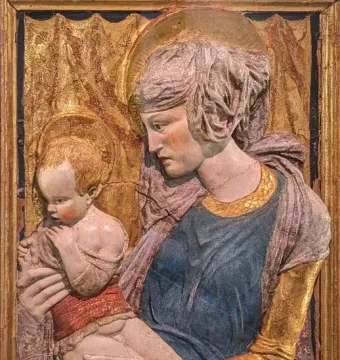
June 2023 © Shonagon · CC0
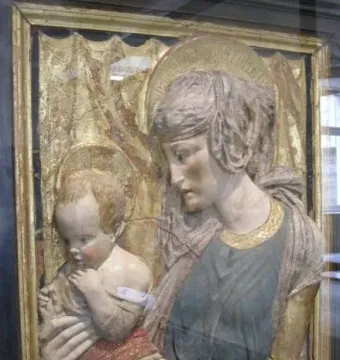
January 2009 © sailko · CC BY 2.5
Identification | |
| Title | Madonna and Child |
| Work type | sculpture |
| Subject | Madonna and Child |
Creator | |
| Artist | Donatello |
| Attribution | Attributed to Donatello; alternately attributed to Donatello or his circle |
| Attribution note | Ludwig Goldscheider stated that there are no Madonna reliefs that can be accepted with perfect confidence as having been chiseled by Donatello |
| Attribution note | The high artistic quality has led to the view that there may have been direct intervention by the master |
Historical context | |
| Date | circa 1440 |
| Dating note | The date has also been disputed; around 1440 is considered probable |
| Stylistic period | Donatello's cultured and graceful period |
| Stylistic comparison | Placed in the same period as the celebrated David |
Materials | |
| Material | polychrome terracotta |
| Material note | The commentary notes that chisels would not have been used to make a terracotta relief |
Physical characteristics | |
| Artistic quality | Very high |
| Dimensions | 102 × 74 cm |
| Condition | Very good state of preservation |
| Type | painted terracotta relief |
Appearance | |
| Composition | The Madonna is seated on a gilded seat and holds the Child on her knees; the figures are shifted toward the left |
| Child's clothing | The Child wears only a small tunic that leaves him uncovered below the navel |
| Gaze direction | Both figures look to the left, for reasons that are not yet clear |
| Interaction between figures | There is no visual contact between Mother and Child |
| Emotional tone | The scene conveys a notable sense of intimacy through the sweetness of the embrace |
| Drapery treatment | The fabrics are notably rendered, often interwoven with gold and decorated in fine relief |
| Background | Gold background with an archaic flavor, justified by a curtain |
| Flesh tones | The pale flesh tones stand out delicately against the background |
Location and ownership | |
| Current location | Louvre Museum, Paris, France |
| Holding institution | Louvre Museum |
| Department | Department of Sculptures |
Discovery and provenance | |
| Museum acquisition | Acquired by the Louvre in 1880 |