
Venus of Laussel
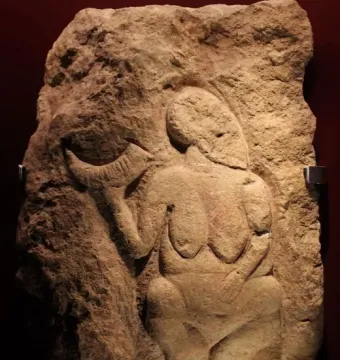
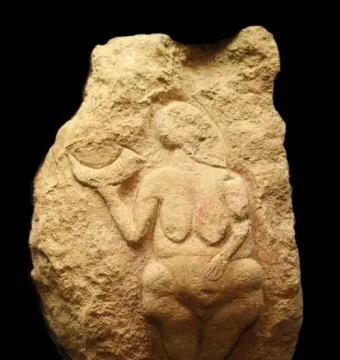
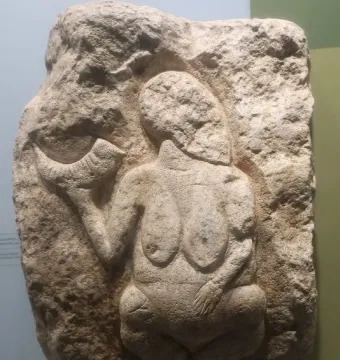
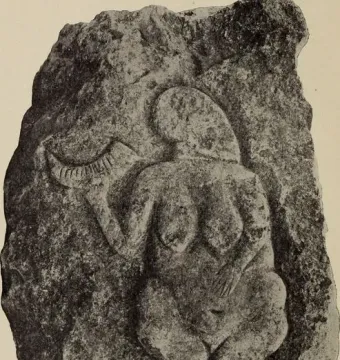
Venus of Laussel is an approximately 25,000-year-old depiction of a woman, about 42 cm high, carved and incised in limestone. The half-relief comes from the Gravettian archaeological culture. It was discovered in 1911 by Dr. J.-G. Lalanne in a side valley of the Vézère, as part of the Abri de Laussel near the commune of Marquay in Dordogne, together with other reliefs and small finds. Although it is thematically and chronologically associated with Venus figurines, it is not a small portable Upper Paleolithic work of art, but a half-relief carved into the limestone rock face. It is now kept in the Musée d’Aquitaine in Bordeaux, France.
January 2023 © Zunkir · CC BY-SA 4.0
September 2008 © 120 · CC BY 3.0
© Hiart · CC0
1913 © Internet Archive Book Images · No restrictions
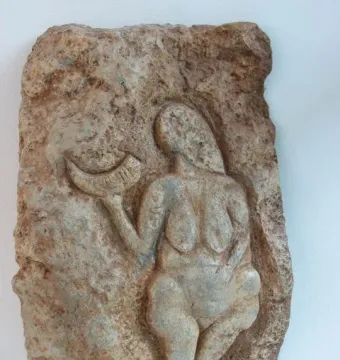
May 2009 © HTO · Public domain
Identification | |
| Title | Venus of Laussel |
| Alternative name | Venus with the Horn |
| Alternative name | Venus with Horn |
| Alternative name | Lady with the Horn |
| Alternative name | Wenus z Laussel |
| Alternative name | la vénus à la corne |
| Alternative name | woman with horn |
| Type | Paleolithic Venus |
Historical context | |
| Cultural context date range | 30,000–20,000 BCE |
| Art period | Paleolithic art |
| Cultural period | Gravettian |
| Chronology | Upper Paleolithic |
| Date | about 25,000 years ago |
Creator | |
| Discoverer | Jean-Gaston Lalanne (Doctor J.-G. Lalanne / Doctor Lalanne / G. Lalanne) |
Discovery and provenance | |
| Discovery date | 1911 |
| Discovery location | Abri de Laussel (Grand Abri), Laussel archaeological site, commune of Marquay, Dordogne, France |
| Discovery context | Found during excavations on a large limestone block a few meters in front of the cliff, in a stratigraphic level yielding Gravettian industry; the decorated block was sawn off and removed |
| Associated finds | Found together with other carved reliefs and small finds from the same shelter |
| Other artifacts from the same shelter | "the hunter", "Venus with the checkered head", "Venus with the playing-card shape", "Venus of Berlin", and "Priapus of Laussel" |
Location and ownership | |
| Current location | Musée d'Aquitaine, Bordeaux, France |
| Temporary exhibition at | American Museum of Natural History, New York (1986); National Gallery of Canada, Quebec (date unspecified) |
History and restoration | |
| Posthumous location | Kept in Jean-Gaston Lalanne's private museum in Le Bouscat after his death in 1924; donated with the Lalanne family's collections to the Bordeaux archaeological museum in 1960 |
| Heritage protection | Classified as historical monuments by decree of President Gaston Doumergue |
| Excavation history | Lalanne leased the Laussel site and Cap Blanc to carry out excavations, starting in 1908 |
Physical characteristics | |
| Hair | long hair hanging over the left shoulder |
| Horn decoration | 13 notches |
| Held object | horn, generally interpreted as a bison horn; alternatively a mountain goat horn or cornucopia |
| Marking | Y-shaped sign on the thigh / right hip |
| Abdomen | pregnant abdomen with visible navel |
| Breasts | large breasts |
| Hips | wide |
| Head | faceless, turned toward the horn |
| Pose | seated, with knees widely apart; right arm bent holding a horn; left hand resting on the abdomen |
| Depicted figure | nude female figure |
| Material | limestone block |
| Thickness | 36 cm |
| Height | about 42 cm |
| Type | bas-relief |
Materials | |
| Surface treatment | painted with red ochre; traces remain on the stone surface |
| Support | limestone rock shelter block |
Technique | |
| Technique | carved, scratched, and engraved in low relief |
Iconography and meaning | |
| Interpretation of held object | The horn is often interpreted as a bison horn; some researchers suggest a mountain goat horn or cornucopia |
| Interpretation of notches | Variously interpreted as the number of female cycles in a year, phases of the moon, or annual rings referring to the optimal hunting age of mountain goats |
| Interpretation of site | Possibly a cult area linked to procreation and female fertility |
| Interpretation of figure | Possibly an idol or amulet intended to ensure fertility |
Significance | |
| Relation to Venus figurines | Thematically and chronologically belongs to the Venus figurines, but unlike them it is not a small portable Upper Paleolithic work of art |
| Significance | One of the basic works for understanding Paleolithic art |