
Cadillac Ranch
Cadillac Ranch is a public art installation and sculpture in Amarillo, Texas, US. Created in 1974 by Chip Lord, Hudson Marquez, and Doug Michels as part of the art group Ant Farm, it consists of a row of ten Cadillacs buried nose-first in the ground. The cars, which date from 1949 to 1963, were older running, used, or junk vehicles that span successive generations of the Cadillac line and its tailfin evolution. According to Visit Amarillo, the cars are inclined at the same angle as the pyramids of Giza.
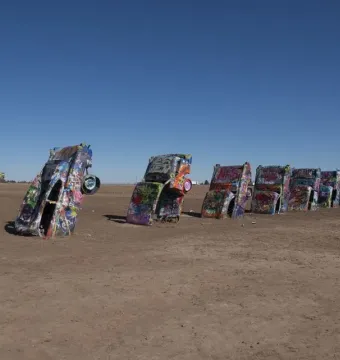
© Carol M. Highsmith · Public domain
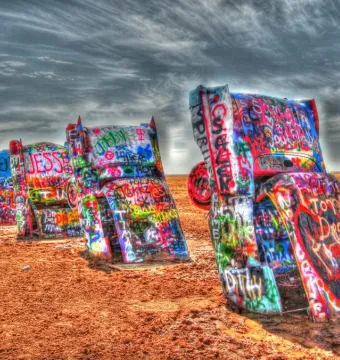
May 2012 © katsrcool · CC BY 2.0
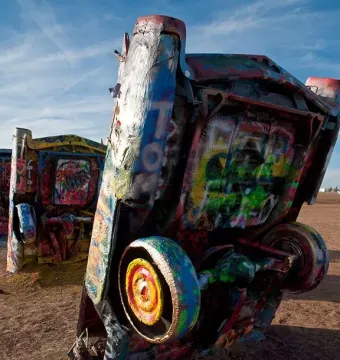
December 2011 © BFS Man · CC BY 2.0
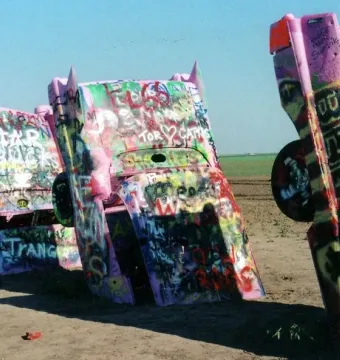
December 2011 © inkknife_2000 (7.5 million views +) · CC BY-SA 2.0
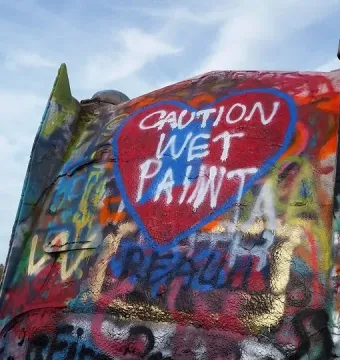
April 2016 © TinyCatMistress · CC BY-SA 4.0
Identification | |
| Title | Cadillac Ranch |
| Type | public art installation and monumental sculpture |
Historical context | |
| Creation date | 1974 |
Creator | |
| Artists | Ant Farm (Chip Lord, Hudson Marquez, and Doug Michels) |
| Artists' background | Chip Lord and Hudson Marquez were architects; Doug Michels was an art student at Tulane University in New Orleans, Louisiana |
| Artists' group origin | San Francisco |
Discovery and provenance | |
| Relocation reason | To place it farther from the boundaries of the growing city |
| Relocation | Moved in 1997 about two miles (three kilometers) west to a cow pasture along Interstate 40, outside the growing city |
| Original site | A wheat field |
| Land ownership | The site belonged to Stanley Marsh 3; ownership later appears to have transferred to his family trust before his June 2014 death |
| Commissioning contact | In 1972, the group was given a list of eccentric millionaires in San Francisco that led them to Stanley Marsh 3 of Amarillo |
| Funding and patron | Financed by Stanley Marsh 3, who also provided the land |
| Inspiration | The Look of Cars, including the rise and fall of the tail fin |
Physical characteristics | |
| Number of cars | Ten |
| Vehicle type | Cadillac automobiles |
| Model years represented | 1948 to 1963 |
| Arrangement | Ten Cadillacs buried nose-first in a straight east-west line, half-buried at an oblique angle and spaced about five meters apart |
| Angle reference | The cars are set at the same angle as the faces of the Great Pyramid of Khufu at Giza |
| Orientation | East-west alignment, parallel to the road |
Materials | |
| Original colors | Turquoise, banana yellow, gold, sky blue, white, and pastel blue |
| Car source | Bought from salvage yards or private owners in the Amarillo region |
| Vehicle condition at acquisition | Used, running, or junk cars |
| Materials | Second-hand Cadillac cars |
Technique | |
| Construction method | The cars were dug into ten holes with identical depth and angles using a backhoe; hubcaps were attached and the wheels were later welded to the axles |
| Acquisition cost | Bought for a few hundred dollars each |
Appearance | |
| Visual form | A row of ten wrecked Cadillacs planted in the ground so they appear to be growing from it |
| Current condition | The cars have lost their original colors and are heavily covered in graffiti and repainting |
| Visibility | Visible from the highway |
Location and ownership | |
| Setting | A flat, semi-desert cattle pasture on the Great Plains of the central United States |
| Distance from Amarillo | About five kilometers west of Amarillo |
| Public access | Visitors are tacitly encouraged to enter from the frontage road through an unlocked gate |
| Location | Potter County, Texas, near Amarillo, on private land along the former Route 66 and current Interstate 40 |
Iconography and meaning | |
| Symbolism | Evokes the golden age of the American automobile, the postwar economic boom, freedom associated with cars, and roadside attraction culture |
| Tailfin meaning | The ten models represent the evolution of Cadillac tailfins and the rise and decline of tailfin styling |
| Interpretive contexts | Associated with land art, street art, pop art, prehistoric megalithic alignments, and the hippie rejection of consumer society and traditional values |
History and restoration | |
| Public interaction | Visitors have long been encouraged to add graffiti and paint to the cars |
| Damage and theft | Windows were broken and radios, loudspeakers, and some doors were stolen over time |
| Repainting history | The cars have been periodically repainted for various occasions, including original-color restorations, a white repaint for a television commercial, pink for Wendy's birthday, black for Doug Michels, rainbow colors for LGBTQ pride events, and black with 'Black Lives Matter' in 2020 to protest police brutality and George Floyd's killing |
| Hampton Inn repaint | Briefly restored to their original colors by Hampton Inn as part of a Route 66 landmark restoration campaign, but graffiti returned within less than 24 hours |
Significance | |
| Associated artist group | Ant Farm |
| Comparison | Often compared with other car-based artworks, but not the first to use cars; César made crushed-car works in the late 1960s |
Other | |
| Portuguese name | Fazenda do Cadillac |