
Celtic Hero from Bohemia
Celtic Hero from Bohemia is the male sculpted head from Mšecké Žehrovice, dated to around 150–50 BC. It was found at the Viereckschanze site in Mšecké Žehrovice, about 65 km northwest of Prague in the Czech Republic. Made of marl, it is one of the best-known works of Celtic art from the Iron Age in Europe and, alongside the Prince of Glauberg and the Warrior of Hirschlanden, one of the few large representations of a human figure in this culture. After its discovery in 1943, it became one of the most photographed, reproduced, and published objects of the La Tène period. It is preserved in the National Museum in Prague under inventory number 111938.
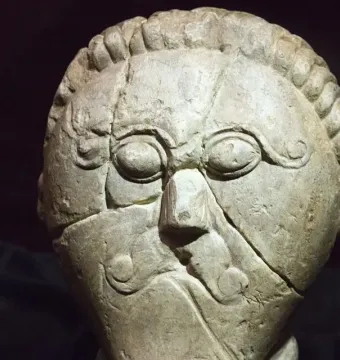
June 2018 © Zde · CC BY-SA 4.0
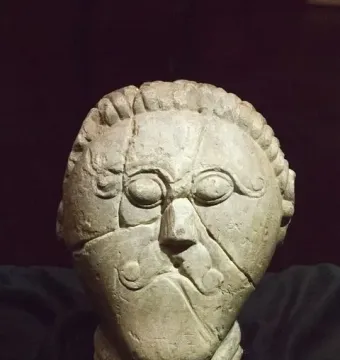
June 2018 © Zde · CC BY-SA 4.0
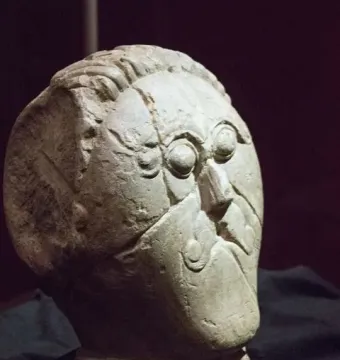
June 2018 © Zde · CC BY-SA 4.0
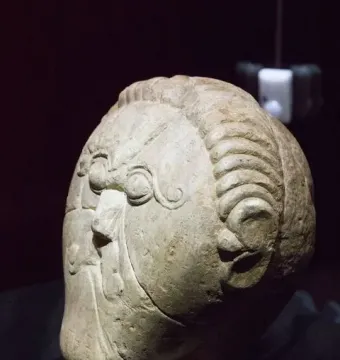
June 2018 © Zde · CC BY-SA 4.0
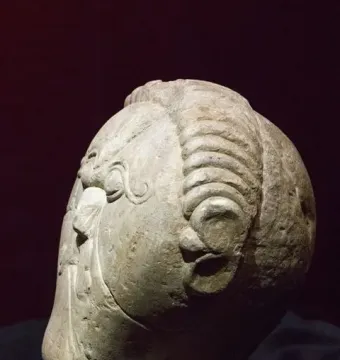
June 2018 © Zde · CC BY-SA 4.0
Identification | |
| Title | Celtic Hero from Bohemia |
| Alternative name | The Mšecké Žehrovice Head |
| Alternative name | The Celtic Hero |
| Object type | Anthropomorphic stone head sculpture |
| Alternative name | Head of Mšecké Žehrovice |
Historical context | |
| Date | c. 150–50 BC |
| Cultural period | La Tène period |
| Art tradition | Celtic art of the European Iron Age |
Creator | |
| Discoverer | Josef Šlajchrt |
Discovery and provenance | |
| Dating of associated feature | Late La Tène period LT C2-D1, approximately 150–50 BC |
| Transfer to museum | In 1952, Šlajchrt handed the head over to the Prague National Museum after it had been hidden during the German occupation to prevent confiscation |
| Missing fragments | The right side of the head, including the upper part of the ear, has not yet been found; possibly more than one fragment is missing |
| Condition when found | Broken into at least five pieces in antiquity; four fragments have been found in fairly good condition |
| Dating support | Burned animal bones and pottery sherd typology |
| Discovery context | Found during an excavation of an oppidum; buried in a pit in the southwest corner of a square enclosure |
| Origin | Mšecké Žehrovice |
| Associated finds | Burned animal bones, pottery sherds, pieces of saprolite, a piece of iron wire, remains of a hearth, bones, jet bracelets, and a large animal tooth |
| Associated archaeological context | Votive pit |
| Discovery location | A sand pit 500 meters south of the village of Mšecké Žehrovice, within a double Viereckschanze/oppidum site in Central Bohemia, Czech Republic |
| Discovery date | 19 May 1943 |
Location and ownership | |
| International exhibitions | Venice (1991), Rosenheim (1993), Tokyo (1998), Avila (2001), and Bern (2009) |
| Public display in the Czech Republic | The original was publicly exhibited only three times: in 1958, 2008, and 2011 |
| Replica location | A copy is on display in the Prague National Museum |
| Inventory number | 111938 |
| Current location | Nové Strašecí Museum |
| Collection | National Museum in Prague |
Physical characteristics | |
| Height | 23.4 cm |
| Width | 17.4 cm |
Materials | |
| Material | Local Cretaceous limestone (marlstone / Plänerkalkstein, chalk limestone) |
Appearance | |
| Moustache | Curved moustache |
| Neck ornament | Torc |
| Ears | Non-naturalistic, represented as lotus buds |
| Mouth | Suggested by a single downward line |
| Eyebrows | Curved eyebrows |
| Eyes | Oval, bulging eyes |
| Hair | Braided hair with a shaved tonsure at the back of the head |
| Facial style | Heavily stylized facial features projected on an almost flat surface |
Technique | |
| Stylistic tradition | A stylized form representative of La Tène art |
Iconography and meaning | |
| Interpretation of depicted figure | Thought to represent a druid or another high-ranking person based on the tonsure and moustache |
| Comparative reference | A similar torc appears on the second-century BC sculpture of the Dying Gaul from Pergamon |
Significance | |
| Notable status | One of the best-known works of Celtic art from Iron Age Europe |
| Comparative significance | Together with the Prince of Glauberg and the Warrior of Hirschlanden, one of the few large representations of a human figure in this culture |
| Reception | After its discovery, it became one of the most photographed, reproduced, and published objects of the La Tène period |
| Later status | Became an icon of Celtic Europe |
| Iconographic interpretation | Its carved head became a prototype of the 'barbarian' in Europe |
| Publication use | Its image appeared on the covers of many scholarly and popular publications on the European Iron Age |