
Marforio
Marforio is a Roman marble sculpture dated to the 1st century, depicting a river deity. The bearded figure is shown reclining, with his head resting on one arm; his torso is bare, while the lower part of his body is draped. It is one of the few ancient sculptures preserved in excellent condition. In the Middle Ages, it still stood on the Forum Romanum near the Arch of Septimius Severus, and it is mentioned in the Itinerarium from Einsiedeln and De mirabilibus urbis Romae. In the 16th century it became one of Rome’s "talking statues." In 1587 it was moved near St. Mark’s Basilica, then to the Capitoline in 1592, where it was restored by Giacomo della Porta and placed in a fountain niche before Palazzo Nuovo.
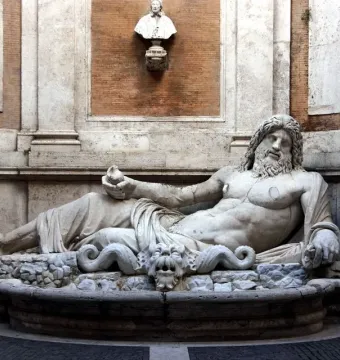
November 2007 © Vicenç Valcárcel Pérez · CC BY-SA 4.0
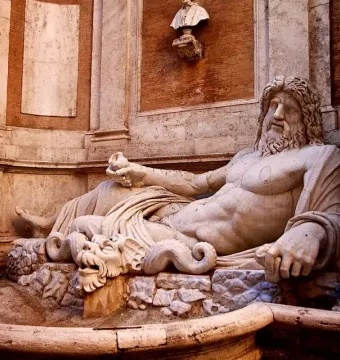
© Sarqua Quasar · CC BY-SA 3.0
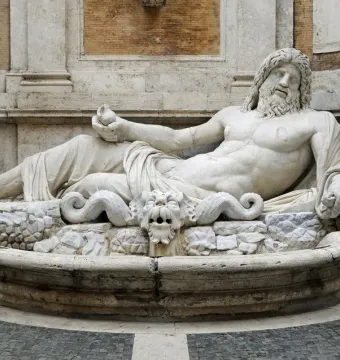
© Son of Groucho · CC BY 2.0
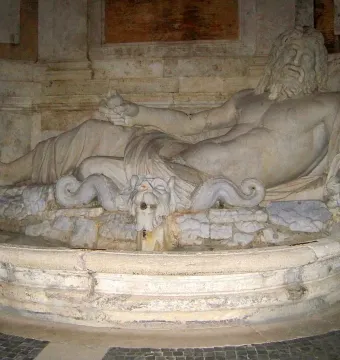
© Unknown artistUnknown artist · CC BY 3.0
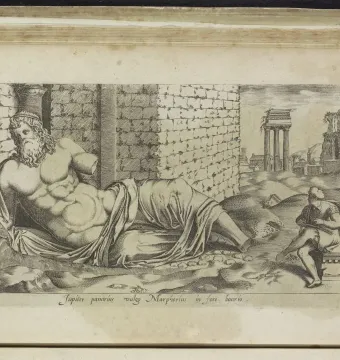
1584 © Rijksmuseum · CC0
Identification | |
| Title | Marforio |
| Alternative names | Marphurius; Marfório |
| Type | Ancient Roman marble sculpture |
Historical context | |
| Date | 1st century CE |
| Period | Roman era |
Creator | |
| Creator | Unknown |
Discovery and provenance | |
| Associated basin at discovery | Found with a large circular granite basin, described as black-and-white granite in some accounts, apparently bearing the inscription "mare in foro" |
| Name origin | Probably derived from the Forum of Mars / Martis Forum where it was found; other proposals connect it to the inscription "mare in foro" or the Marioli / Marfuoli family |
| Original findspot | The area known as the Forum of Mars / Martis Forum |
| Discovery date | Around 1510 |
| Discovery place | Forum of Augustus, near the Temple of Mars Ultor, in the area later called the Forum of Mars |
Physical characteristics | |
| Size | Colossal; enormous |
| Pose | Reclining, half-lying on a rock with the head resting on one arm |
| Condition | Preserved in excellent condition |
| Figure shown | A bearded reclining river god |
| Previous identifications | Previously identified as Jupiter, Neptune, Oceanus, the Tiber, or a personification of the Nera River |
Materials | |
| Main material | Marble |
| Associated basin material | Granite |
Appearance | |
| Lower body | Covered with drapery |
| Upper body | Bare torso |
Iconography and meaning | |
| Function | One of the talking statues of Rome, used for public satire |
| Satirical texts | Pasquinades and other anonymous satirical writings were posted beside it, usually mocking prominent public figures and Roman power |
| Satirical style | Often in verse or dialogue form, as if the statues were communicating with one another |
| Rival statue | Pasquino |
| Relationship to rival | Maintained a friendly rivalry with Pasquino for centuries |
| Subject interpretation | Probably a river god; some later interpretations identify him as Neptune, Oceanus, or the Tiber |
Location and ownership | |
| Current location | Courtyard of Palazzo Nuovo, Capitoline Museums, Rome |
| Historical locations | Near the Arch of Septimius Severus in the Roman Forum; moved to Piazza di San Marco in 1588; moved to Piazza del Campidoglio in 1592; moved to the courtyard of Palazzo Nuovo in the mid-17th century |
History and restoration | |
| Fountain context | Installed as the central figure of a fountain designed by Giacomo della Porta and associated with Michelangelo's design on the wall of Santa Maria in Aracoeli, facing the Palazzo dei Conservatori |
| Public access | Until 2008 the courtyard was freely accessible; afterward it became part of the Capitoline Museums visitor route |
| Later relocation | Moved again in the mid-17th century by order of Pope Innocent X, when the Palazzo Nuovo was built around the fountain |
| Early references | Mentioned in the Itinerarium of Einsiedeln and De mirabilibus urbis Romae; Poggio Bracciolini described it as a surviving sculpture from antiquity |
| Restoration | Restored in 1594 by Giacomo della Porta / Roger Bescapè; missing arms and attributes were recreated, and parts of the face, right foot, and left hand were reconstructed, including a shell attribute |
| Renaissance status | Became famous as one of the talking statues of Rome and gained particular notoriety during the Renaissance |
| Early fame | A landmark in Rome by the late 12th century |
Significance | |
| Relative fame | Possibly the best known of the talking statues after Pasquino |
| Symbolic status | A symbol of Rome since the end of the 15th century |
Other | |
| Engraving depiction | Depicted in an engraving by Antonio Lafrery in Speculum Romanae Magnificentiae (1550), with a poem explaining the legend of Marforio |