
Sculpture of a Horse (Olympia B 1741)
Sculpture of a Horse (Olympia B 1741) is an early archaic bronze sculpture discovered in Olympia in 1939 and now kept in the Archaeological Museum of Olympia. It is dated to the early 7th century BC and measures 45.5 cm in height and 47 cm in length. The figure was found in an early archaic well beneath the Mosaic Hall of the Nero House. Although heavily damaged, it is largely complete, with only the ends of the legs and tail broken off; the tail was later reattached. The work is significant as a unique transitional piece between small geometric sculpture and the larger-scale art of the Archaic period, and as an important example in the history of ancient bronze casting.
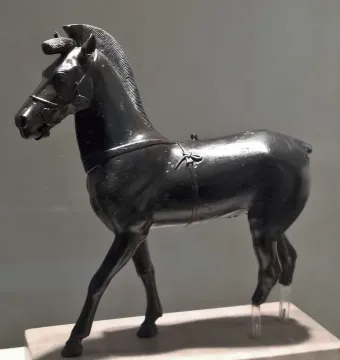
May 2019 © Milo44 · CC BY-SA 4.0
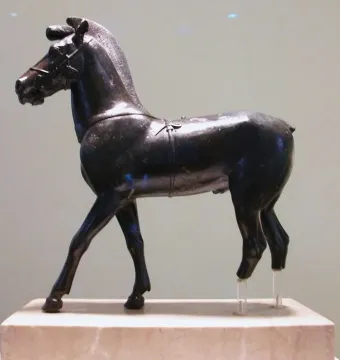
April 2011 © Joanbanjo · CC BY-SA 3.0
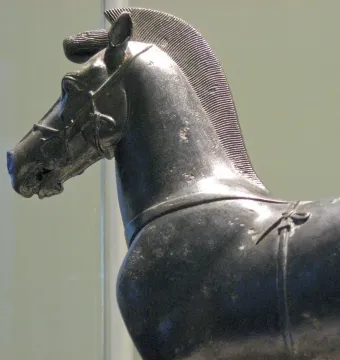
June 2007 © Nicholas Hartmann · CC BY-SA 4.0
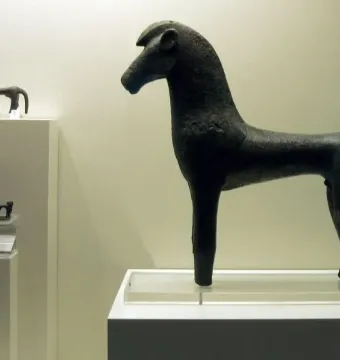
© Xocolatl · Public domain
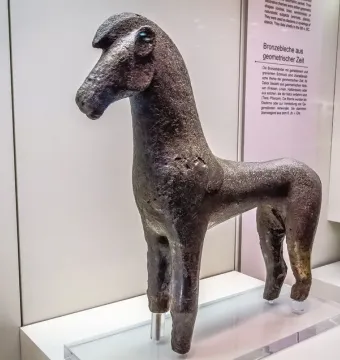
September 2014 © Made by Numbers · CC BY-SA 2.0
Identification | |
| Title | Sculpture of a horse (Olympia B 1741) |
| Object type | Archaic bronze sculpture |
| Subject | Horse |
Historical context | |
| Period | Early Archaic |
| Date | Early 7th century BC |
Discovery and provenance | |
| Discovery date | 1939 |
| Discovery location | Olympia |
| Findspot context | Found during excavations in an archaic well beneath the mosaic floor of the House of Nero |
| Inventory number | B 1741 |
Location and ownership | |
| Current location | Archaeological Museum of Olympia |
Physical characteristics | |
| Tail | The bent tail was broken off and reattached |
| Original height | About half a metre tall |
| Condition | Heavily battered but largely preserved; only the ends of the legs and the tail are broken off |
| Dimensions | 45.5 cm high, 47 cm long |
Materials | |
| Material | Bronze |
Technique | |
| Construction | Cast in solid bronze in two separately cast parts that were then joined together |
| Casting assessment | The solid-cast technique was not suitable for a sculpture of this size, and the attempt to join the two parts without a visible seam failed |
| Manufacturing defects | Both parts show casting defects |
Appearance | |
| Artistic quality | Artistically and stylistically modest; the formal execution was considered unsatisfactory |
Iconography and meaning | |
| Interpretation | An attempt to enlarge a figure using traditional technique; possibly intended as a monument commemorating a victorious horse in the ancient Olympic Games |
Significance | |
| Art-historical significance | The only surviving work of its kind and of great art-historical interest as a unique transitional work between Geometric small-format sculpture and the larger format of the Archaic period |
| Historical significance | Highly important for the history of ancient bronze casting; unsuccessful attempts like this probably contributed to the development of hollow casting in the course of the 7th century BC |