
The Last of the Tribes
The Last of the Tribes is a neo-classical sculpture by Hiram Powers, modeled between 1867 and 1872 in marble. It depicts a partially nude young Native American girl walking with her head turned slightly to one side. It was Powers’ last full-length sculpture. The work reflects the artist’s idea of a time “when the last Indian will pass away” through contact with Euro-Americans, and he described the figure as “fleeing before civilization [and] looking back in terror.” The sculpture has been on public display at the Museum of Fine Arts, Houston since 2001.
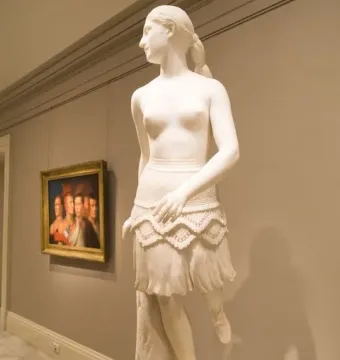
© Hiram Powers · Public domain
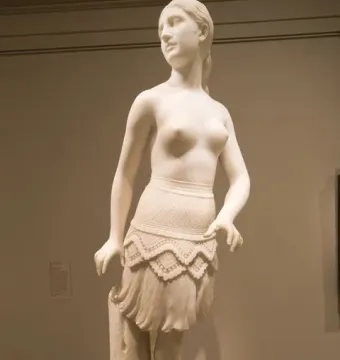
© Hiram Powers · Public domain
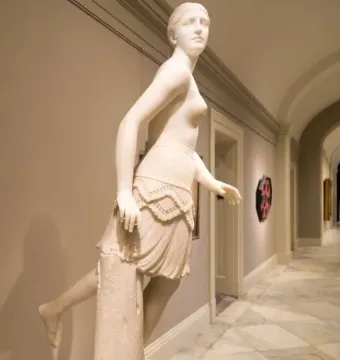
© Hiram Powers · Public domain
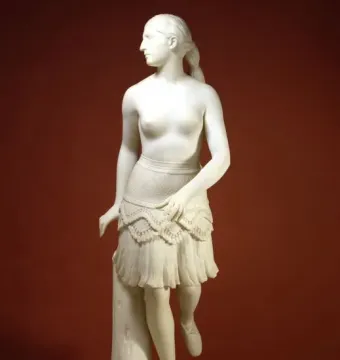
© Powers, Hiram · CC0
Identification | |
| Title | The Last of the Tribes |
| Type | Full-length statue |
| Style | Neoclassical |
| Original title | L'ultima della tribù |
Historical context | |
| Reception at the time | Nude and semi-nude works were disapproved of, and Powers was criticized by much of society |
| Date created | 1867–1872 |
| Completion status | Hiram Powers' last full-length sculpture completed |
| Related works | Eve; The Greek Slave; Eva sconsolata; La schiava greca |
| Related works' subject | Full-length nude or semi-nude artistic figures |
| Contemporary appreciation | Some admirers of Powers still appreciated his art |
Creator | |
| Artist | Hiram Powers |
| Artist nationality | American |
Materials | |
| Material | Marble |
Physical characteristics | |
| Subject | A semi-nude young Native American woman |
| Pose | Running with her head turned slightly to one side |
Appearance | |
| Expression | Looking back in terror |
| Model | An Italian girl, not a Native American woman |
| Stylistic features | Wavy, graceful lines capture the figure's form and motion; the skirt's details reinforce a sense of movement |
| Clothing | An exquisitely detailed skirt with diamond patterns and tassels |
Iconography and meaning | |
| Artist's interpretation | Fleeing from civilization |
| Intended meaning of the title | Reflects the idea that 'the last Indian will pass away' as a result of contact with Euro-Americans |
| Theme | Reflects a view of Native Americans as 'noble savages' doomed to extinction by westward expansion of the United States |
Location and ownership | |
| Current location | Museum of Fine Arts, Houston |
| On public display since | 2001 |
Discovery and provenance | |
| Second version location | Smithsonian American Art Museum, Washington |
Significance | |
| Later attention | Included in The United States Academic Decathlon 2003–2004 curriculum and catalog; drew increased attention and popularity |
| Curriculum focus | Lewis and Clark Expedition and Native Americans |