
Venus of Berekhat Ram
Venus of Berekhat Ram is a possible anthropomorphic figure only 3.5 cm long, apparently made of reddish volcanic rock partly worn by erosion and partly marked with artificial incisions. It was discovered by Alexander Marshack in 1981 at Mas'adah, at the foot of Mount Hermon near the Golan Heights. It has been dated with considerable confidence to between 250,000 and 280,000 years ago, in an Acheulean context, based on an ash layer dated to 230,000 years. Studies suggest the marks may have been made with a sharp stone tool, though recent research leans toward a natural origin or non-artistic manipulation.
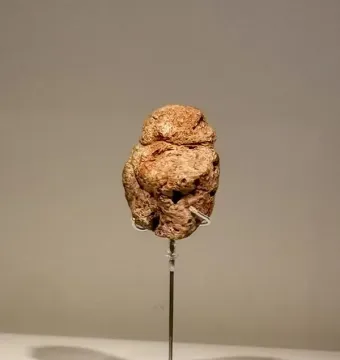
August 2021 © Thomas cahana · CC BY-SA 4.0
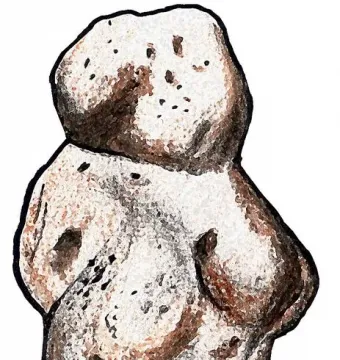
February 2006 © José-Manuel Benito · Public domain
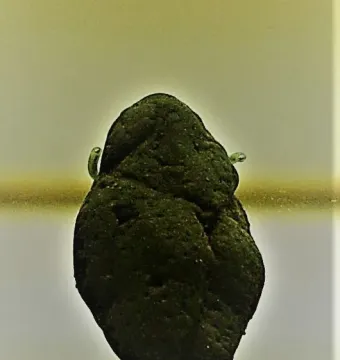
August 2018 © Museum of Human Evolution · CC BY-SA 4.0
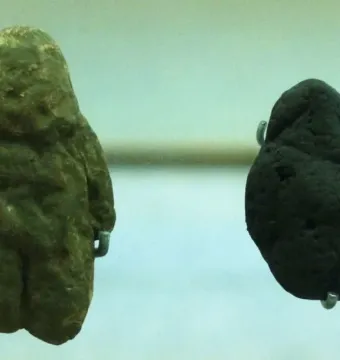
2018 © Own work · CC BY-SA 4.0
April 2008 © Epson291 · Public domain
Identification | |
| Title | Venus of Berekhat Ram |
| Type | Possible anthropomorphic figure; possible Venus figurine |
| Alternative name | Venus of Berejat Ram |
Historical context | |
| Date | about 280,000–250,000 years ago |
| Archaeological context | Acheulean context; late Acheulean |
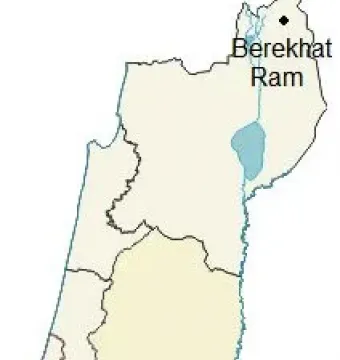
| Find spot | Berekhat Ram, Golan Heights, near Lake Ram, at the foot of Mount Hermon |
| Site type | Volcanic crater now containing a lake |
Discovery and provenance | |
| Discovery date | 1981, during archaeological excavations |
| Discoverer | Naama Goren-Inbar (Hebrew University of Jerusalem) |
| Discovery context | Found at an Acheulean site between two ash layers; the find layer was an alluvial sediment layer 0.25 m thick |
| Associated finds | Flint finds from the Acheulean, including Levallois flakes, and Upper Paleolithic types such as burins and end-retouched pieces |
Physical characteristics | |
| Surface condition | Partly worn by erosion |
| Surface markings | At least three incisions or grooves |
| Dimensions | 35 mm long, 25 mm wide, 21 mm thick; about 10 g |
| Object type | Stone pebble; sculptural object |
Materials | |
| Material | Red volcanic tuff |
Technique | |
| Incision technique | Possibly engraved with a sharp stone or lithic tool |
Appearance | |
| Groove description | One deep incision encircles the narrower part of the pebble; two shallower grooves run down the sides |
| Possible identified features | The grooves have been interpreted as the head, neck, arms, shoulders, or legs |
| Comparative resemblance | It bears little resemblance to later Upper Paleolithic Venus figurines |
Interpretive significance | |
| Interpretation status | Its anthropomorphic and symbolic nature is disputed; some scholars see it as a natural object with accidental or utilitarian marks, while others regard it as a deliberately modified figurine |
| Possible maker | Possibly Homo erectus or another early human/hominin |
| Proposed depiction | Possibly a female human figure |
| Scholarly significance if intentional | If intentional, it would be among the oldest known examples of representational art and Paleolithic Venus figures; some scholars treat it as one of the few Old Paleolithic small-art objects accepted by part of prehistoric scholarship |
| Comparative object | Venus of Tan-Tan |
History and restoration | |
| Scientific studies | Microscopic and comparative analyses by Alexander Marshack (1997) and later by Francesco d'Errico and April Nowell |
| Study conclusions | Marshack and later d'Errico and Nowell argued that at least some grooves are anthropogenic, but later analysts also noted possible abrasion and did not rule out a functional explanation |
Significance | |
| Name origin | The term 'Venus' was used by analogy with the traditional name for much younger Upper Paleolithic figurines depicting women |
Other | |
| Scholarly debate | Whether the marks were made by humans or hominins, whether they were non-utilitarian or symbolic, and whether they were intended to depict a woman |