
Immodest Venus
Immodest Venus, also known as the Venus of Vibraye, is regarded as the first Paleolithic sculptural representation of a woman discovered in modern times. It was found by Paul Hurault, the 8th Marquis of Vibraye, around 1864 at the famous archaeological site of Laugerie-Basse in the Vézère valley in Dordogne, southwestern France. The Magdalenean figurine, carved from mammoth ivory, is missing its head and feet and lacks arms, while its sharply incised vaginal opening gave rise to its name. Unlike most other Paleolithic Venus figures, it has a slender body, a flat belly, narrow hips, and almost no breasts, suggesting it may depict a girl.
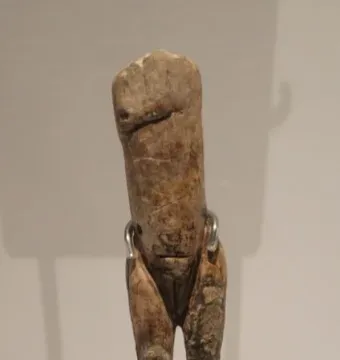
January 2023 © Zunkir · CC BY-SA 4.0
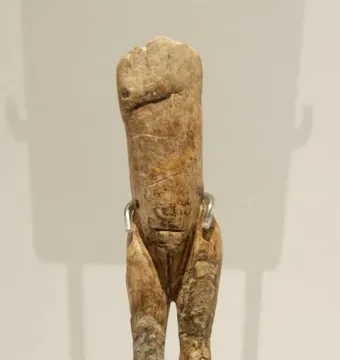
May 2023 © Marie-Lan Nguyen · Public domain
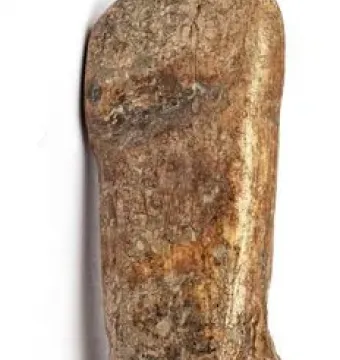
September 2018 © Jc Domenech · CC BY-SA 4.0
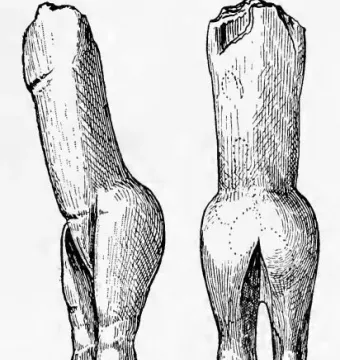
1907 © Unknown authorUnknown author · Public domain
Identification | |
| Title | Immodest Venus |
| Original French name | Vénus impudique |
| Alternative names | Vénus de Vibraye; Vénus de Laugerie-Basse; Venus Impudica; Vênus impudica |
| Translated name | "Immodest Venus" |
| Type | Upper Paleolithic female figurine |
Historical context | |
| Cultural period | Magdalenian |
| Estimated age | about 16,000 years old |
Creator | |
| Discoverer | Paul Hurault de Vibraye (1809–1878) |
Discovery and provenance | |
| Discovery date | circa 1864 |
| Discovery site | Laugerie-Basse, Les Eyzies-de-Tayac-Sireuil, Dordogne, southwestern France |
| Discovery site context | famous archaeological site in the Vézère valley; one of many important Stone Age sites in and around the commune of Les Eyzies-de-Tayac-Sireuil |
| Discovery site type | important Upper Paleolithic site |
| Other finds at site | about 600 Magdalenian art objects, along with stone artifacts and other tools |
| Related object found at same site | the "woman with the reindeer" (la femme au renne), discovered by Abbé Landesque in 1867/68 |
Physical characteristics | |
| Anatomical feature | strongly incised vertical vaginal opening |
| Condition | Head and feet missing; no arms |
| Body type | slender body with flat abdomen, narrow hips, and almost no breasts |
| Length | 8.2 cm |
Materials | |
| Material | mammoth ivory |
Appearance | |
| Probable original form | Probably had a head; likely without arms |
| Interpretation | May represent a girl or young woman |
| Stylistic comparison | Unlike most other Paleolithic Venus figures, it is slender and lacks the large breasts, prominent belly, and wide hips typical of the genre |
| Comparison with Venus Pudica | Named in contrast to the Venus Pudica, a Roman sculpture type depicting Venus covering her pubis with one hand and her breasts with the other |
Iconography and meaning | |
| Naming explanation | The name was inspired by the figure's uncovered pudenda and contrasted with the Venus Pudica |
| Name origin | The term "Venus" in the name refers to Venus, the Roman goddess of love |
| Naming significance | The statue's name gave the wider genre of Paleolithic Venus figurines its name and set a precedent for later names in the group |
| Common term derived from this name | "Venus figurines" |
| Interpretive note | The term is sometimes criticized as an unfortunate or androcentric label; many figurines were long thought to have erotic character and to represent women made by men |
Significance | |
| Significance | Described as the first Paleolithic sculptural representation of a woman discovered in modern times and the first Stone Age female statuette discovered in France |
Location and ownership | |
| Current location | Musée de l'Homme, Paris |