
Stele of Dexileus
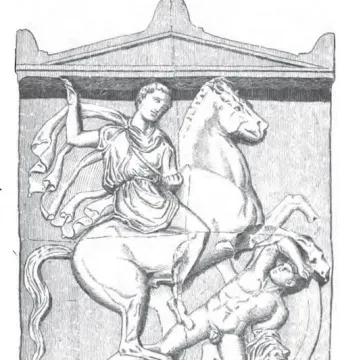
The Stele of Dexileus is the funerary stele of an Athenian cavalry soldier named Dexileus, who died in the Corinthian War against Sparta in 394 BC. It is attributed to "The Dexileus Sculptor" and can be dated to 394 BC from the inscription at its base, which gives Dexileus’s birth and death dates. The stele is made of costly Pentelic marble and features a high-relief battle scene with an inscription below. Discovered in 1863 in the Dexileus family plot in the Ceramicus cemetery of Athens, it was found in situ, later moved during World War II, and is now displayed in the Ceramicus Archaeological Museum.
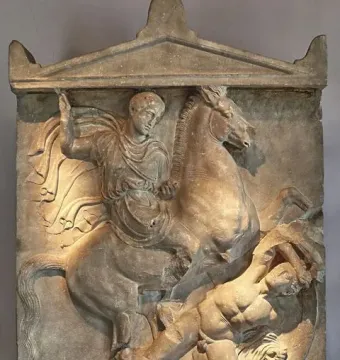
June 2018 © George E. Koronaios · CC BY-SA 4.0
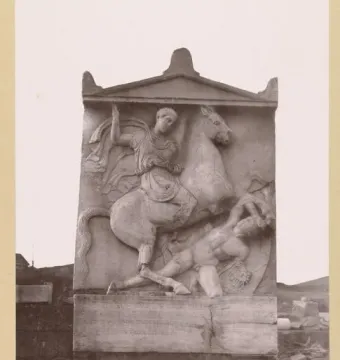
© Rijksmuseum · CC0
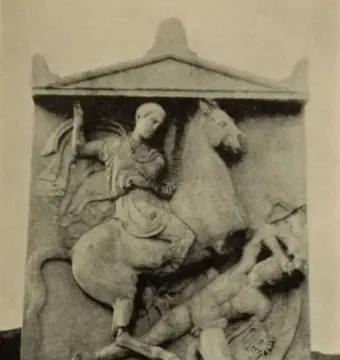
© Unknown photographerUnknown photographer · CC0
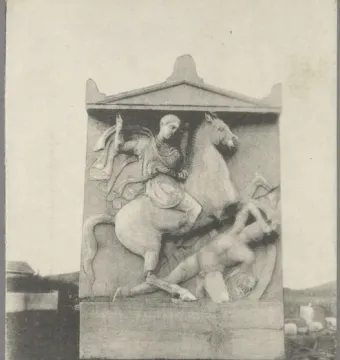
© Rijksmuseum · CC0
1876 © Diomedes, Paulos · Public domain
Identification | |
| Title | Stele of Dexileus |
| Alternative name | Grave Stele of Dexileus |
| Type | stele |
| Alternative name | Dexileos stele |
| Type | funerary stele |
Historical context | |
| Historical period | Classical Greek |
| Burial/ashes | The ashes of Dexileus and the four other knights were transferred to Athens and deposited at the Public Cemetery |
| Age at death | 20 years old |
| Social status | Wealthy young Athenian |
| Political context | After Athens's defeat in the Peloponnesian War in 404 BC and the restoration of Athenian democracy in 403 BC after the overthrow of the Thirty Tyrants |
| Historical context | Athens during a period of chaos and disorder |
| Battle context | Probably the Battle of Nemea in 394 BC during the Corinthian War |
| Other knights mentioned | Four other knights were killed with Dexileus in 394 BC |
| Associated person | Antiphates, the leader of Dexileus's tribe |
| Military service | Had completed three years of military service as part of the ephebic rite of passage |
| Date | 394 BC |
| Social status | Athenian cavalryman and ephebe |
| Age at death | 20 |
| Death context | Died in the Corinthian War against Sparta in 394 BC, probably at the Battle of Nemea |
| Person commemorated | Dexileus |
Creator | |
| Attribution | Attributed to the sculptor Dexileus |
Discovery and provenance | |
| Findspot | Kerameikos, Athens |
| Later movement | Moved during World War II |
| Discovery condition | Found in situ |
| Discovery location | Dexileus's family plot in the Kerameikos cemetery of Athens |
| Discovery date | 1863 |
Physical characteristics | |
| Height | Not specified |
Materials | |
| Material quality | A costly variety of Pentelic marble |
| Material | Pentelic marble |
Technique | |
| Technique | High relief |
Appearance | |
| Architectural frame | Bordered at the top by a pediment adorned with acroteria |
| Enemy nudity | Completely nude |
| Pose | Dexileus's torso twists forward while his head is shown in three-quarter view, inclined downward toward the enemy |
| Clothing | Chiton, chlamys, petasos, and crepides |
| Horse action | The horse rears upward |
| Arm position | Raises one arm to hold a spear |
| Missing attachments | Spear, reins, and petasos |
| Evidence of missing attachments | Their former presence is indicated by stains and peg holes in the relief |
| Depicted enemy | A Greek enemy below the horse, fallen in combat and shielding himself with one arm over his head |
| Depicted scene | A battle scene with an inscription below |
| Depicted subject | Dexileus, a young Athenian cavalryman on horseback charging a Spartan enemy |
| Enemy pose | Front-facing with head raised toward Dexileus |
| Age depiction | Youthful, shown by the absence of a beard |
Iconography and meaning | |
| Family meaning | The monument brings pride to Dexileus's family and presents him as part of the Athenian community |
| Meaning of death | His death is presented as a sacrifice for his people |
| Related monument | The Polyandrion, which honors all soldiers who died for the city in a given year, including Dexileus |
| Related burial practice | The remains of the soldiers were mixed, cremated, and deposited in the Demosion Sema for burial |
| Historical interpretation | The ritual equalized all Athenians after death to create a complete democracy |
| Another related monument | A monument honoring all fallen cavalry soldiers, listing eleven in total, including Dexileus |
| Interpretation of meaning | This monument preserved the sacrifices of those cavalry soldiers for democracy |
| Ideological themes | Combines individual glorification of the deceased with the Athenian democratic inclusion of aristocracy and the idea of death as sacrifice for the state |
| Enemy nudity interpretation | Represents vulnerability and worthiness as an opponent |
| Narrative meaning | The scene describes Dexileus's death in battle at Corinth |
| Religious association | Designed to evoke a naiskos, giving the stele a religious appearance |
Location and ownership | |
| Location | Dipylon cemetery, Athens |
| Current display status | Currently exhibited at the Kerameikos Archaeological Museum |
| Current location | Kerameikos Archaeological Museum, Athens |
| Discovery location | West of Athens, in the area of the Demosion Sema |
| Current location | National Archaeological Museum of Athens |
History and restoration | |
| Builder/commissioners | Constructed later by Dexileus's relatives |
| Construction basis | Dated from the inscription below, which gives Dexileus's birth and death dates |
| Date of construction | 394 BC |
| Inscription | An inscription below the relief gives the dates of Dexileus's life and describes his death in battle at Corinth |
| Setting | Built within a family enclosure |
| Surviving part | Only the crown of the monument survives |
| Inscription location | On the epistyle |
| Commemorated battles | Corinth and Coronea |
| Commemorated group | Athenian horsemen who fell in battle |
| Named individual in inscription | Dexileus |