
Melqart di Sciacca
Melqart di Sciacca, also known as Melqart of Selinunt, is a 38 cm-high bronze statuette found in January 1955 in the sea between Selinunte and Capo San Marco, near Sciacca on the southwest coast of Sicily. It was cast between the 13th and 9th centuries BC and is now exhibited at the Regional Archaeological Museum Antonio Salinas in Palermo. The figure has been interpreted variously as Melqart, Baʿal, Hadad, and more recently as Reshef. Its conical hat, raised right arm, and pointed beard place it within the wider iconography of Near Eastern storm and sky deities, while its discovery at sea suggests ancient cultural exchange across the Mediterranean.
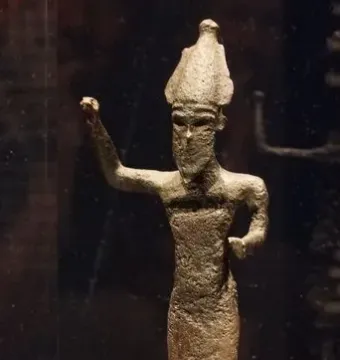
January 2016 © NearEMPTiness · CC BY-SA 4.0
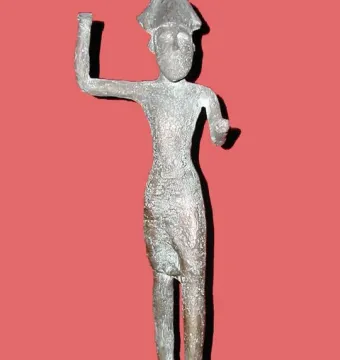
January 2018 © Corriere di Sciacca · CC BY-SA 4.0
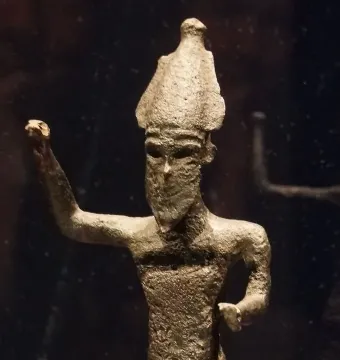
January 2016 © NearEMPTiness · CC BY-SA 4.0
Identification | |
| Title | Melqart of Sciacca |
| Type | Bronze statuette |
| Height | 36–38 cm |
| Alternative title | Melqart of Selinunte |
Discovery and provenance | |
| Discovery date | January 1955 |
| Discovery location | Sea area between Selinunte and Capo San Marco, near Sciacca, on the southwest coast of Sicily |
| Discovered by | A fishing boat |
| Find context | Recovered from the sea |
| Provenance implication | The sea recovery suggests it was not autochthonous, but this does not prove its original provenance |
Historical context | |
| Casting date | Between the 13th and 9th centuries BC |
| Initial dating | 14th–13th century BC |
Creator | |
| Attribution | Unknown |
Iconography and meaning | |
| Similar work | The Baʿal of Ugarit in the Louvre (14th century BC) |
| Beard significance | This beard type is characteristic of Mesopotamian peoples and is more consistent with Baʿal, Hadad, Teššub, or Reshef than with Melqart; it also excludes a female deity such as Anat |
| Meaning of held object | Symbol of power over the atmosphere, thunderstorms, whirlwinds, hurricanes, and storms |
| Possible held object | Thunderbolt, scepter, or weapon such as an axe, mace, or club |
| Later identifications | Baʿal, Hadad, or Reshef |
| Comparative context | Placed within the tradition of ancient Mesopotamian sky gods and later Syro-Anatolian derivatives such as Canaanite Baʿal, Greek Zeus, and Roman Iupiter Dolichenus |
| Current proposed interpretation | Reshef, a Mediterranean god from the Hyksos period in ancient Egypt |
| Initial identification | Melqart |
| Depicted figure | A Canaanite deity |
Physical characteristics | |
| Headgear | Conical headdress with a knob-like protrusion, compared to the Egyptian Osiris atef crown |
| Arm pose | Right arm in a threatening, admonitory pose |
| Hand condition | The bent hand suggests it originally held an object |
| Facial hair | Pointed beard |
Location and ownership | |
| Current location | Museo del Mare di Sciacca |
| Current collection | Antonio Salinas Regional Archaeological Museum, Palermo |
Significance | |
| Historical significance | The find has been used to suggest pre-Greek Sicily lay on major ancient Mediterranean routes, was in close cultural contact with Aegean and Near Eastern peoples, and may witness the spread of Canaanite peoples into the western Mediterranean around 1200 to 1000 BC |