
Regisole
Regisole was an ancient bronze equestrian monument that once stood before Pavia Cathedral. The original sculpture, known from numerous engravings, showed a ruler on horseback in a military tunic and cloak, raising his right hand in greeting, with the horse lifting its left hoof. The figure has been variously identified as Antoninus Pius, Marcus Aurelius, Septimius Severus, Aurelian, Odoacer, Theodoric the Great, or Justinian. Originally in Ravenna, it was brought to Pavia in 1024 and later moved several times before being destroyed by French troops in 1796. In 1937, a 6-meter bronze copy by Francesco Messina was unveiled on a travertine pedestal before the cathedral.
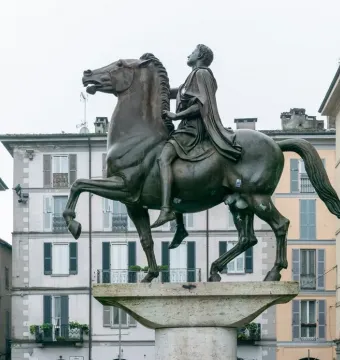
January 2025 © Tournasol7 · CC BY 4.0
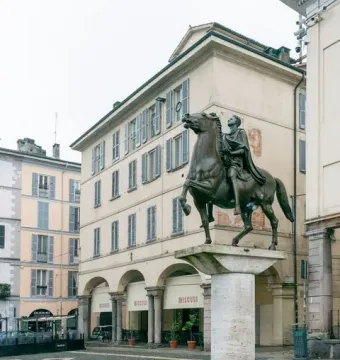
January 2025 © Tournasol7 · CC BY 4.0
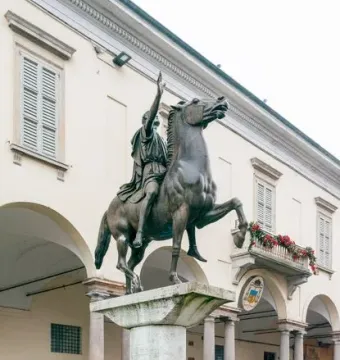
January 2025 © Tournasol7 · CC BY 4.0
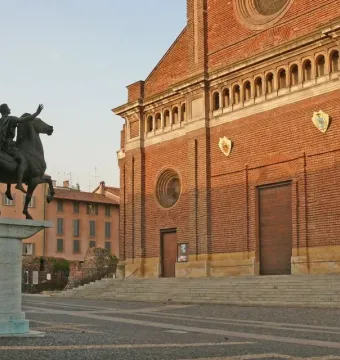
May 2009 © Superzen · Public domain
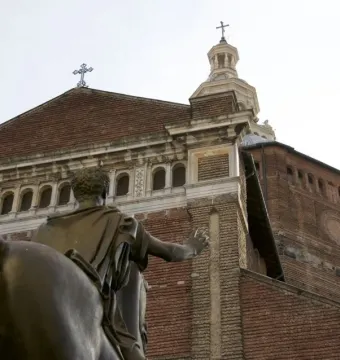
September 2012 © Fortunato Marcovicchio · CC BY-SA 4.0
Identification | |
| Title | Regisole |
| Type | Bronze equestrian statue |
Historical context | |
| Period | Late antiquity or possibly a Roman work of the 3rd century AD |
| Origin status | Unclear and disputed |
Creator | |
| Copy sculptor | Francesco Messina (1900–1995) |
Discovery and provenance | |
| Evidence for original sculpture | Known from numerous engravings and other early images |
| Reproduction | A bronze copy was made in 1937 and installed in Pavia |
| Destruction | Destroyed in 1796 by the Jacobins in Pavia, who saw it as a symbol of monarchy |
| Later wartime removals | Taken to Milan by the Visconti from 1315 to 1335, and to Cremona from 1527 to 1552 |
| Historical testimony | Ibrāhīm al-Turtuši reported seeing a large bronze equestrian statue near one of the gates of the Royal Palace in Pavia between 960 and 965 |
| Legendary transfer story | According to Benzo of Alessandria, Pavia took the Regisole from Ravenna during a war, and the Ravennans retaliated by removing gilded bronze plates from a gate in Pavia |
| Alternative provenance hypotheses | Possibly brought to Pavia as war booty in 740 or 751, or taken there by Charlemagne; another hypothesis places it in Aachen near the Palatine Chapel |
| Early placement in Pavia | First in the Royal Palace courtyard; later on a column in front of Pavia Cathedral |
| Transferred to Pavia | In the Middle Ages; documented there from the 10th century |
| Original location | Ravenna, Italy; possibly near the royal palace |
Materials | |
| Original material | Bronze |
| Copy material | Bronze |
| Copy base material | Travertine |
Technique | |
| Casting technique | Lost-wax casting |
Physical characteristics | |
| Copy height | 6 meters |
Appearance | |
| Additional details | Spurs on the rider's feet and a small dog standing on its hind legs beneath the raised foreleg |
| Later additions | The spurs, dog, and possibly harness and stirrups are considered later medieval additions |
| Depicted figure | A ruler on horseback |
| Horse pose | Left foreleg raised |
| Gesture | Right hand raised in greeting |
| Clothing | Military tunic and cloak |
Iconography and meaning | |
| Subject identification | Disputed; modern hypotheses include Theodoric the Great, Septimius Severus with later modifications, Antoninus Pius, Marcus Aurelius, Aurelian, Constantine, Charles V, or a Roman work of the 3rd century AD |
| Name meaning | Probably from "Rei Sol" or "sun king"; other proposed origins are "regisolio" meaning royal throne, or the raised arm as if holding the sun |
| Symbolism in Pavia | A symbol of Pavia's communal pride, civic power, and connection with Imperial Rome |
| Artistic influence | Very influential in the Italian Renaissance and a model for later equestrian monuments such as Donatello's Gattamelata and the Colleoni Monument |
| Admired by | Petrarch, Boccaccio, and Leonardo da Vinci |
| Depictions and references | Shown on the silver seal of the Commune of Pavia and in a 1505 woodcut; Leonardo da Vinci made a drawing of it and remarked on it; Edward Gibbon described it in 1764 |
Location and ownership | |
| Current location | In front of the Cathedral of Pavia |
| Current version | 1937 bronze copy on a travertine pedestal |
History and restoration | |
| Destruction date | 1796 |
| Copy unveiling date | 8 December 1937 |
| Copy occasion | Unveiled for the 2000th anniversary of the founding of the Roman Empire |
| Copy restoration context | Commissioned by Mussolini and based strictly on ancient reproductions |
Significance | |
| Historical significance | Considered one of the symbols of Pavia and an important survival model for Renaissance sculptors |
Other | |
| Related historical context | Ravenna was the capital of the Western Roman Empire from 402 to 476 and later of the Ostrogoths and the Exarchate of Ravenna |
| Student tradition | Students of the University of Pavia in a fraternity paint the horse's testicles yellow at the start of each academic year; the custom dates back several decades and yellow is the fraternity's color |