
Evening: Interpretations of the Sculpture
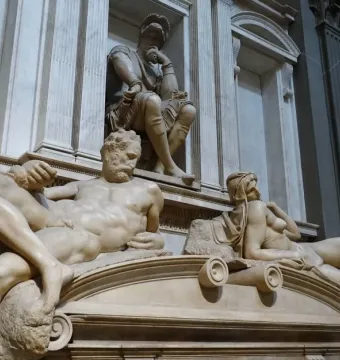
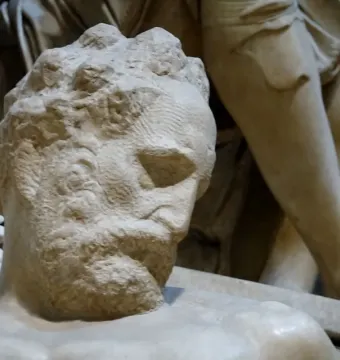
Evening (Twilight) is a marble allegorical sculpture by Michelangelo Buonarroti, created between 1524 and 1531. It represents the allegory of Evening, or Twilight, and is part of the tomb of Lorenzo II, Duke of Urbino, in the Medici Chapel in Florence. Its paired sculpture is Morning. The work measures 155 × 170 cm, with a maximum diagonal length of 195 cm. The figure is shown as an elderly muscular man whose face is barely defined, contrasting with the polished marble of the body. He appears to be falling asleep, with one arm scarcely supporting him and his head inclined toward his chest. Commentators have described the sculpture as conveying drowsy thought, unrest, and the oppressive atmosphere of old age and nostalgia.
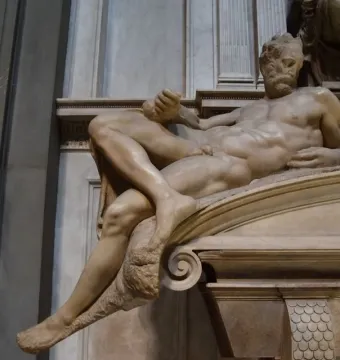
June 2019 © George M. Groutas · CC BY 2.0
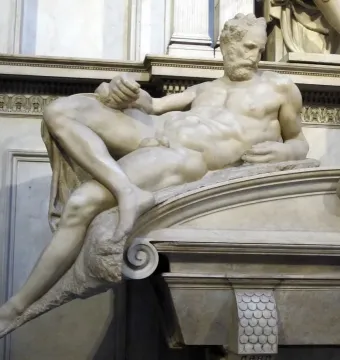
June 2014 © Francesco Bini · CC BY-SA 4.0
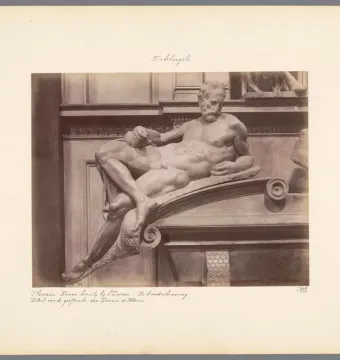
© Rijksmuseum · CC0
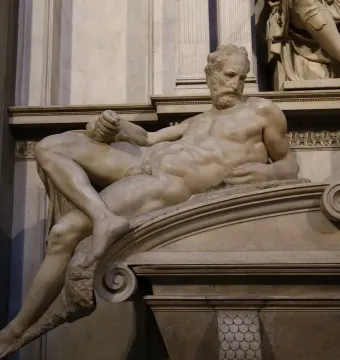
August 2014 © Rufus46 · CC BY-SA 3.0
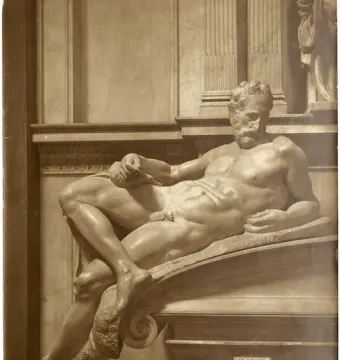
© Fratelli Alinari · Public domain
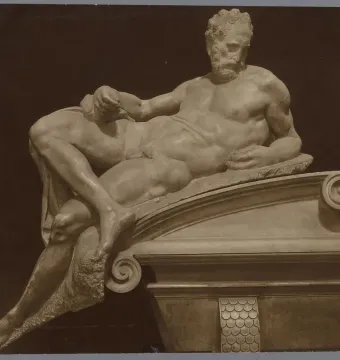
© Rijksmuseum · CC0
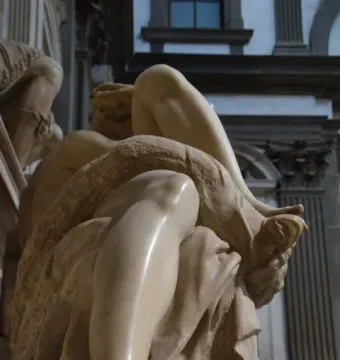
June 2019 © George M. Groutas · CC BY 2.0
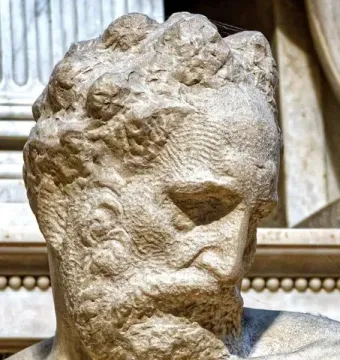
© Holger Uwe Schmitt · CC BY-SA 4.0
June 2019 © Richard Mortel · CC BY 2.0
June 2019 © Richard Mortel · CC BY 2.0
Identification | |
| Title | Dusk |
| Subject | An allegory of Evening (or Twilight); one of the four allegories of the Parts of the Day; a male personification of dusk; an elderly male figure of athletic build; an elderly man |
| Original titles | "Evening" (Twilight); "Evening"; Le Crépuscule; Le Soir; Il Crepuscolo; El Crepúsculo; Puesta del sol; Tramonto |
| Type | Marble allegorical sculpture; sculpture; marble statue; sculpture / statue; personification statue; allegorical sculpture; statue / deity |
Creator | |
| Artist nationality | Italian |
| Artist | Michelangelo Buonarroti; Michelangelo |
Historical context | |
| Date of creation | 1524–1531; 1524-1531; between 1524 and 1531; datable to 1524-1531; 1524–1534; 1524-1534; 1524 to 1534 |
| Work period | 1524–1534 |
| Work phase | Second phase of the work |
| Completion status | Nearly completed by March 1526; visibly unfinished in 1534; still visibly unfinished in 1534; completion date unknown; started in 1524; not known when it was completed |
| Historical notes | It was begun after the resumption of work on the Sagrestia following the election of Clement VII to the papal throne; Michelangelo had to work on it substantially again after the interruption caused by the Siege of Florence in 1531; in 1534, the year of Michelangelo's definitive departure from the city, the sculpture was still visibly unfinished |
Discovery and provenance | |
| Associated monument | Tomb monument of Lorenzo II de' Medici; New Sacristy (funerary chapel) |
| Model source | Described in Christoph Gottlieb Murr's 1797 catalogue; described in Christoph Gottlieb von Murr, Description Du Cabinet de Monsieur Paul de Praun Nuremberg (1797), Nabu Press, 2011, 548 pages |
| Later history of model | Nothing has been known about the terracotta model since 1802, when the collection was sold |
| Part of | Decoration of the New Sacristy in San Lorenzo, Florence; the tomb of Lorenzo II de' Medici, Duke of Urbino |
| Intended purpose of monument | Memorial chapel for Giuliano de' Medici and Lorenzo, his nephew, both of whom died young |
| Associated figure | Lorenzo II, Duke of Urbino (grandson of Lorenzo the Magnificent); Giuliano de' Medici, brother of Pope Leo X |
| Original conception | an idea of Pope Leo X |
| Model | A terracotta model existed for the sculpture |
| Commissioned for | the New Sacristy (Sagrestia Nuova), conceived as a memorial chapel |
| Commissioned by | Pope Clement VII; Cosimo I de' Medici |
Location and ownership | |
| Location | Medici Chapel, Florence; Basilica of San Lorenzo, Florence |
| Location on tomb | On the left side of the sarcophagus of the tomb of Lorenzo II de' Medici, Duke of Urbino |
| Location context | the New Sacristy |
| Related location | Sagrestia |
Physical characteristics | |
| Build | Athletic |
| Maximum length | 195 cm |
| Dimensions | 155 × 170 cm; not specified in the fragment |
Materials | |
| Surface | Polished marble; polished |
| Material | Marble |
Technique | |
| Support and adjustment | Did not fit perfectly on the sarcophagus lid; had to be adapted to the tilt using a little filler material |
| Completion technique | Face, hands, and feet were consciously left unfinished; deliberately left unfinished in the face, hands, and legs; unfinished parts in the limbs and head; face, hands, and feet unfinished |
Appearance | |
| Arm position | One arm loosely resting on the thigh and holding a veil that falls backward; the other arm bent with the elbow folded, supporting the figure; left arm barely supports the body |
| Leg position | The right leg appears as if it will straighten in a few moments, after which the figure will lie flat in complete oblivion |
| Head position | Leaning down onto the chest |
| Body position | Body extended with one leg placed over the other for greater dynamism; body stretched out with one leg crossed over the other for greater dynamism |
| Gaze / expression | Looks thoughtfully; looks pensively downward; the figure is immersed in vague reflections; the limbs seem about to settle down wearily; the body seems to have lost strength; the figure is falling asleep |
| Facial features | Bearded face; bearded; face barely indicated; unfinished; sunken eyes, a bony nose, and a bearded face |
| Pose | Half-reclining / half-stretched out, nude; semi-reclining and nude; asleep with the left arm barely supporting the body, the head leaning on the chest, and the right leg thrown over, as if about to lie flat; body elongated with one leg crossed over the other; one arm resting on the thigh holding a veil that falls backward; the other arm bent at the elbow to support the figure |
Iconography and meaning | |
| Depicted figure | A male personification of dusk; an allegory of Evening (or Twilight); one of the four allegories of the Parts of the Day |
| Companion figure | Morning; Aurora |
| Interpretations | Emblem of the phlegmatic temperament; emblem of the element water; emblem of the element earth; personification of George Berkeley; the face was described as a portrait of Michelangelo's own face; the sculpture's face was said to be a portrait of the sculptor's own face; the unfinished features were intended to emphasize that dusk is approaching, when all objects seem covered with a veil; it is very difficult to see elements or temperaments in this deity; the statue was interpreted as conveying old age and nostalgia; Michelangelo deliberately left the face, hands, and feet unfinished to emphasize dusk, when all objects seem veiled |
| Possible model or inspiration | May have been modeled on the mountain and river deities on the Arch of Septimius Severus in Rome |
| Related contrast | If Aurora is waking up, Dusk should be lying down |
Significance | |
| Scholars mentioned | Ernesto Steinmann (1907); Erwin Panofsky (1997); V. N. Lazarev; M. Ya. Libman; Herbert von Einem; Viktor Lazarev; Libman; Ainem |
| Cultural references | Mentioned in Irving Stone's biographical novel The Agony and the Ecstasy (1961); appears in the Japanese anime series Ergo Proxy (2006) |
Other | |
| Anime interpretation | Serves as a counselor to the ruler of the city of Romdo; appears as one of four allegorical statues serving as advisers to the ruler of the city of Romdo; personification of George Berkeley; George Berkeley was an influential Irish philosopher known for works on subjective idealism; work referenced: "Being is to be felt"; work referenced: "To Be Is to Be Perceived" |
| Source note | Christoph Gottlieb von Murr, Description Du Cabinet de Monsieur Paul de Praun Nuremberg (1797), Nabu Press, 2011, 548 pages |