
Transi of René of Chalon
The Transi of René of Chalon, also known as the Monument to the Heart of René of Chalon, is a funerary monument in Bar-le-Duc, northeastern France. Carved in limestone by Ligier Richier between 1544 and 1557, it was made for the tomb of Prince René of Chalon, who died at age twenty-five during a military campaign. Commissioned by his widow, Anne of Lorraine, it shows his body as a decomposing cadaver, nearly reduced to a skeleton. Unusually for the period, it stands upright as if alive, and is regarded as a notable memento mori and an influential work of funerary art.
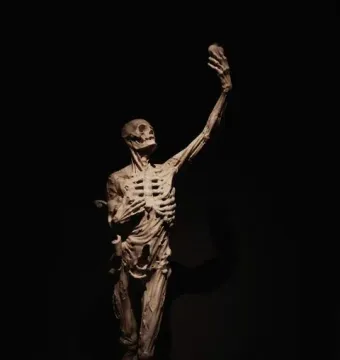
October 2010 © H. Zell · CC BY-SA 3.0
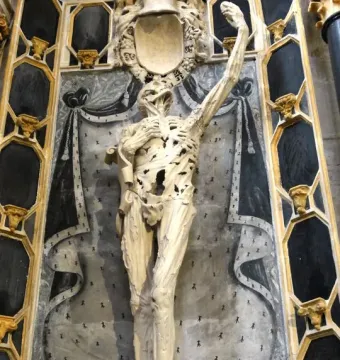
August 2016 © Havang(nl) · CC0
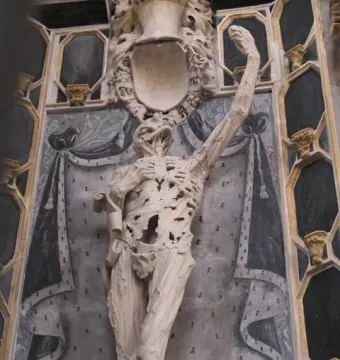
September 2015 © GFreihalter · CC BY-SA 3.0
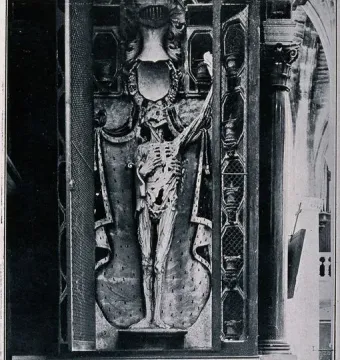
· CC BY 4.0
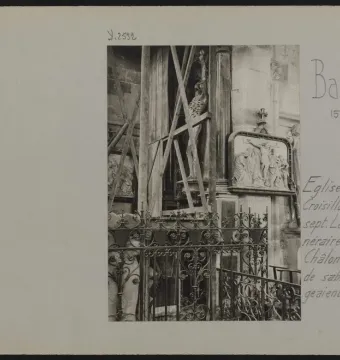
October 1917 © Ernest Baguet · Public domain
Identification | |
| Title | Cadaver Tomb of René of Chalon |
| French title | Le Transi de René de Chalon |
| Alternative names | Monument to the Heart of René de Chalon; Le Squelette; Le Décharné; Monument au cœur de René de Chalon; The Skeleton |
| Type | Funerary monument; transi; cadaver tomb |
| Style | Late Gothic; Renaissance funerary monument |
Historical context | |
| Historical period | 16th century; early modern period, with roots in late medieval funerary sculpture |
| Historical context | Created amid social anxiety about death in Europe, during epidemics, war, and religious conflicts |
| Artistic tradition | European funerary art; transi tradition |
Creator | |
| Sculptor | Ligier Richier |
| Attribution status | Attributed to Ligier Richier; regarded as his best-known and most prestigious work |
| Commissioned by | Anne of Lorraine, widow of René of Chalon |
| Commissioned for | The tomb and burial site of René of Chalon, Prince of Orange |
Discovery and provenance | |
| Replicas | Musée Barrois, Bar-le-Duc; Palais de Chaillot, Paris; Musée des monuments français, Paris; a tomb in Moux; tomb of Henri Bataille in the commune of Mu |
| Heritage status | Listed as a historic monument of France on 18 June 1898 |
| War relocation | Moved to the Panthéon in Paris for safekeeping during World War I and returned to Bar-le-Duc in 1920 |
| Current location | Saint-Étienne Church, Bar-le-Duc, France |
| Original location | Collégiale Saint-Maxe in the castle of the Dukes of Bar, Bar-le-Duc, France |
| Death context | Died from a wound sustained during the siege of Saint-Dizier |
| Death date | 15 July 1544 |
| Age at death | 25 years old |
| Subject | René de Chalon, Prince of Orange |
Physical characteristics | |
| Form | Standing upright like a living person rather than a recumbent effigy |
| Depicted figure | A life-sized corpse of René de Chalon shown as a decomposing living corpse |
| Condition depicted | Putrefied, emaciated, rotting, with skin and muscles decayed and nearly reduced to a skeleton |
| Pose | Right hand on the chest; left arm raised or extended upward |
| Composition | The statue consists of three limestone blocks forming the head and torso, left arm, and legs and pelvis |
| Support | Supported by an iron stud at the pelvis |
| Base and setting | Set on a stylobate supported by two black marble columns with Corinthian capitals, above the church altarpiece |
| Associated elements | An altarpiece and a black marble ossuary |
Materials | |
| Primary material | Limestone; Sorcy limestone |
| Associated materials | Black marble; plaster |
| Original heart object | A gilded silver or vermeil heart-shaped reliquary, possibly able to contain René de Chalon’s embalmed heart |
Technique | |
| Construction | Carved from three limestone blocks |
| Restoration techniques | Ground-penetrating radar, replacement of rusted iron dowels with stainless-steel dowels, cleaning, disinfection, removal of old restoration material, and crack filling |
Appearance | |
| Distinctive feature | A standing cadaver tomb, unusual among transi tombs of the period |
| Realism | Unflinchingly realistic |
Iconography and meaning | |
| Biblical interpretation | The raised hand has been read as a reference to Job 19:26 |
| Other scholarly interpretation | Some art historians see it as transforming medieval transi forms into an affirmation of faith and resistance to death |
| Interpretation by Kathleen Cohen | The statue represents a transition to a living corpse and offers its own heart to God in devotion |
| Heart symbolism | The left hand originally held a heart-shaped object, possibly René de Chalon’s embalmed heart |
| Theological interpretation | The pose has been linked to the three Christian virtues: belief, hope, and love |
| Interpretive debate | Historians debate the specific meaning of the transi and especially its pose |
| Symbolism | A memento mori that also emphasizes faith in resurrection and eternal life |
| Purpose | To show the transition from life to dust and the transience of earthly glory, and to encourage prayers for the dead |
Location and ownership | |
| Placement | Placed above the church altarpiece on a stylobate with black marble columns |
| Current church | Saint-Étienne Church, Bar-le-Duc |
History and restoration | |
| Restoration campaigns | Extensively restored in 1968 and again from 1998 to 2003 |
| Historic monument protection | The statue was classified as an object under the French Monuments historiques system; the retable and altar were later also classified |
| Protection during World War II | Stored safely at the start of the conflict |
| Restored components | The statue, retable, altar, mortuary mantle, and associated building elements were restored; the sculpture was also displayed in the Musée Barrois during restoration |
| Move in 1790 | Moved from the demolished collegiate church to Collégiale Saint-Pierre, later Saint-Étienne Church |
| Protection measures | A grill, grille, and later a glass panel were used as security measures |
| Restoration in 1810 | The monument was restored; the hand was remade, a sundial then a plaster heart was placed in it, and it was set on a new base with protective grilles |
| Damage during transfer | The statue was damaged in several places and roughly repaired |
| Revolutionary damage | During the French Revolution the heart reliquary was stolen and the left hand was broken |
| Later additions | Coat of arms added in the 16th century; funerary drapery added in the 18th century |
Significance | |
| Artistic significance | A major work of the Renaissance and of Ligier Richier; a notable and highly influential transi |
| Influence | Its standing format became influential in funerary art and inspired other works |
| Uniqueness | Unique among transi tombs of its period because most others depicted the dead lying down |
| Scholarly context | About two hundred transi sculptures are known, and this work is often discussed as part of a shift from idealized recumbent effigies to more realistic depictions of death and decomposition |
Other | |
| Related forms | Contrasted with the earlier jacent or gisant recumbent effigy and with two-storey noble tombs |
| Historical development | Transi tombs emerged in the late Middle Ages, became more common into the Renaissance, and were especially popular in France, England, the Holy Roman Empire, and the Low Countries |
| Etymology | Transi comes from the French verb transir, from Latin trans and ire |
| Current object in hand | A plaster heart-shaped object |