
Brunelleschi Crucifix
The Brunelleschi Crucifix is a polychrome painted wooden sculpture by Filippo Brunelleschi, made from pearwood around 1410–1415. It depicts the crucifixion of Jesus in an idealised, carefully measured form, with proportions inspired by classical naturalism. The sculpture is the only surviving wooden work by Brunelleschi. According to Giorgio Vasari, it was created in response to Donatello’s earlier crucifix, though it remained in Brunelleschi’s workshop until 1445 before being donated to the Dominican friars of Santa Maria Novella in Florence. Since 1572 it has been displayed in the Gondi Chapel. The work has been restored several times and was shown in 2012 alongside crucifixes by Donatello and Michelangelo.
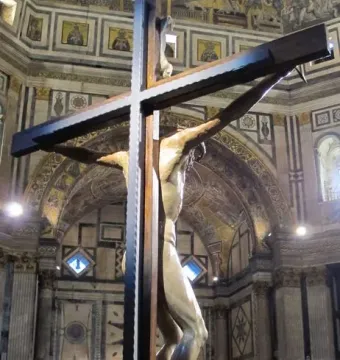
November 2012 © sailko · CC BY-SA 3.0
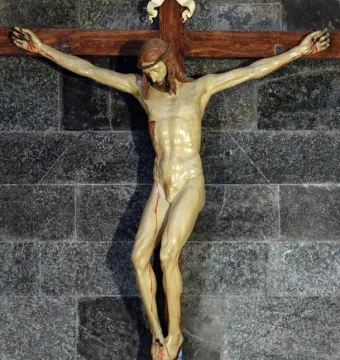
February 2014 © sailko · CC BY 3.0
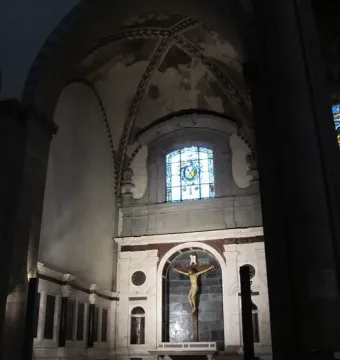
March 2013 © sailko · CC BY-SA 3.0
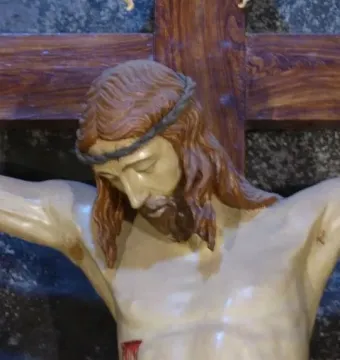
August 2019 © Benjamín Núñez González · CC BY-SA 4.0
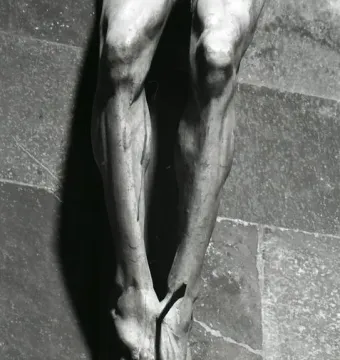
© Paolo Monti · CC BY-SA 4.0
Identification | |
| Title | Crucifix in Santa Maria Novella |
| Alternative titles | Brunelleschi Crucifix; Crucifix of Brunelleschi; Crucifix of the Gondi Chapel |
| Type | Crucifix |
| Subject | Crucified Christ |
Creator | |
| Artist | Filippo Brunelleschi |
Historical context | |
| Date | c. 1410–1415 |
| Commission status | Not made for a specific commission |
| Inspiration and comparison | According to Vasari, Brunelleschi made it in response to Donatello's polychrome wooden crucifix for Santa Croce, which he criticized as 'a peasant on the cross'; he also reworked Giotto's crucifix at Santa Maria Novella as a model |
Discovery and provenance | |
| Initial storage | Kept in Brunelleschi's house or workshop until about one year before his death |
| Donation | Donated by Brunelleschi to the Dominican friars of Santa Maria Novella in 1445 |
| Original installation | Placed on a pilaster between the Filippo Strozzi Chapel and the Bardi Chapel |
| Relocation | Moved to the Gondi Chapel in 1572 |
| Mounting evidence | The nails used to fix it in its earlier position are still visible |
Physical characteristics | |
| Anatomical treatment | Carefully studied and measured anatomy, modeled from a nude study |
| Proportions | The arms span equals the figure's height, and the nose points toward the navel's center of gravity |
| Pose | The figure has a slight twist to the left |
| Height | 170 cm |
| Dimensions | 170 × 170 cm |
Materials | |
| Material | Polychrome pearwood with a separate stiffened linen loincloth |
| Genitals | Not sculpted |
Technique | |
| Construction | Polychrome painted wooden sculpture with a separately attached loincloth |
Appearance | |
| Stylistic character | More idealized, lighter, better proportioned, calmer, and more grave than Donatello's crucifix |
| Visual effect | The twist creates privileged viewpoints and a sense of space, encouraging the viewer to move around the figure in a semicircle |
Iconography and meaning | |
| Artistic aim | Essential, inspired by antiquity, emphasizing sublime dignity and harmony |
| Meaning | The mathematical perfection of the forms is presented as reflecting the divine perfection of Christ |
Significance | |
| Uniqueness | The only surviving wooden work by Brunelleschi |
| Art-historical assessment | Luciano Bellosi described it as probably the first Renaissance work in art history |
| Influence | A point of reference for later works by Donatello, Nanni di Banco, and Masaccio |
Location and ownership | |
| Current location | Gondi Chapel, Basilica of Santa Maria Novella, Florence, Italy |
History and restoration | |
| Restoration | Restored several times |
Other | |
| Anecdote | According to Vasari, Donatello was so astonished when he saw it that he dropped the eggs he was carrying |
| Anecdote reliability | The Vasari account is of uncertain reliability |