
River God
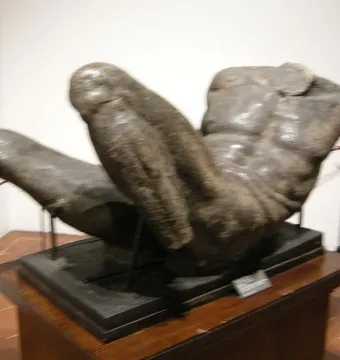
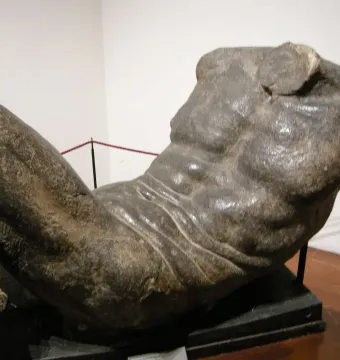
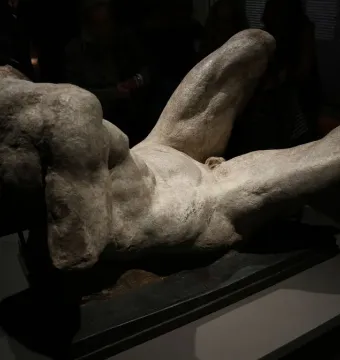
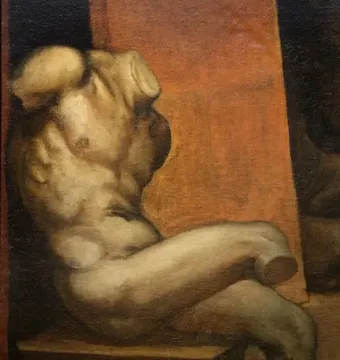
River God is a sculpture model by Michelangelo Buonarroti, dated around 1524. Made of wood, clay, wool, and tow and measuring 180 cm in length, it is the only known life-size model by the artist. It was intended to represent one of the river deities never carved for the space at the foot of the Medici sarcophagi in the New Sacristy of San Lorenzo. The figure is shown half-reclining in an ancient style and is headless and armless, with both legs mutilated. The work was conserved until 2017 in Casa Buonarroti in Florence and then returned to the Academy of Drawing Arts, its owner.
June 2009 © sailko · CC BY-SA 3.0
June 2009 © sailko · CC BY-SA 3.0
© Sailko · CC BY 3.0
December 2019 © Sailko · CC BY 3.0
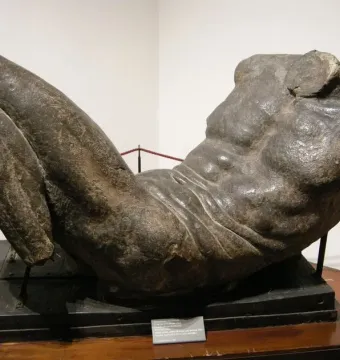
June 2009 © sailko · CC BY-SA 3.0
Identification | |
| Title | River God torso |
| Type | Sculptural model (bozzetto); torso |
| Original titles | El Dios fluvial; Il Dio fluviale; Le Dieu fluvial |
Historical context | |
| Date | c. 1524 |
Creator | |
| Artist | Michelangelo Buonarroti |
| Attribution | Attributed to Michelangelo; attribution was once disputed, but later confirmed by documentation and by iconographic references in sixteenth-century paintings and drawings |
Physical characteristics | |
| Length | 180 cm (sources also give about 140 cm) |
| Condition | Headless and armless; the legs are mutilated, with the left leg missing the foot and the right leg missing everything from the knee down |
| Pose | Half-reclining / half-lying down; the legs are partially spread apart |
| Scale | Life-size |
Materials | |
| Materials | Wood, clay, wool, and tow (estopa/étoupe); one source also mentions sand and wire, and refers to it as a clay model |
Iconography and meaning | |
| Subject | A river god |
| Intended subject | One of the unsculpted river deities intended for the Medici tombs |
| Intended meaning | A symbolic figure representing dominion over land and waters |
| Stylistic reference | Ancient Roman iconographic tradition; the separated legs recall classical examples such as the Barberini Faun |
Location and ownership | |
| Former location | Casa Buonarroti, Florence |
| Intended location | The New Sacristy (Sagrestia Nuova) of the Basilica of San Lorenzo |
| Current owner | Accademia delle Arti del Disegno |
| Intended placement | At the foot of the tomb of Lorenzo II de' Medici, Duke of Urbino |
History and restoration | |
| Creation context | Made for the New Sacristy at the request of Pope Clement VII, to speed up the project at the design stage |
| Project status | The intended statue was never realized; the model remained at the design stage |
| Early mention | Seen in the New Sacristy by Anton Francesco Doni around the mid-16th century and described in I Marmi |
| Provenance | Later entered the collections of Cosimo I, who gave it to Bartolomeo Ammannati; on 20 April 1583 Ammannati donated it to the Accademia delle Arti del Disegno |
| Restoration history | Restored in 1590; later cleaned and restored for the Palazzo Strozzi exhibition on sixteenth-century Florence / the Florentine Cinquecento |
| Exhibition history | Rediscovered in 1906 through the studies of Adolf Gottschewski and Adolf von Hildebrand, then deposited at the Galleria dell'Accademia in Florence and displayed there near Michelangelo's works until 1965 |
| Later transfer | In 1964/1965 the Accademia delle Arti del Disegno agreed, at Charles de Tolnay's request, to deposit the work in the Museo di Casa Buonarroti; it was kept there until 2017, then returned to its owner |
| Later planned relocation | After the restoration, it was planned to move the work to the rooms of the Accademia delle Arti del Disegno at Palazzo dell'Arte dei Beccai |
Significance | |
| Uniqueness | The only known life-size model by Michelangelo |
Other | |
| Related drawing | A drawing for its twin statue is in the British Museum, London |
| Twin model | It had a twin companion model; the fate of the other is unknown and it may have deteriorated because of the perishable material |
| Reconstruction note | Studies of the sources indicate at least three variants; the right calf was probably originally extended |