
Battle of the Centaurs
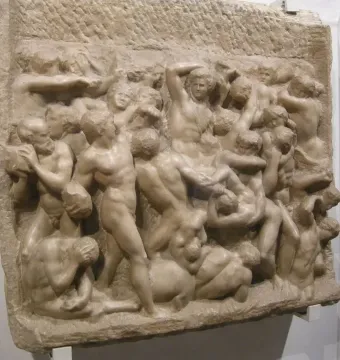
Battle of the Centaurs is a marble relief sculpture by Michelangelo, created around 1492 while he was under the patronage of Lorenzo de’ Medici. Inspired by a classical relief by Bertoldo di Giovanni and suggested by Poliziano, it depicts the mythic battle between the Lapiths and the Centaurs. The work is notable for Michelangelo’s multidimensional approach, departing from then-current practice, and for being the first sculpture he made without a bow drill. It also shows the marks of the subbia chisel left as a final surface, linking it to the tradition of non finito. The sculpture is exhibited in Casa Buonarroti in Florence, Italy.
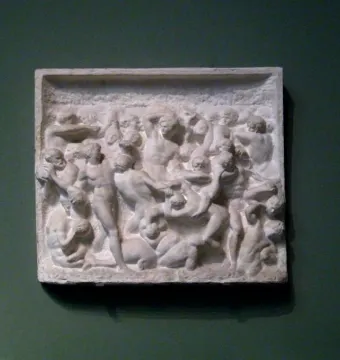
2011 © shakko · CC BY-SA 3.0
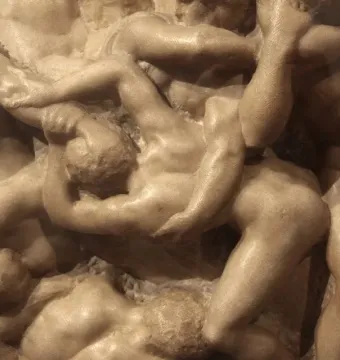
© Sailko · CC BY 3.0
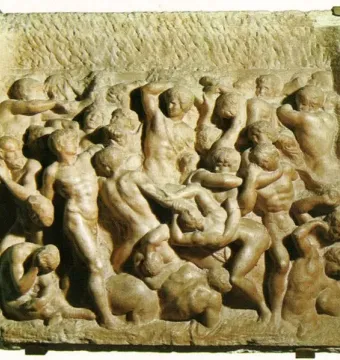
· Public domain
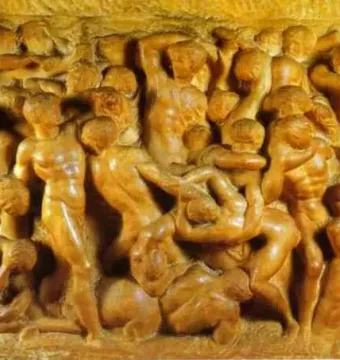
January 2008 © carulmare · CC BY 2.0
June 2009 © sailko · CC BY-SA 3.0
© Giovanni Dore · CC BY 3.0
© Sailko · CC BY 3.0
© Michelangelo · Public domain
© Sailko · CC BY 3.0
June 2009 © sailko · CC BY-SA 3.0
Identification | |
| Title | Battle of the Centaurs |
| Type | relief sculpture; marble relief; unfinished relief; bas-relief; bar relief; relief; battle scene in relief; early work |
| Alternative titles | Hercules' Fight with the Centaurs; The Rape of Deianira; Battle of Hercules and the Centaurs; The abduction of Deianira and the battle of the centaurs; Kentauromachie; Centauromachia; "Бой Геркулеса с кентаврами"; "Битва кентавров" |
| Original titles | La batalla de los centauros; Battaglia dei centauri; Die Kentaurenschlacht; La Bataille des Centaures |
Creator | |
| Nationality | Italian |
| Art movement / period | Renaissance |
| Artist | Michelangelo; Michelangelo Buonarroti |
Historical context | |
| Patronage context | the last work Michelangelo created while under Lorenzo de' Medici's patronage; Michelangelo was working under the patronage of Lorenzo de' Medici when he sculpted it |
| Commission status | not commissioned; created for himself |
| Biographical note on dating | Ascanio Condivi stated that it was executed shortly before Lorenzo's death, at the beginning of 1492 |
| Patron | Lorenzo de' Medici; Lorenzo the Magnificent; Lorenzo il Magnifico |
| Status at the time of Lorenzo de' Medici's death | unfinished |
| Age of artist at creation | 16 |
| Date created | around 1492; circa 1493; c. 1492 |
| Suggested subject source | Angelo Poliziano; Agnolo Poliziano |
Materials | |
| Material | marble; Carrara marble |
| Chosen medium | marble, chosen to keep down costs rather than using the more expensive medium of bronze |
Technique | |
| Technique | relief |
| Work process | Michelangelo departed from the then current practice of working on a discrete plane and instead worked multidimensionally |
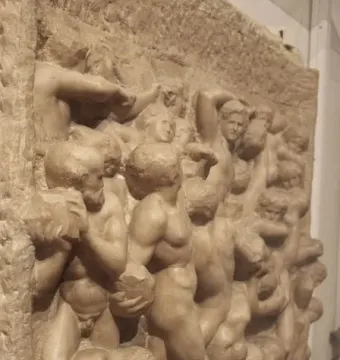
| Surface finish | subbia chisel marks left visible as a final surface |
| Tools used | the first sculpture Michelangelo created without using a bow drill |
| Completion status | possibly intentionally left unfinished; unknown whether intentional; never finished; left incomplete; unfinished |
| Non-finito significance | significant in the tradition of non finito sculpting technique; considered the first known work that can be regarded as non-finito; the first of a long series of unfinished works; preceded the Taddei Tondo and Pitti Tondo as an early example of non finito |
Appearance | |
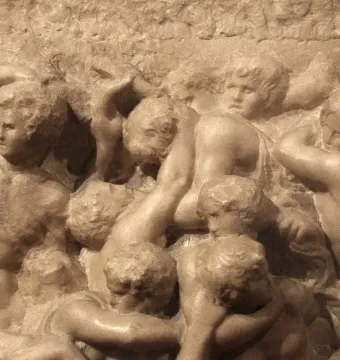
| Lower section | the losers are visible below, including a seated man protecting his head, a fallen centaur, a man collapsing, and two wrestlers in almost identical positions |
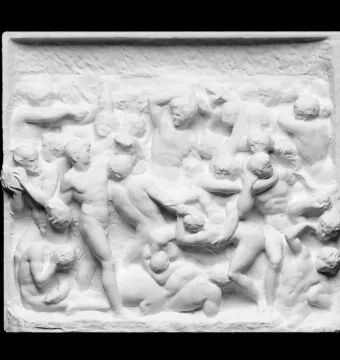
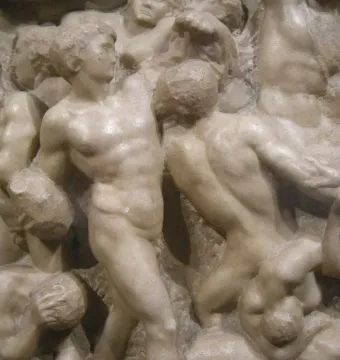
| Visual effect | the relief seems as if it were composed entirely of male nudes |
| Border | an irregular framing band |
| Spatial treatment | the figures blend into one another, sometimes emerging strongly from the background and sometimes only slightly in relief |
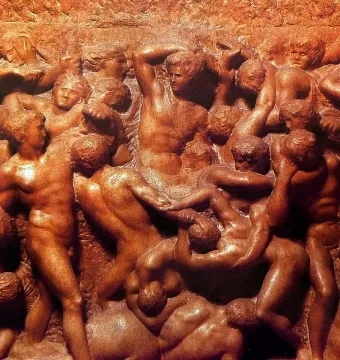
| Action depicted | one figure seen from behind drags a second by the hair; the second is held around the waist by a third man; among them, a woman strangles a man who is trying to free himself; an elderly man is about to hurl a large squared stone; one warrior is attacking another with a stone |
| Central figure | a young man at the center with his arm raised, in a pose that in Roman sarcophagi was reserved for generals on horseback |
| Figure treatment | Hippodamia is shown from behind; only the upper bodies of about half of the figures, the centaurs, are visible; the figures show varied poses and facial expressions; the figures blend into one another, sometimes emerging strongly from the background and sometimes only slightly in relief |
| Figures | numerous naked young male figures, mostly soldiers; one elderly soldier/warrior on the left holding a stone; two female figures; a fallen centaur; a seated man protecting his head; a man collapsing; two wrestlers one on top of the other; possible figures include Theseus and Eurytus |
| Composition | a tangle of bodies arranged so that the most protruding figures form a kind of visual pyramid whose apex is the young man's head |
| Description | a marble relief slab framed by an irregular border, showing a mass of figures engaged in a confused battle |
Iconography and meaning | |
| Subject | the mythic battle between the Lapiths and the Centaurs; the battle between the Greeks and the centaurs; a battle scene during the wedding of the Lapith king Peirithous and Hippodamia; the rape of Hippodamia by the centaur Eurytus during her wedding with Pirithous; the battle of Hercules with the centaurs; the battle of the centaurs with the Lapiths; the abduction of Deianira and the battle of the centaurs; The Rape of Deianira and the fight of the centaurs |
| Scene type | centauromachy |
| Mythological source | Ovid's Metamorphoses; Ovid's Metamorphoses (Book XII); the fables of Hyginus; Theseus in Dante Alighieri |
| Possible figures identified | Hippodamia; Pirithous; Theseus; Eurytus |
| Interpretations | a wedding battle; an orgy; the victory of civilization over barbarians; the victory of stone over flesh; a visual reminder of why Michelangelo should have focused his efforts on sculpture; Michelangelo embodied the commandments/precepts of the Greeks and Romans; Michelangelo focused on the form of the sculpture rather than its content; the human nude as a central theme; the relief was a scene of combat between figures including centaurs |
| Symbolic details | the name of the Lapiths sounds similar to words meaning stone and tombstone; the warriors are armed with stones rather than swords or spears; the predominance of nude young male figures fit the Neoplatonic academic concept of love |
| Possible theme | the victory of civilization (the Lapiths) over barbarians (the centaurs), though in a much softer form than in Michelangelo's interpretation |
Discovery and provenance | |
| Context of inspiration | a current fashion for reproducing ancient themes |
| Influences | Roman sarcophagi; the panels of Giovanni Pisano's pulpits; the contemporary bronze relief by Bertoldo di Giovanni |
| Location of related inspiration | in the Medici palace at the time; it hung in the Medici palace |
| Source of Bertoldo's model | a sarcophagus in the Camposanto of Pisa |
| Nature of Bertoldo's model | a recreation of a damaged Roman battle sarcophagus, requiring liberal imagination to fill in the gaps left by the damaged original |
| Related source work by Bertoldo di Giovanni | The Equestrian Battle in the Ancient Manner, also known as Battle (with Hercules) |
| Source of inspiration | a classical relief created by Bertoldo di Giovanni; a relief made for Lorenzo by Bertoldo di Giovanni; a bronze by Bertoldo di Giovanni imitating a Roman sarcophagus battle relief; Bertoldo di Giovanni's bronze relief depicting a battle of cavalry; Antonio del Pollaiuolo's engraving Battle of the Nudes |
Location and ownership | |
| Current location | Casa Buonarroti, Florence; Museum of Casa Buonarroti, Florence |
| Current city | Florence |
| Current country | Italy |
| Ownership / retention | Michelangelo kept it for the rest of his life |
History and restoration | |
| Historical note | the relief has long been remembered in the Buonarroti Palace |
| First known mention | a letter written in 1527 by Giovanni Borromeo, representative of the Gonzaga house in Florence, to Frederick, Marquis of Mantua |
| Condition | unfinished; never finished; left incomplete; possibly intentionally left unfinished |
Significance | |
| Artistic significance | a remarkable sculpture in several ways; Michelangelo found himself as a sculptor in this work; Michelangelo regarded it as the best of his early works; this theme later became one of the most characteristic of his art, as in the Last Judgment; it presaged Michelangelo's future sculptural direction |
| Historical significance | one of Michelangelo's first known independent works; one of Michelangelo's earliest known independent works; an important early work by Michelangelo |
| Art-historical importance | important in Michelangelo's early career; important in the tradition of non finito sculpting technique; the first of several non finito sculptures; the first known work that can be regarded as non-finito; the second known bas-relief sculpted by Michelangelo |
| Critical reception | Vasari described it as beautifully made, so wonderfully made, and perfect in the science and practice of art, to the point that a viewer could not believe it was the work of a youth rather than a respected master; Eric Scigliano argued that the young sculptor embodied the precepts/commandments of the Greeks and Romans; art historians have noted that, because of the schematic treatment, the depicted scene cannot be determined unambiguously and some figures cannot be identified |
| Artistic evaluation | Michelangelo found himself as a sculptor in this work; the artist was especially interested in exploring the theme of the human nude in different poses and states of muscular tension; the models, especially the ancient ones, are described as surpassed by the young artist; the work shows extraordinary ability to exploit the potential of marble to create different spatial planes, with dynamic movement, anatomy, fluid gestures, and strong compositional effectiveness; the work shows bodies in different poses admired for the beauty of classical proportions and extraordinary energy |