
Raimondi Stela
Raimondi Stela is a paralelepiped stone monolith from the Chavín culture of pre-Inca Peru. Carved on one face in relief, it shows a front-facing anthropomorphic, feline-like deity holding staffs or scepters in both hands, with clawed hands and feet. Made of granite, it measures 1.98 meters high, 74 centimeters wide, and 17 centimeters thick. It was discovered around 1840 at Chavín de Huántar by Timoteo Espinoza and later named after the Italian naturalist and geographer Antonio Raimondi, who promoted its transfer to Lima in 1874 for study and preservation. It is now kept in the courtyard of the National Museum of Archaeology, Anthropology and History of Peru in Lima.
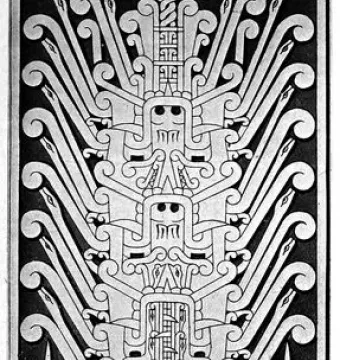
1912 © Sir Clements Robert Markham · Public domain
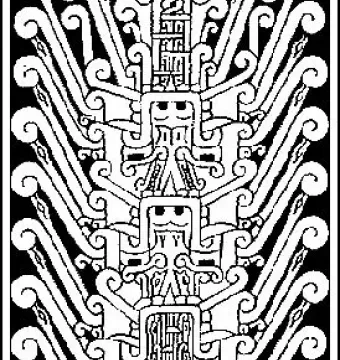
1875 © Original drawing by Antonio Raimondi (1824-1890) · Public domain
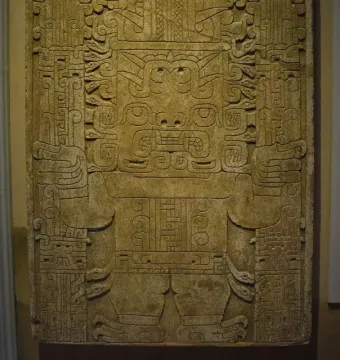
June 2024 © Markus Köllner · CC BY-SA 4.0
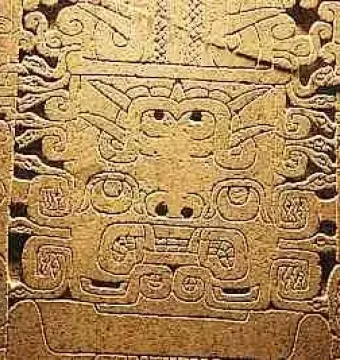
© Ghirlandajo · Public domain
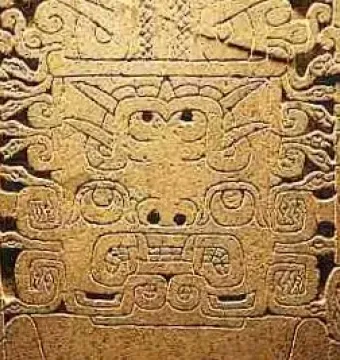
· Public domain
Identification | |
| Title | Raimondi Stela |
| Type | Stele; monolith; stone sculpture |
| Alternative names | Stele of Raimondi; Piedra de Chavín (initial name); Estela Raimondi; Raimondi-Stele; Stela Raimondiego |
Historical context | |
| Culture | Chavín culture |
| Period | Late Chavín, Black-White Phase, Early Horizon period of Andean cultures, approximately 900–550 BC |
| Region | Chavín de Huántar, Huari province, central Andes, present-day Peru |
Creator | |
| Name origin | Named after Antonio Raimondi |
Discovery and provenance | |
| First modern record | José Toribio Polo wrote about it in 1871 |
| Transfer to Lima | Moved to Lima in 1873/1874 on government order and Raimondi's recommendation; transport carried out by Sargento mayor Manuel Marticorena |
| Raimondi's recommendation | He recommended moving it to Lima for conservation and study |
| Raimondi's observation | Antonio Raimondi saw it in a private house in Chavín de Huántar around 1860 and made a paper copy |
| Original findspot | Not found in situ |
| Early post-discovery use | Taken to Timoteo Espinoza's house and used as a table, with the carved side facing down |
| Discovery location | A field near the temple/castle in Chavín de Huántar |
| Discoverer | Timoteo Espinoza, a local farmer/resident of Chavín |
| Discovery date | Around 1840 |
History and restoration | |
| Public display in Lima | First displayed at the Palace of the Exhibition (old Exhibition Park) |
| Preservation in 1881 | Saved from looting during the Chilean occupation of Lima because it had fallen to the ground showing only its plain reverse side, which looters mistook for a simple stone slab |
| Damage in 1940 | An earthquake caused it to fall to the ground and break/crack at one end |
| Repatriation discussion | In September 2021, the Peruvian Ministry of Culture said it would study returning the stela to Chavín de Huántar |
Physical characteristics | |
| Shape | Parallelepiped-shaped cuboid stone slab |
| Dimensions | About 1.95–1.98 m high, 73–76 cm wide, 15–17 cm thick |
Materials | |
| Material | Granite, polished/finely worked |
Technique | |
| Carving technique | Low-relief line carving with contour contrast; lightly incised, thin sloping lines |
Appearance | |
| Carved face | One face is decorated in bas-relief; the reverse side is smooth and undecorated |
| Viewing effect | The design can be read in different ways depending on viewing angle and when turned upside down; raking light makes the lines more visible |
Iconography and meaning | |
| Interpretation | Often considered an early representation of a Peruvian deity and one of the most refined examples of contour-contrast technique in Chavín art |
| Stylistic features | Bilateral symmetry, contour rivalry, dualism, and transformation |
| Inverted reading | When inverted, the image transforms into a smiling reptile face, stacked smiling fanged faces, and rows of faces in place of the staffs |
| Additional motifs | The belt is depicted as a face with snake ears; snakes protrude from the waist; the composition includes many eyes, mouths, and serpents |
| Headdress | Large elaborate headdress of snakes, volutes, caiman, or stacked predatory animals, depending on interpretation |
| Hands and feet | End in claws; bird or feline claws are described in different accounts |
| Attributes | Holds a staff or scepter in each hand, sometimes interpreted as resembling San Pedro cactus stalks |
| Main pose | Shown frontally with open arms |
| Depicted subject | The Staff God, shown as an anthropomorphic feline-like or hybrid deity |
Location and ownership | |
| Current location | Courtyard of the Museo Nacional de Arqueología, Antropología e Historia del Perú, Lima, Peru |
| Current district | Pueblo Libre |
| Inventory number | 3600 in the Museum of History inventory |
Significance | |
| Historical significance | The first Chavín-style object to become known |
| Comparative significance | Its iconography has been compared with the Gate of the Sun and the god Wiracocha; similar monoliths such as the Tello Obelisk helped prompt further study of Chavín monuments |
| Broader meaning | The imagery reflects Chavín concerns with duality, reciprocity, transformation, and hallucinogenic ritual knowledge |