
Madonna of the Stair
Madonna of the Stair is a marble relief sculpture by Michelangelo, dated around 1491. It is one of his earliest works and is associated with the same period as The Battle of the Centaurs. The unfinished relief measures 55.5 x 40 cm and is now kept in Casa Buonarroti in Florence. Its treatment recalls Donatello’s virtuoso stiacciato style, especially the Madonna Pazzi. The Virgin is shown seated on a stone block, with the Child sitting on her lap. A staircase appears on the left, possibly alluding to a 1477 book, the five letters of Mary’s name, or the stone of Saint Peter. The work was given to Duke Cosimo in 1566 and returned to the Buonarroti family in 1991.
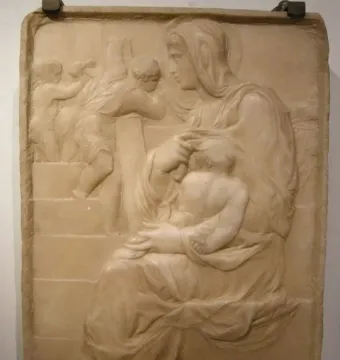
June 2009 © sailko · CC BY-SA 3.0
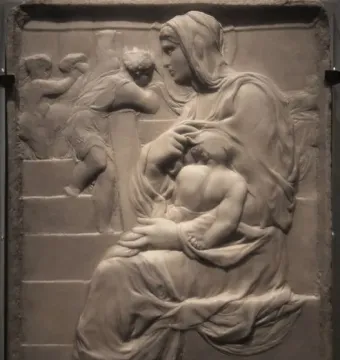
May 2022 © Francesco Bini · CC BY-SA 4.0
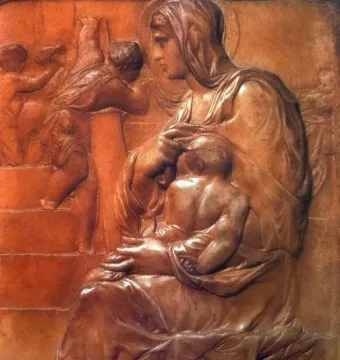
© Giovanni Dore · CC BY 3.0
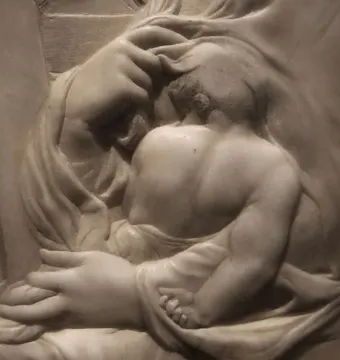
May 2022 © Francesco Bini · CC BY-SA 4.0
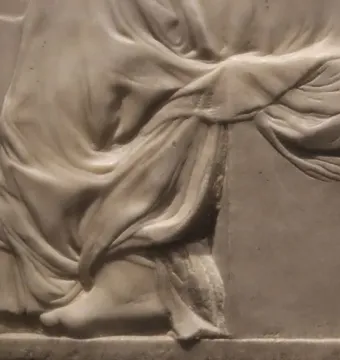
May 2022 © Francesco Bini · CC BY-SA 4.0
Identification | |
| Title | Madonna of the Stair |
| Original titles | La Virgen de la escalera; Madonna della scala; La Vierge à l'escalier; Madonna przy schodach; "Madonna by the Stairs"; "Madonna on the Stairs"; "Madonna at the Stair"; "Madonna on the Stair"; Madonna da Escada; Madonna u lestnitsy |
| Subject | Madonna and Child with four children/putti |
Historical context | |
| Date | c. 1491 |
| Creation period | Made when Michelangelo was about 15–16 years old, during his stay in the Medici Gardens/Palazzo Medici in Florence after leaving Ghirlandaio's workshop |
| Chronology | One of Michelangelo's earliest works; scholars disagree on the exact order among his earliest sculptures |
| Related early works | Head of a faun; Battle of the Centaurs |
| Contemporary work | Battle of the Centaurs |
Creator | |
| Early source note | Ascanio Condivi does not mention the work |
| Historical attribution | First included among Michelangelo's works in Vasari's 1568 Lives |
| Attribution status | Traditionally attributed to Michelangelo, but authenticity has been disputed; Colin Eisler completely denied it |
| Artist | Michelangelo Buonarroti |
Discovery and provenance | |
| Early provenance | The relief remained in Michelangelo's family until his death in 1564; first known record is in the 1568 edition of Vasari's Lives, in Leonardo Buonarroti's house |
| Gift to Cosimo I de' Medici | In 1566 Leonardo Buonarroti gave the relief to Cosimo I de' Medici after making a bronze copy |
| Return to family | Returned to the Buonarroti family in 1616 |
| Museum transfer | Transferred to the Casa Buonarroti collection in 1617 |
Location and ownership | |
| Current location | Casa Buonarroti, Florence, Italy |
| Display location | Displayed at Casa Buonarroti, on the wall next to Battle of the Centaurs |
Physical characteristics | |
| Support | Square stone block |
| Relief depth | Very shallow relief, up to 5 cm deep |
| Dimensions | 55.5 × 40 cm |
| Type | Marble bas-relief sculpture |
| Condition | Unfinished |
Materials | |
| Material | Carrara marble |
Technique | |
| Technique | Stiacciato low relief |
| Creation context | Made while Michelangelo was a student in Bertoldo di Giovanni's drawing school in the Gardens of San Marco, organized by Lorenzo de' Medici |
| Patronage | Lorenzo de' Medici paid for the materials; finished works in the school became the property of the artist |
Appearance | |
| Stylistic features | Severe, monumental, and classical in feeling, with a contrast between the Madonna's body and drapery and the Christ Child's athletic form; the work combines vigorous figures with realistic drapery and varied surface treatment |
| Composition details | The arrangement creates a spiral movement and a blocked-but-dynamic composition; Mary avoids a frontal view and looks to the side |
| Figure details | The Christ Child is shown sleeping, with his back partly to the viewer and his right arm hanging behind him; Mary lifts or covers him with her garment and has a halo that projects partly beyond the unfinished marble |
| Background elements | A staircase and railing appear in the background; the steps are pronounced and there are handrails |
| Composition | The Madonna sits in profile on a square stone block, with the Christ Child on her lap and four children/putti around the stairs; the work is designed to be viewed from below |
Iconography and meaning | |
| Symbolic staircase meaning | The staircase may allude to the Virgin as a stairway between heaven and earth, to a 1477 Book of the Stairway of Paradise, or to the five letters of Mary's name |
| Square block meaning | The square stone seat may refer to Saint Peter, the rock on which the Church was founded |
| Child's right hand meaning | The infant's outward-turned right hand has been linked to the Farnese Hercules and later used by Michelangelo as a symbol of sleep or death |
| Putti meaning | The children/putti may be a decorative motif, a tribute to Donatello's dancing putti, or part of an internal symbolic scheme |
Interpretation | |
| Interpretive uncertainty | The meaning of the background scene is unclear; it has been interpreted as either a style exercise or a tribute to Donatello |
Significance | |
| Status | Michelangelo's earliest surviving work and one of his first independent sculptures |
| Art-historical significance | Seen as already revealing mature Michelangelo and as marking his entry into the great sculptural tradition |
| Critical reception | Described by some critics as mysterious, premature, monumental despite its small size, and showing occasional uncertainty in proportion and perspective |
| Influence | Strongly influenced by Donatello, especially his stiacciato reliefs and Madonna Pazzi; also related to Masaccio's example |