
Pericles with the Corinthian Helmet
Pericles with the Corinthian helmet is a lost life-size bronze statue of the Athenian statesman and general Pericles, created by the sculptor Cresilas. It was probably installed on the Acropolis of Athens around the time of Pericles’ death or shortly afterward. Only part of the base survives, including a dedicatory inscription and a slot indicating that the figure held a spear in its left hand. The original is known through four Roman marble busts inspired by the statue’s head. The best-known copy, in Berlin, shows Pericles as an idealized adult man with a Corinthian helmet, short curled hair, a trimmed beard, and a calm, serious expression.
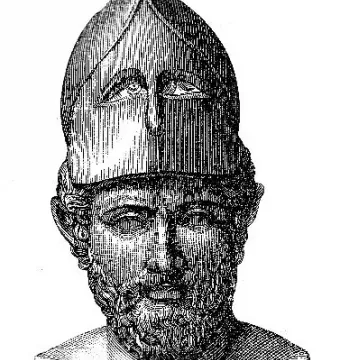
© Ernst Wallis et al · Public domain
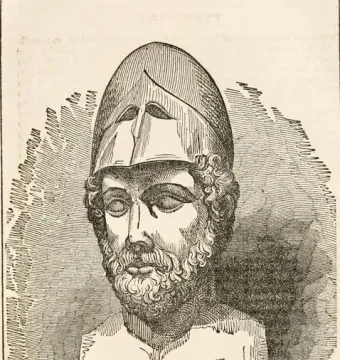
1856 © Internet Archive Book Images · No restrictions
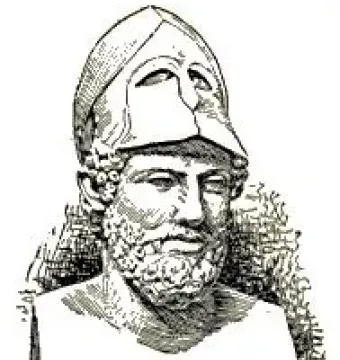
© Unidentified engraver · Public domain
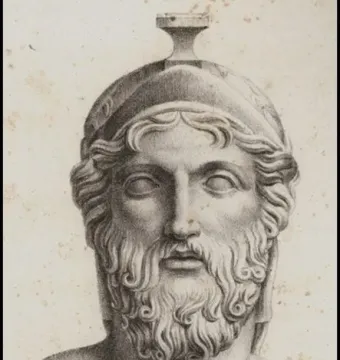
1827 © Johann Jakob Horner, Public domain, via Wikimedia Commons · Public domain
© uncertain Roman sculptor; photo by the British Museum · CC BY-SA 4.0
Identification | |
| Title | Pericles with the Corinthian Helmet |
| Scale | Life-size |
| Type | Statue |
| Depicted figure | Pericles |
| Subject | Pericles, the Athenian statesman and general |
Creator | |
| Artist | Kresilas |
Historical context | |
| Date of original statue | Probably shortly before or shortly after Pericles' death |
| Original work | A life-size bronze statue of Pericles, probably by Kresilas |
| Original location | Probably the Athenian Acropolis, directly beyond the Propylaea, according to Pausanias |
| Current status of original | Not preserved; known only through copies and indirect evidence |
Discovery and provenance | |
| Modern copy | The Pushkin Museum in Moscow has a cast made from the Pio-Clementino example |
| Notable copy | The Berlin copy was executed with particular care |
| Surviving copies | Four Roman Imperial-period marble busts |
| Surviving copies locations | British Museum; Berlin Antikensammlung; Baracco; Pio-Clementino |
| Identification basis | Two copies are inscribed with Pericles' name |
| Known through | Roman copies of the statue, including inscribed examples in the Vatican Museum and the British Museum |
Physical characteristics | |
| Hair | Short, curly hair at the temples, with additional curls visible behind the helmet eye openings in some copies |
| Clothing or armor | Disputed: naked, clothed, or fully armored |
| Helmet | Corinthian helmet, pushed back or raised upward |
| Mouth | Full lips slightly open |
| Eyes | Broad, even eyelids with eyebrows carved above |
| Beard | Closely trimmed beard with small, orderly curls |
| Facial expression | Calm, serious, and emotionally restrained |
| Appearance | An idealized portrait of Pericles rather than a realistic likeness |
| Attribute held | A spear in the left hand, indicated by a groove or hole in the base |
| Pose | A slight turn of the head and a relaxed contrapposto stance |
| Base | Base fragments with a dedicatory inscription survive |
| Preservation state | The original sculpture is lost; only part of the base survives |
| Depiction | A mature adult man |
Materials | |
| Original material | Bronze |
| Material of surviving copies | Marble |
Appearance | |
| Helmet decoration | Unadorned |
| Style | Idealized and non-realist, with a quiet civic dignity |
| Berlin copy description | The helmet is pushed back and the short curly hair sticks out at the temples |
Iconography and meaning | |
| Historical references | Pericles' head shape is discussed in Attic comedy and in Plutarch's Life of Pericles |
| Reason for helmet depiction | According to later tradition, the Corinthian helmet was used to conceal the height of Pericles' head |
| Meaning attributed to the sculpture | Interpreted as a symbol of Athenian democracy and the civic ideal of equal citizenship |
| Interpretation of hair behind helmet eye openings | May hint at Pericles' unusually shaped head, perhaps the source of the nickname 'leek-head'; more likely a learned sculptor's addition |
| Helmet symbolism | The helmet symbolized Pericles' military role as strategos and may also have concealed the height of his head |
Location and ownership | |
| Probable installation location | The Acropolis of Athens |
| Position on the Acropolis | Directly beyond the Propylaea, in the entrance area of the Acropolis, according to Pausanias |
| Inscribed copies locations | Vatican Museum and British Museum |
History and restoration | |
| State of knowledge | Very few details are known; the appearance and arrangement must be inferred from analogies and conjecture |
| Copying method | The four surviving marble busts were hand-carved from a common model and are not exact copies of one another |
| Later popularity | The bust remained popular in modern times and was copied for European aristocratic residences and museum collections |
Significance | |
| Art-historical interpretation | The portrait was seen as a model image of Athenian democracy |
| Relation to realism | It departs from the realistic tendencies of Athenian art, as seen for example in the portrait of Themistocles |
| Characterization of Pericles | The expression matches the self-controlled personality attributed to Pericles in historical tradition |
| Comparable figure | The Athenian general Themistocles was also depicted wearing the same type of helmet |