
Motya Charioteer
Motya Charioteer, also known as the Youth of Motya, is a sculpture dated to 480 BC and preserved in the Whitaker Museum on the island of Motya, Italy. It is believed to have been carved by artists of Ancient Greece, although it was found in Punic territory in Sicily. The source text also places it within the broader context of Phoenician and Carthaginian history, noting the strong influence of Hellenic artists on Punic art after the decline of Phoenician influence.
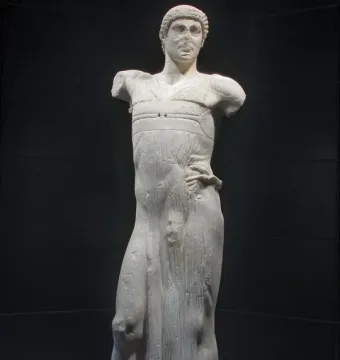
August 2022 © Ismoon · CC BY-SA 4.0
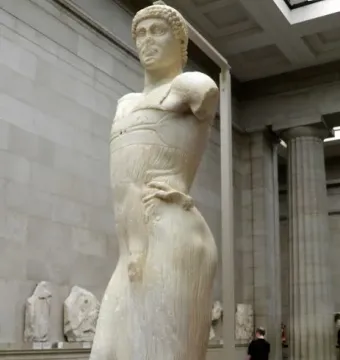
July 2012 © Carole Raddato · CC BY-SA 2.0
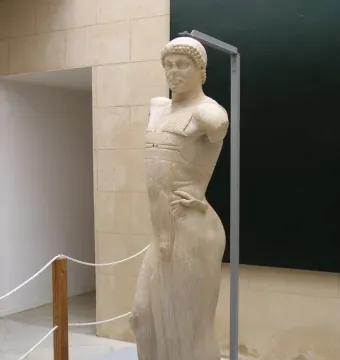
October 2006 © Hartmut Riehm · CC BY-SA 2.5
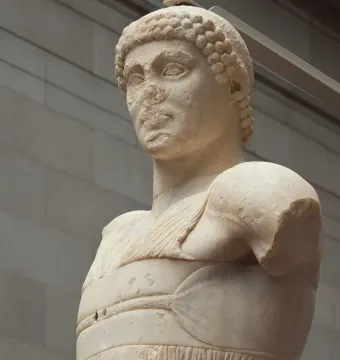
July 2012 © Egisto Sani · CC BY-SA 2.0
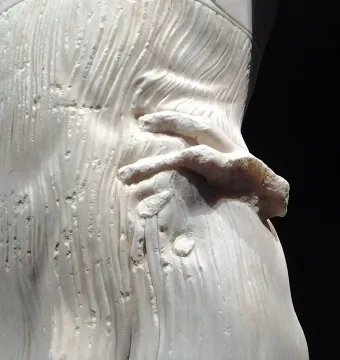
December 2014 © Silviettar86 · CC BY-SA 4.0
Identification | |
| Alternative names | Giovinetto di Mozia; Auriga di Mozia; Efebo di Mozia; Mozia Charioteer; Il Giovane di Mozia; Efebo de Motia |
| Title | Motya Charioteer |
Historical context | |
| Date | c. 470s BC; variously dated to around 470 BC or after the middle of the 5th century BC; Ancient Greek Classical Period |
| Cultural context | Punic territory / Carthaginian context; Motya was a Phoenician/Punic colony in western Sicily |
Creator | |
| Attribution | Attributed to ancient Greek sculptors; some scholars suggest a pupil of Phidias, sculptors from Paros, Pythagoras of Reggio, a Greek-Punic artist, a Punic artist, or production in southern Italy/Hellenic Sicily |
Discovery and provenance | |
| Find context | Lying on its back; head detached but resting in place |
| Provenance hypothesis | Probably not in its original context; possible original display location was a nearby sanctuary; it may have been displaced during the Syracusan siege or brought to Motya as war booty after the destruction of Selinunte in 409 BC |
| Discoverer | Italian archaeologists from the University of Palermo, including Gioacchino Falsone; first noticed by Alfonso Leto |
| Discovery context | Found buried during excavations in a fill of rubble, clay, and limestone marl, likely reused wall material from the siege of Motya |
| Discovery location | Northeastern sector of the island of Motya (San Pantaleo), Sicily, near the sanctuary of Cappiddazzu / Melqart, in the former Punic settlement |
| Discovery date | 26 October 1979 |
Physical characteristics | |
| Type | Marble statue |
| Height | 1.81 m, excluding the lower extremities |
| Condition | Fairly well preserved but damaged; head heavily damaged and reattached, face disfigured, arms and feet lost, with scratches and minor surface losses |
| Pose | Standing in a swinging contrapposto with the body weight on the left leg; right arm raised, left hand resting on the hip |
| Figure | Young male, possibly an ephebe or athletic youth |
| Facial expression | Impassive, with a proud gaze |
| Hair | Three rows of snail curls; featureless dome above the curls with holes probably for a metal skull cap or helmet |
| Anatomical depiction | Musculature, genitals, and posterior visible through sheer fabric; bulging veins shown on the upper arms |
Materials | |
| Material | Marble |
| Metal attachments | Five bronze nails in the head, probably for a helmet or victory crown; belt had two holes for a metal fitting, perhaps a clasp |
Technique | |
| Carving style | Full-round sculpture with carefully finished surfaces on all sides |
Appearance | |
| Clothing | Long chiton or tunic with numerous folds, secured by a broad flat belt; the drapery is treated in a wet-cloth style |
| Style | Greek early Classical / Severe style, with some Archaic and Archaic Ionic features |
| Scale | Life-size, slightly larger than average Greek statues |
Iconography and meaning | |
| Punic interpretation | A Punic priest or deity, with the chest belt compared to priestly regalia in Punic art |
| Associated meaning | May commemorate victory; one proposal describes it as embodying agonistic arete |
| Greek interpretation | A charioteer celebrating a victory in the Panhellenic or Olympic Games, possibly an owner-charioteer |
| Alternative interpretations | Possibly a Punic priest, Melqart/Hercules, Baal, a Punic magistrate (suffete), Hamilcar I of Carthage, Hamilcar of Gisco, Nichomachos, Alcimedon, Pythagoras, Daedalus, a young man disguised for a cult, a homosexual dancer or musician, or a pyrrhic dancer |
| Subject identification | Heavily disputed; commonly interpreted as a victorious charioteer or young man driving a chariot |
Location and ownership | |
| Current location | Museo Giuseppe Whitaker (Whitaker Museum), on the island of Motya/San Pantaleo near Marsala, Sicily |
| Ownership | Owned by the Museo Giuseppe Whitaker |
| Inventory number | 4310 |
History and restoration | |
| Condition at discovery | Found with the head detached, the face disfigured, and without arms or feet |
| Restoration | The head was later reattached by archaeologists |
| Historical context | Motya was a Punic settlement/ Phoenician colony; the statue was found in a context associated with the destruction of Motya in 397 BC and the Carthaginian siege of Dionysius I of Syracuse |
| Historical interpretation | It may have been deliberately buried or hidden during or after the siege of Motya; some scholars link associated finds to hurried defensive reuse of rubble |
Significance | |
| Heritage status | Included among the Immovable Assets of the Sicilian Region since 27 June 2013 |
| Interpretive note | The statue’s meaning and origin remain debated; some commentators emphasize its sexual ambiguity and its uncertain identification |