
The Porter
The Porter is one of Rome’s "speaking statues" and, unlike the others, dates from the late Renaissance rather than antiquity. It was made around 1580, based on a drawing by Jacopino del Conte for the Corporazione degli Aquaroli. The sculpture shows a man in a cap and long-sleeved shirt carrying a barrel; water flows from the center of the barrel, making it a fountain. The figure represents an acquarolo, a water seller who brought water from the Tiber to the streets of Rome before the papal repair of the aqueducts. Its face is badly damaged from stones thrown over the years, as people associated the soft cap with Martin Luther. Originally on the via del Corso, it was moved in 1874 to its current location on the side of the same building on via Lata.
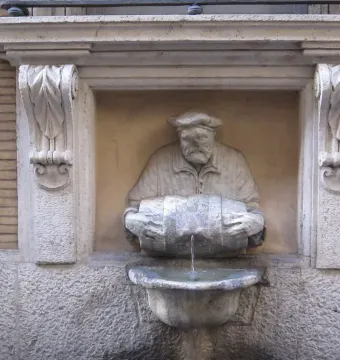
November 2016 © Carlomorino · CC BY-SA 4.0
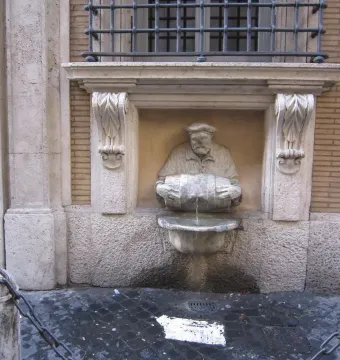
November 2016 © Carlomorino · CC BY-SA 4.0
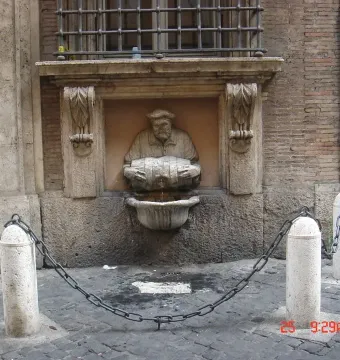
June 2006 © Lalupa · CC BY-SA 4.0
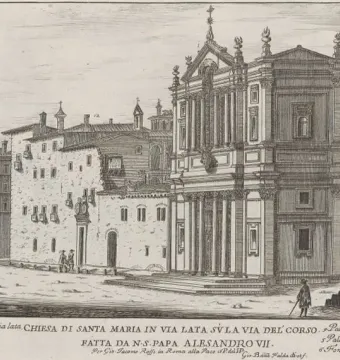
1665 © Giovanni Battista Falda · Public domain
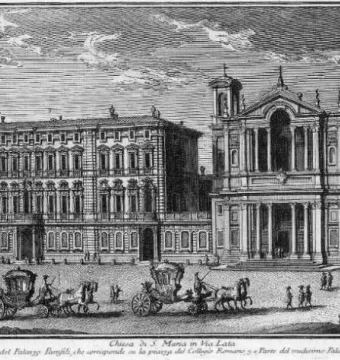
1753 © Giuseppe Vasi · Public domain
Identification | |
| Title | Il Facchino |
| Type | Fountain; one of the six Talking Statues of Rome |
| English title | The Porter |
Historical context | |
| Date of creation | circa 1580 |
Creator | |
| Designer | Jacopo del Conte |
| Commissioned by | Corporazione degli Aquaroli |
| Artist attribution | Attributed by Luigi Vanvitelli in 1751 to Michelangelo; actually sculpted by Florentine craftsmen |
Discovery and provenance | |
| Original location | Via del Corso, on the main facade of Palazzo De Carolis Simonetti, near Piazza Venezia, Rome |
| Current location | Side facade of Palazzo De Carolis Simonetti (now Banco di Roma) on Via Lata, Rome |
| Relocation date | 1874 |
| Relocation reason | Moved to avoid further vandalism and damage |
| Original function | Public drinking fountain |
Physical characteristics | |
| Water feature | Water flows from the barrel, forming a fountain |
| Condition | The face is badly damaged and almost completely worn away |
| Depicted figure | A man wearing a cap and a long-sleeved shirt, carrying or pouring water from a barrel |
Iconography and meaning | |
| Historical context of subject | Represents the period before the Roman aqueducts were repaired and public fountains resumed under papal orders |
| Name origin | The name comes from the porters' corporation (fachini) |
| Alternative identifications | Martin Luther; Abbondio Rizio |
| Subject interpretation | Probably an acquarolo, a water carrier who fetched water from the Tiber or public fountains to resell it in the streets of Rome; the identification was uncertain |
| Popular identification | Popular tradition identified it as Martin Luther because of the soft cap, barrel, and clothes |
History and restoration | |
| Cause of damage | Repeatedly struck by paving stones thrown by passersby and children over the years |
| Former inscription | A lost Latin inscription associated the figure with Abbondio Rizio and the porter trade; it disappeared during the last transfer to Via Lata |
| Lost accessories | The original shell-shaped basin and marble frame were lost during relocation |
Other | |
| Public use | It received satirical pasquinades posted beside it and served as a voice for anonymous criticism of public figures in Rome |
Significance | |
| Age status | The youngest of the Talking Statues of Rome |