
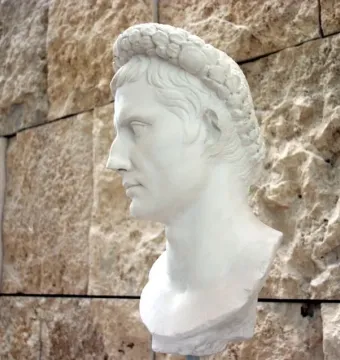
Bust of Augustus with Gemmed Crown
Musei Capitolini MC 495 is a Roman bust depicting Augustus, the first emperor of the Roman Empire. Discovered in 1889, it is now displayed in the Capitoline Museums on the Capitoline Hill in Rome, Italy, in the Hall of the Emperors. The bust is accessioned as inv. MC0495. Augustus is shown at the height of his glory, with a calm expression, head slightly tilted to the right, and closed lips. The crown has been interpreted as a civic crown, though later analysis suggests myrtle, laurel, or another triumphal wreath associated with his victory at the Battle of Actium. The sculpture is similar to the Augustus of Prima Porta and belongs to a third chronological type identified by Dietrich Boschung.
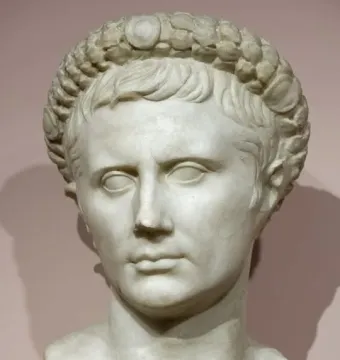
January 2019 © Marie-Lan Nguyen · Public domain
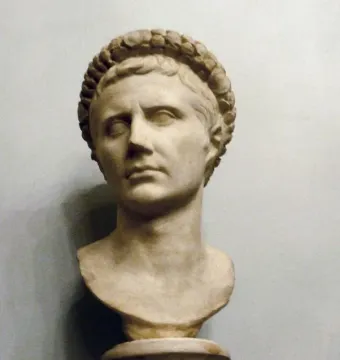
December 2010 © Rosemania · CC BY 2.0
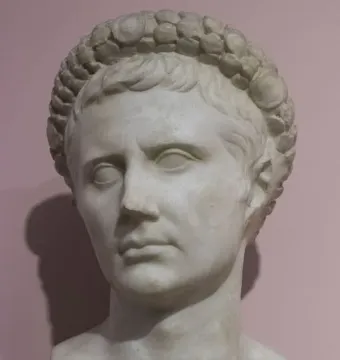
© Unknown authorUnknown author · Public domain
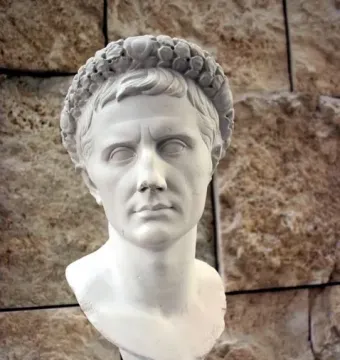
© G.dallorto · Attribution
© G.dallorto · Attribution
Identification | |
| Title | Bust of Augustus with Gemmed Crown |
| Alternative title | Portrait of Augustus; Musei Capitolini MC 495 |
| Type | Roman bust |
| Subject | Augustus, first emperor of the Roman Empire |
| Accession number | inv. MC0495 |
Discovery and provenance | |
| Discovery date | 1889 |
| Findspot | Via Merulana, near the church of Santi Marcellino e Pietro al Laterano, Rome, Italy |
| Find context | Reused as fill in a medieval wall |
| Identification by | Carlo Ludovico Visconti |
Historical context | |
| Chronological type | Third chronological type of representations of Augustus |
| Stylistic comparison | Features recall the Augustus of Prima Porta and a similar bust in the Museum of Fine Arts, Boston |
Creator | |
| Scholar of classification | Dietrich Boschung |
Physical characteristics | |
| Forehead detail | A slight wrinkle crosses the middle of the forehead |
| Head position | Slightly inclined to the right |
| Hair | Hair arranged in comma-shaped locks, brushed to one side |
| Expression | Calm expression with closed lips |
Materials | |
| Crown | Wreath tied with lemnisci and decorated with three gems; material interpretation disputed, variously identified as civic crown, triumphal crown of oak leaves, or myrtle or laurel leaves |
Iconography and meaning | |
| Interpretation of crown | Previously considered a civic crown; more recent interpretations link it to a triumphal crown commemorating Augustus' triple triumph of 29 BC or his victory at the Battle of Actium |
| Triple triumph | Celebrated victories in Illyria, at Actium, and in Egypt |
| Depiction | Augustus shown wearing the crown as a symbol of imperial victory |
Location and ownership | |
| Current collection | Musei Capitolini |
| Current location | Palazzo Nuovo, facing Piazza del Campidoglio, Rome, Italy |
| Displayed in | Sala degli Imperatori (Hall of the Emperors) |
| Display context | Gallery of imperial portraits of Roman emperors and other prominent figures, arranged chronologically |
History and restoration | |
| Hall of the Emperors established | 1733 by Pope Clement XII |
| Exhibition history | The sculpture has been exhibited on several occasions |