
La Pigna
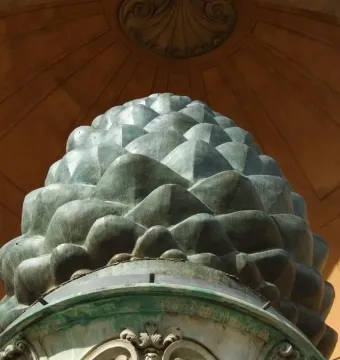
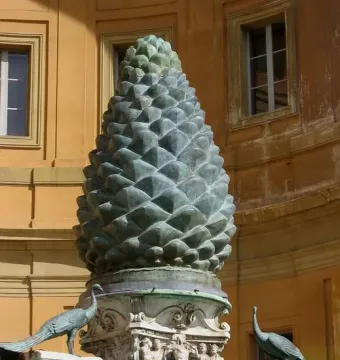
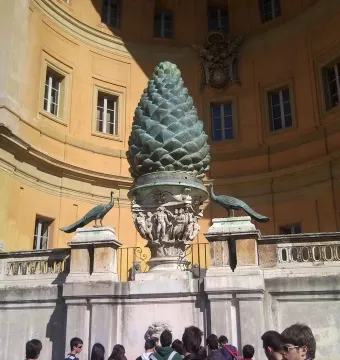
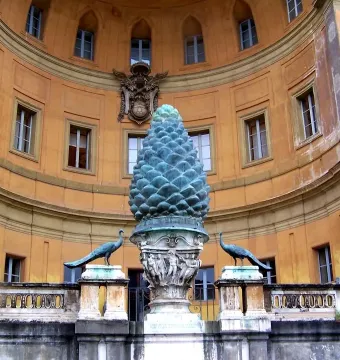
La Pigna is an ancient Roman fountain in the shape of a pine cone, now located in the Vatican Museums. It was made between the 1st and 3rd centuries CE, probably by Publius Cincius Slavius, whose signature appears at the base. The sculpture originally stood in Rome, was later found in medieval times, and eventually placed in the atrium of Old St. Peter’s Basilica. In 1608, it was installed in its current position in the northern part of the Courtyard of the Pine Cone, inside Il Nicchione. Although it no longer functions as a fountain, it remains one of the oldest surviving Roman fountains.
October 2008 © gnuckx · CC0
March 2009 © Manfred Heyde · CC BY-SA 3.0
© Laci30 · CC BY 3.0
© vivali · CC BY 3.0
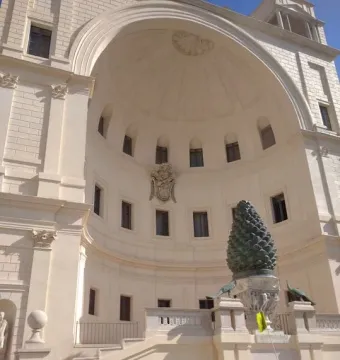
© Valina Tsikalá · CC BY-SA 4.0
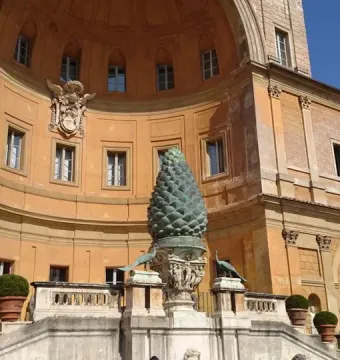
October 2014 © SuperKrzysztof · CC BY-SA 4.0
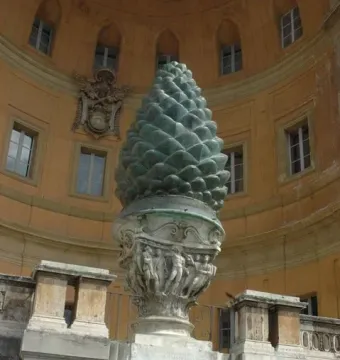
August 2006 © 林高志 · CC BY-SA 4.0
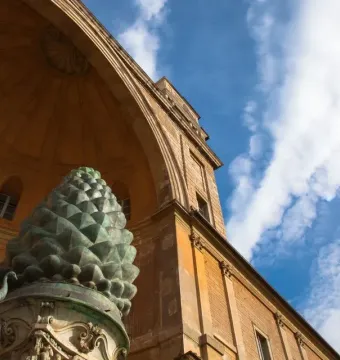
January 2017 © Bradley Weber · CC BY 2.0
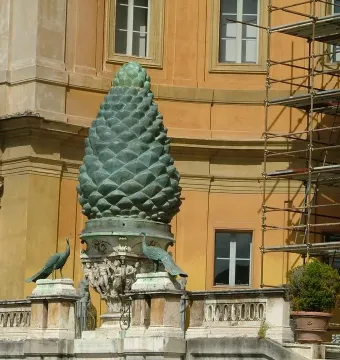
© Richard Mayer · CC BY 3.0
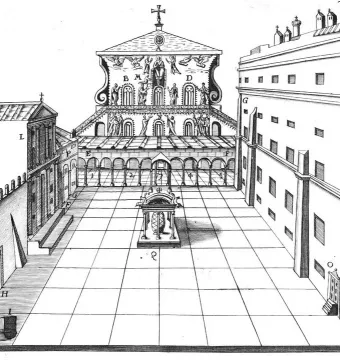
1693 © Giovanni Ciampini · Public domain
Identification | |
| Title | Fontana della Pigna |
| Type | Sculpture; former Roman fountain; fountain sculpture; large Roman sculpture; ancient bronze sculpture; colossal statue; colossal bronze sculpture; giant pine cone (giant strobilus of pine); fountain / sculpture; sculpture of a pine cone (fontana della pigna); fountain |
| Names | La Pigna; La Pigne; La Piña (Pigna) del Vaticano; Il Pignone; the Pine Cone; simply "pinecone"; Pigna / Pignone; the Pigna |
Historical context | |
| Date | Between the 1st and 3rd century AD; 1st, 2nd, or 3rd century CE; Antiquity, Roman Antiquity; 3rd century |
| Origin | Ancient Roman origin |
Creator | |
| Maker | Publius Cincius Savio; Publius Cincius Slavius |
| Evidence for maker | Signed by a certain Publius Cincius Savio; a signature at the base of the sculpture; signed by Publius Cincius Savius; signed in the 3rd century AD (exact year not specified in the fragment) |
Discovery and provenance | |
| Literary reference | Mentioned by Dante Alighieri in the Divine Comedy (Inferno XXXI, 59; Inferno, XXXI, 59); referred to in the Divine Comedy, Inferno, Canto XXXI, in the description of Nimrod; used by Dante to describe the size of the head of the giant Nimrod |
| Permanent relocation date | 1608 |
| Relocation history | Moved to the old Saint Peter's Basilica (the Constantinian basilica), where it stood in the atrium; in 1608 it was finally placed at the center of the exedra of Bramante's courtyard; moved to its current location in 1608; placed at the center of the exedra of the Bramante Courtyard |
| Dante's sighting | It is not known whether Dante saw it during a supposed pilgrimage for the Jubilee of 1300; it is unknown whether Dante saw the Pinecone there during a hypothetical pilgrimage for the Jubilee of 1300; it is not certain whether Dante actually saw it himself |
| Original function | Probably part of a fountain, spouting water from the tips; probably part of a monumental fountain where water flowed from its tip; probably decorative at the Temple of Isis in the Campo Marzio (Campus Martius), where it was likely part of a fountain that sent water from the top |
| Later use | Used to decorate the center of the quadriportico of the ancient Basilica of St. Peter in the Vatican; moved to the courtyard of the Old St. Peter's Basilica (the Constantinian basilica), where it stood in the atrium; the center of the portico of the old Basilica of Saint Peter |
| Name origin | The discovery gave its name to the district/rione of Pigna, still in use today |
| Probable original location | The Campus Martius, near or on the site of the Baths of Agrippa, or the Pantheon, in the area of the later Basilica of Santa Maria sopra Minerva; probably decorated the nearby Temple of Isis in the Campus Martius; near the Pantheon next to the Temple of Isis; likely from the nearby Temple of Isis |
| Discovery location | Near the Baths of Agrippa; the Baths of Agrippa, Rome |
| Discovery | Found in the Middle Ages; discovered in the Middle Ages near the Baths of Agrippa; discovery period: Middle Ages |
Location and ownership | |
| Peacocks provenance | Probably from the Mausoleum of Hadrian; the peacocks decorating the tomb of the Emperor Hadrian, now the Castel Sant'Angelo |
| Related historic monument | Emperor Hadrian's tomb, now the Castel Sant'Angelo |
| Original peacocks location | The original peacocks are in the Braccio Nuovo; Museo Braccio Nuovo; Chiaramonti Museum |
| Associated place name | Cortile della Pigna (Courtyard of the Pine Cone); the courtyard is now called the Cortile della Pigna; the Bramante Courtyard is now called the Courtyard of the Pinecone (Cortile della Pigna); the upper (northern) part took its name from the sculpture placed there in 1608; it gives its name to the Cortile della Pigna |
| Nicchione | A large niche created by Pirro Ligorio through the reconstruction of an old exedra |
| Current function | Decorates a vast niche in the wall of the Vatican; it no longer serves its original function |
| Facing | the Cortile della Pigna |
| Current location | Vatican City, in the Courtyard of the Pine Cone, within the Vatican Museums; Open air, in the Courtyard of the Pine Cone of the Belvedere, within the Vatican Museums complex, Rome; one of the courtyards of the Vatican; Cortile della Pigna, in the Vatican Museums complex; the upper part of the Cortile del Belvedere / Cortile della Pigna in the Vatican; Vatican City, Rome, Italy; Vatican Museums, in the northern part of the Courtyard of the Pinecone (Cortile della Pigna), in the Nicchione; placed at the top of a double-ramp staircase designed by Michelangelo, in front of the niche (nicchione); at the top of a double staircase designed by Michelangelo, in front of the niche |
Physical characteristics | |
| Height | Nearly 4 metres; 4 m; Almost 4 meters; almost four meters high; just under 4 meters |
| Width | 2.5 meters |
| Shape / form | Pine cone; a large bronze pine cone |
Materials | |
| Material | Bronze; not specified in the fragment |
Technique | |
| Original finish | Gilded |
Appearance | |
| Replacement in Rimini | Replaced a statue of Saint Paul damaged by Napoleon's army; replaced a 16th-century statue of St. Paul |
| Depicted object | Pine cone of a stone pine; a pine cone |
| Function in Rimini | Crowns the fountain |
| Condition in Rimini | Very restored; heavily restored |
| Location in Rimini | Rimini; Rimini, Italy |
| Installation date in Rimini | 1807 |
| Base | Placed on a 3rd-century CE capital; a capital with the inscription "Incoronazione di un atleta vittorioso"; the base is a work whose attribution is incomplete in the fragment; it came from the Baths of Nero |
| Top sculpture in Rimini fountain | A pinecone sculpture; pine cone sculpture |
| Additional sculpture in the courtyard | In 1990, one of Arnaldo Pomodoro's Sfera con sfera sculptures was placed in the center of the Courtyard of the Pine Cone; it rotates when the wind blows |
| Lions date | 4th century BCE |
| Flanking lions | Two ancient Egyptian basalt sculptures of reclining lions |
| Staircase | The stairs leading to the pine cone were designed by Michelangelo; a double-ramp staircase designed by Michelangelo; the stairs leading to the pine cone were designed by Michelangelo |
| Surrounding setting | Surrounded by an aedicula supported by eight porphyry columns and covered by a carved marble roof |
| Visible features | Base with relief, inscription, and peacocks |
| Water feature | Water originally emerged from a nozzle at the top and then flowed down the carved scales; once spouted water from the top; water spouts from the mascaron into a basin |
| Decorative elements | Bronze peacocks on either side of the fountain; bronze peacocks on both sides of the fountain are copies of those that decorated the tomb of the Emperor Hadrian; modern copies of two bronze peacocks placed on both sides of the fountain; two bronze peacocks; decorative mascaron |
| Base decoration | Bas-relief showing the crowning of a victorious athlete with a wreath; "Coronation of a victorious athlete" |
Iconography and meaning | |
| Interpretation | The survival of virility beyond Attis's death and, by extension, human mortality; the survival of life in general after biological death |
| Mythological act | Self-castration under a tree, a pine or a fir |
| Mythological association | Attis; Cybele; Nana |
| Related Roman celebration | Arbor intrat on 22 March |
| Symbolic meaning | The pine cone is said to have a pagan and symbolic meaning; the celebration involved bringing a tree into the Phrygianum, sanctuary of the Phrygian mother goddess; associated with Attis, consort of Cybele and a divinity of Phrygia; Attis is described as the androgynous son and lover of Nana, his mother; according to the mystery myth, Nana was impregnated by a fruit full of seeds; Attis practiced self-castration under a tree, a pine or a fir; the loss of virility is compensated by the flowering of new trees generated from the blood of Attis; with its seeds, the pine cone symbolizes the survival of virility beyond Attis's death and, by extension, human mortality; the tree celebrated in arbor intrat symbolizes the separation of Attis's virility from his body, while the pine cone symbolizes the survival of that virility and of life in general after biological death |
History and restoration | |
| Courtyard history | Originally part of the Belvedere Courtyard designed in the early 16th century by Donato Bramante, linking the Apostolic Palace with Pope Innocent VIII's villa; originally part of the Cortile del Belvedere; construction of the Vatican Library divided the Cortile del Belvedere into two areas; a transverse wing of the Vatican Library built in 1585–1590 split the courtyard into two parts; after Bramante died, Pirro Ligorio finished the project; he added the wall and niche to close the courtyard; design of the courtyard: designed by Donato Bramante to connect the palace of Pope Innocent VIII with the Sistine Chapel; completion of the courtyard project |
| Condition | Preserved outdoors |
| Restoration context | Very restored; heavily restored |
Significance | |
| Historical significance | One of the oldest surviving Roman fountains |
| Etymological significance | Its discovery gave the district/rione of Pigna its name, still in use today |
Other | |
| Description | A large statue that likely originally decorated the nearby Temple of Isis and was probably part of a monumental fountain. |
| Depicted in image captions | The sculpture is shown in several views: from the Pine Cone Courtyard and the Il Nicchione niche (2005), the base with relief, inscription, and peacocks (2025), from the niche side (2013), from the fountain side (2011), and together with the Sphere within a Sphere sculpture and the Fontana della Pigna (2005). |