
Lanzón
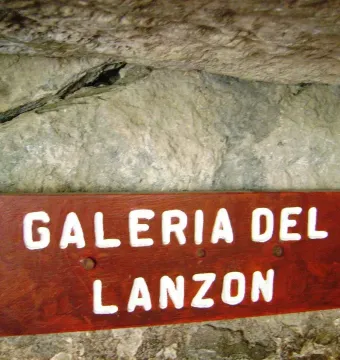
Lanzón, also known as the Lanzón of Chavín, is a sacred monolith from the ancient Chavín culture of Peru. Carved from irregular granite, it stands 4.54 meters tall and remains in its original location in a small square space within an interior gallery of the Old Temple of Chavín, known as the "Lanzón Gallery." The sculpture has three sides covered with engraved motifs depicting a deity or supernatural being with both human and animal traits, including serpent-shaped hair and eyebrows, fangs, and feline claws. Its unusual shape has long been discussed, and it may have been carved to resemble a fang. It is the largest surviving sculpture of the Chavín culture.
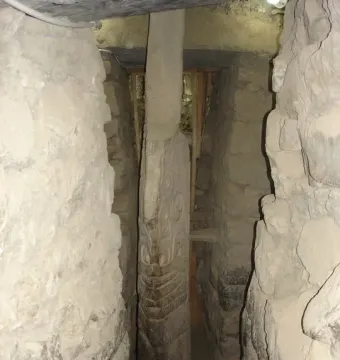
July 2006 © Reto Luescher · CC BY 2.5
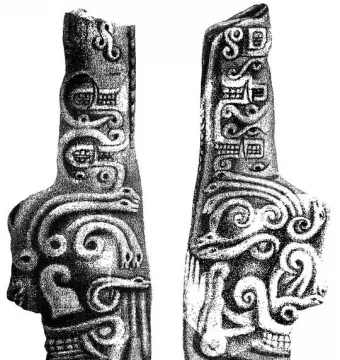
1907 © Enock, C. Reginald (Charles Reginald), 1868-1970 · Public domain
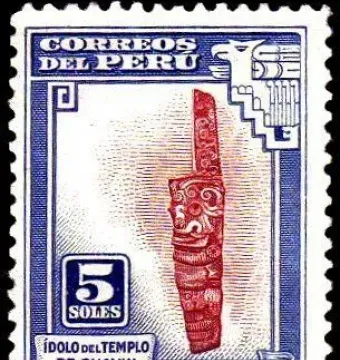
1950 © Post of Peru · Public domain
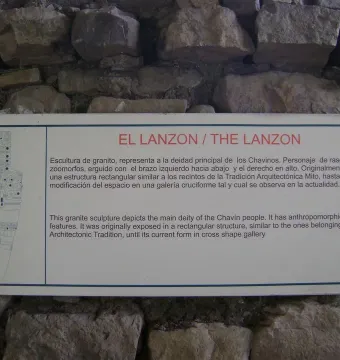
December 2009 © Dtarazona · CC BY-SA 3.0
December 2009 © Dtarazona · CC BY-SA 3.0
Identification | |
| Title | Lanzón |
| Alternative name | Lanzón de Chavín |
| Type | Monolith; stela; sacred huanca (wanka) stone |
Historical context | |
| Culture | Chavín culture |
| Associated region | Ancient Peru; Peruvian highlands |
| Site | Chavín de Huántar |
| Temple | Old Temple |
| Date | ca. 1100–900 BC to around 500 BC; source dates vary, with some giving around 500 BC and John Rowe placing it in the earliest phase of Chavín development |
Creator | |
| Attribution | Produced by the Chavín culture |
Discovery and provenance | |
| Later description | Described in detail by Julio C. Tello in 1923 and John Rowe in 1962 |
| Naming history | José Toribio Polo named it "Lanzón" in 1871; Ernst Wilhelm Middendorf recorded the name "huanca" in 1883 |
| First known mention | Described by Antonio Raimondi in the mid-19th century |
Physical characteristics | |
| Height | 4.53–4.54 m |
| Shape | Triangular, spearhead-like monolith |
| Sides | Three-sided |
| Surface | Covered with engraved motifs in low relief |
| Placement | Set vertically with its ends embedded in the floor and ceiling |
| Placement within site | In the central cruciform chamber of the underground passages of the Old Temple |
| Placement in site | Original emplacement; it remains in place |
| Material | Granite; one source specifies irregular granite, and another identifies it as diorite, a type of granite |
Appearance | |
| Pose | Right arm raised; left arm resting on the thigh |
| Symmetry | Almost perfectly symmetrical except for the arm positions |
| Facial features | Open eyes, bared teeth, and a menacing grin or snarl |
| Animal features | Snake-like hair and eyebrows, large fangs, jaguar-like claws and teeth, feline and serpent heads on the hair and belt, and a bat between the eyes |
| Depicted figure | Anthropomorphic deity or supernatural being, probably the principal deity of the Chavín religion |
Iconography and meaning | |
| Form interpretation | Its shape may intentionally imitate a fang or a hoe/chaquitaclla with the point upward; the naming based on a lance is considered misleading |
| Interpretation of central image | The central image has been interpreted as the axis of the world connecting heaven, earth, and the underworld |
| Meaning | Possibly linked to an agrarian cult |
| Comparative works | Often compared with the Raimondi Stela, Tello Obelisk, and Yauya Stela; it appears similar to the god on the Raimondi Stela but does not carry staffs |
Location and ownership | |
| Current location | Gallery of the Lanzón, in the Old Temple of Chavín de Huántar, Peru |
| Replica location | A replica is displayed at the Museo Nacional in Lima |
History and restoration | |
| Flood history | The 1945 Chavín flood blocked access to the underground galleries, and the Lanzón remained buried until the site was cleared |
| Preservation tradition | A local belief says moving the sculpture would cause major natural catastrophes; a plan to remove it to a museum was never carried out |
| Associated ritual elements | Worshippers were given a San Pedro cactus potion before entering; priests probably accompanied them |
| Acoustic context | The temple setting may have used a hydroacoustic system with stone pits to produce low-frequency sounds and pressure waves |
| Ritual context | Placed at the end of a labyrinthine ritual route in dim underground passages to confront worshippers and intensify fear, reverence, disorientation, and altered states |
Significance | |
| Importance | The largest surviving sculpture or monolith of the Chavín culture |
| Religious significance | Regarded as the main deity of the Chavín people and a central cult image of the Old Temple |
| Site significance | Part of a major ceremonial-religious center and oracular sanctuary with public, communal, festive, and pilgrimage rituals |
| Influence | Chavín art, including the Lanzón, influenced other cultures; related textiles and carved objects have been found as far south as the South Coast, including Karwa |
Other | |
| Historical note | A 1657 account by Estanislao de Vega Bazán described the temple below as having underground chambers and large carved stones where the god Guari was worshipped |
| Later worship | The Huari people later worshipped the huanca in the galleries of Chavín, associating it with the sun, agriculture, water, and an underworld giant |