
The Vision of Constantine
The Vision of Constantine is an equestrian statue by Gian Lorenzo Bernini, positioned at the base of the Scala Regia in the Apostolic Palace of Vatican City. It was initially commissioned as a work to be installed without any special link inside St. Peter’s Basilica, but it was conceived in 1670 after Bernini had long worked on the reconstruction of the staircase, as an integral part of it. Art historians generally agree that the sculpture was carried out almost entirely by Bernini himself, in part because no other artists were paid for the commission. Bernini was paid a total of 7,000 Roman scudi for the work.
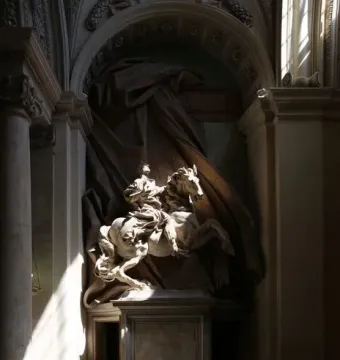
May 2017 © Sailko · CC BY 3.0
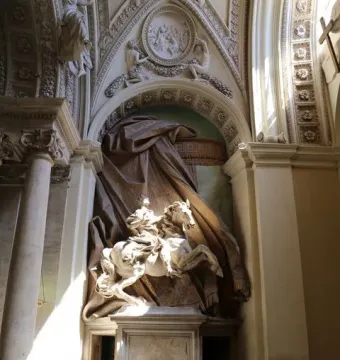
May 2017 © Sailko · CC BY 3.0
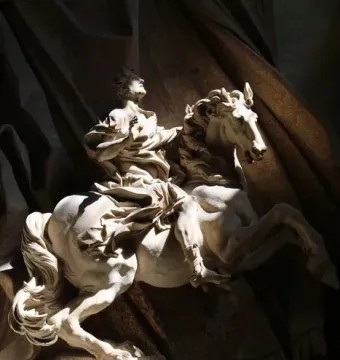
May 2017 © Sailko · CC BY 3.0
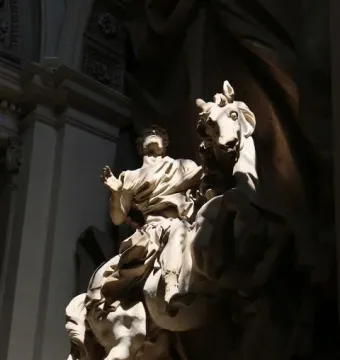
May 2017 © Sailko · CC BY 3.0
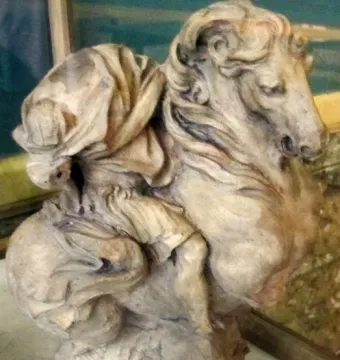
© sailko · CC BY-SA 3.0
Identification | |
| Title | The Vision of Constantine |
| Working title | Costantino |
| Type | Equestrian statue |
| Original-language title | La Visione di Costantino |
Materials | |
| Material | Marble |
Creator | |
| Authorship | Historians of art agree it was made almost entirely by Bernini himself |
| Artist | Gian Lorenzo Bernini |
| Artist nationality | Italian |
Historical context | |
| Project revived under | Pope Alexander VII |
| Probable commissioner | Pope Innocent X |
| Context of creation | Originally commissioned as an independent, free-standing work for St. Peter's Basilica, then reworked for Bernini's redesigned Scala Regia |
| Date installed | 12 January 1669 |
| Date completed | 1668 |
| Date of conception | 1654 |
Discovery and provenance | |
| Preparation materials | A large marble block and terracotta/clay models |
| Work on marble block began | 1662 |
| Preparatory studies | Sketches and bozzetti |
| Transport to installation site | It took ten days to move the sculpture from Bernini's workshop to the Scala Regia, with guards watching at night |
| Transport methods | Straw, winches, planks, beams, sledges, and oxen were used |
| Fee to Bernini | 7,000 Roman scudi |
| Evidence for authorship | No other sculptors or artists are known to have been paid for the commission |
Location and ownership | |
| Current location | At the base of the Scala Regia of the Apostolic Palace in Vatican City, by St. Peter's Basilica |
| Scala Regia description | The main ceremonial staircase between St. Peter's Basilica and the Apostolic Palace |
| Relation to Scala Regia | Conceived as an integral part of the staircase |
| Later intended location | Bernini's redesigned Scala Regia |
| Original intended location | Inside St. Peter's Basilica |
Physical characteristics | |
| Scale adjustment | The sculpture was initially overwhelmed by the large niche, prompting changes to fit the new site |
| Added element | A large, dynamic drapery was placed behind the statue |
| Post-installation finishing | Architectural and decorative work, including the drapery, and polishing of the sculpture continued through 1669 |
Iconography and meaning | |
| Subject | Constantine the Great |
| Depicted scene | Before the Battle of the Milvian Bridge, Constantine prays with his army and sees a cross in the sky above the sun with the inscription 'In hoc signo vinces' ('By this sign, you will conquer') |
| Associated battle | Battle of the Milvian Bridge |
| Associated opponent | Maxentius, the pagan Roman emperor |
| Aftermath in the narrative | Constantine won the battle, entered Rome in triumph, and granted religious tolerance to Christians |
| Religious significance | The vision convinced Constantine and his troops and is presented as a miracle significant to Christian history |
Significance | |
| Contextual significance | Constantine was especially appealing to later popes as an early Christian ruler |