
Black Nazarene
The Black Nazarene is a life-sized Roman Catholic image of Jesus Christ carrying the True Cross and is enshrined in the Minor Basilica and National Shrine of Jesus Nazareno in Quiapo, Manila, Philippines. Often called Jesús Nazareno, the statue is known for its dark complexion, braided wig, golden Crown of Thorns, and three-ray halo called the Tres Potencias. Jesus is depicted barefoot and genuflecting, with a black wooden cross and a maroon velvet tunic embroidered in gold. Devotees believe touching the image can bring miracles and healing, and it is brought out in procession three times a year. The original image was broken into pieces, and the shrine now maintains main replicas as well as official Callejero copies sent on visits and donated to churches in the Philippines and abroad.
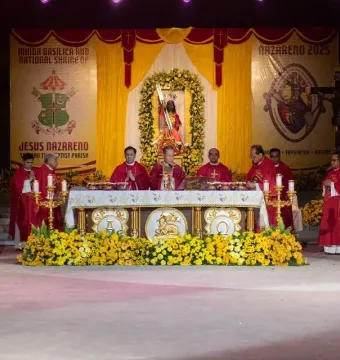
January 2025 © City government of Manila · Public domain
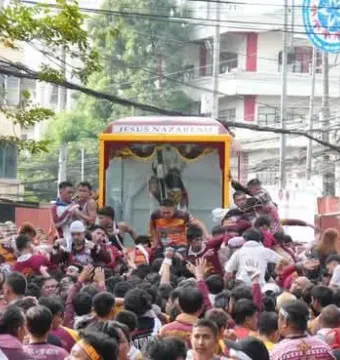
January 2025 © Historia Caviteño · CC BY 4.0
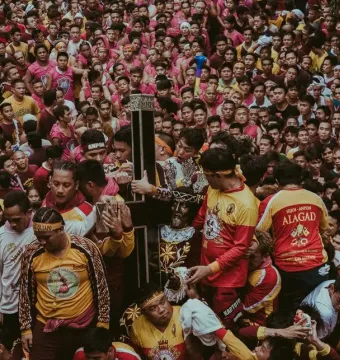
January 2018 © Ira Villanueva · CC BY-SA 4.0
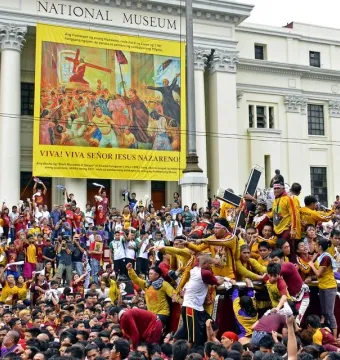
January 2015 © Richmond Chi · CC BY-SA 4.0
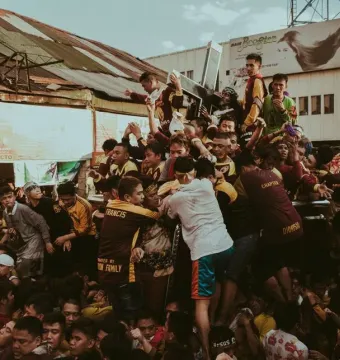
January 2018 © Ira Villanueva · CC BY-SA 4.0
Identification | |
| Title | Black Nazarene |
| Feast day | January 9 |
| Associated devotion day | Quiapo Day (Fridays) |
| Associated procession | Traslación |
| Official name | Jesús Nazareno |
| Description | A dark, life-size wooden statue |
| Subject | Jesus Christ carrying the Cross of Calvary |
| Type | Venerated religious image; life-size statue |
| Common names | Black Nazarene; Black Christ; Jesús Nazareno; Nuestro Padre Jesús Nazareno; Itim na Nazareno; Poong Itim na Nazareno; El Cristo Nazareno Negro; Nazarene Noir |
Creator | |
| Maker | Anonymous sculptor from New Spain (present-day Mexico) |
Historical context | |
| Origin | Mexico |
| Date made | 1606 |
| Arrival in Manila | Arrived from Acapulco, New Spain, by Manila galleon in 1607 |
| Attribution of black color | Traditionally explained as having been blackened by a ship fire; other explanations include soot from candles, intentional dark skin tone, or original mesquite wood coloration |
Discovery and provenance | |
| Provenance notes | The original image is believed to have come from Mexico via the Manila galleon; there is also a historical claim that two identical Black Nazarene images existed in Manila |
| Current location | Minor Basilica and National Shrine of Jesus Nazareno, Quiapo, Manila, Philippines |
| Transfer to Quiapo | A copy was transferred to Quiapo Church during the archbishopric of Basilio Sáncho de Santa Justa y Rufina to give devotees greater access and to protect Intramuros; the exact transfer date is not historically recorded |
| Later enshrinement | Church of San Nicolás de Tolentino (Recoletos Church) in Intramuros |
| Early custodianship | Augustinian Recollects |
| First enshrinement | Church of San Juan Bautista of the Augustinian Recollects in Bagumbayan, Luneta |
Physical characteristics | |
| Size | Life-size |
| Color | Dark-skinned; black coloration |
| Condition | The original image has lost several fingers and was broken into several pieces; the surviving composite arrangement combines original and later parts |
| Pose | Barefoot and genuflecting |
| Hair | Braided wig of dark dyed abacá |
| Headgear | Golden Crown of Thorns with attached Tres Potencias halo and three rayos |
| Clothing | Maroon velvet tunic embroidered with gold floral and plant designs, trimmed with white lace collar and cuffs |
| Accessories | Gold-plated metal belt embossed with the word NAZARENO; golden neck chain ending in spheres |
| Cross | Black wooden cross tipped with flat pyramidal brass caps |
Materials | |
| Hair material | Dark dyed abacá |
| Belt material | Gold-plated metal |
| Body material | Wood |
| Cross material | Black wood |
Technique | |
| Carving material tradition | Mesquite wood is suggested by Monsignor Sabino Vengco as the original sculpting material |
| Processional support | The image is carried on a wooden base called the peana and on an ándas carriage |
Appearance | |
| Original appearance | Originally had a light complexion |
| Current appearance | Dark complexion unusual for depictions of Jesus, though found in Mexican iconography |
| Iconography | Jesus carrying the Cross of Calvary; the chain represents the Flagellation of Christ; the posture symbolizes the agony and burden of the Cross |
| Halos and symbolism | Tres Potencias may symbolize the Trinity, Christ's faculties of will, memory, and understanding, or his authority, power, and strength; three rayos signify divinity in traditional Filipino and Hispanic iconography |
Location and ownership | |
| Belief about contact | Devotees believe touching the image can bring miracles and heal diseases |
| Religious status | A greatly venerated image considered miraculous by many Filipino devotees |
| Venerated at | Minor Basilica and National Shrine of Jesus Nazareno, Quiapo, Manila |
History and restoration | |
| Vestment rite | The image is vested in the rite of Pabihis, with vestments changed by male attendants behind a curtain while a priest presides; old vestments are presented to the faithful |
| Señor Cabeza provenance | Previously kept by Father Emmanuel del Rosario of the Diocese of Cubao and donated as a Callejero replica on 26 October 2022 after his death |
| Other replicas | The basilica maintains official Callejero replicas, including Uno, Dos, Katorse, Disisiete, and Señor Cabeza; they are used for Dalaw Nazareno visits and official donations to churches in the Philippines and abroad |
| Special procession event | At the Basilica of San Sebastian, the Black Nazarene procession pauses for the Dungaw encounter with the Virgin of Mount Carmel |
| Processional attendance | Millions of devotees participate in the January 9 procession, which lasts several hours and is associated with crowding and dangerous stampedes |
| Procession practice | The image or a replica is carried in procession three times a year, including the annual January 9 Traslación in the streets of Manila |
| Livestreaming | Some vesting rites have been livestreamed online since 2022 |
| Vesting frequency | Five times a year, in preparation for major religious occasions |
| 1945 destruction | The church and one Manila image were destroyed in the Allied bombardment of Manila in 1945 |
| Restoration and reassembly | The full statue was reassembled in 2007 for its 400th anniversary |
| Conservation replica | Quiapo Church commissioned a replica in the 1980s to protect the image |
| Replica and composite image | Because the original was damaged and fragmented, a composite image was created from original and later parts; the original head and hands are now on a newer body, and the older torso contains newer head and hands |
| Survival history | The image survived the earthquakes of 1645 and 1863, the fires of 1791 and 1929, and the bombing of Manila in World War II |
| Indulgence | Pope Pius VII granted a plenary indulgence to those who piously prayed before the image |
| Apostolic blessing | Pope Pius VII gave the image and its cult an apostolic blessing in 1880 |
| Confraternity | Cofradía de Nuestro Santo Jesús Nazareno |
| Cult approval | Pope Innocent X approved the cult in 1650 |
Significance | |
| Devotional importance | One of the most popular objects of devotion in the Philippines, alongside Santo Niño |
| Associated meaning | Strongly associated with the Passion and suffering of Christ, and many devotees relate it to their own poverty and daily struggles |
| Devotional practices | Barefoot walking, riding the carriage for blessings, hand-clapping after Mass, novena prayer, Pahalik, Pabihis, Pasindí, and kneeling toward the altar image are common devotions |
| Cultural presence | The image appears on Pasyóng Mahál covers and is linked to the Nazarene Catholic School and its newsletter The Nazarene |
| Music | "Nuestro Padre Jesús Nazareno" by Lucio San Pedro serves as the basilica's official anthem for the image and its rites |