
Apollino
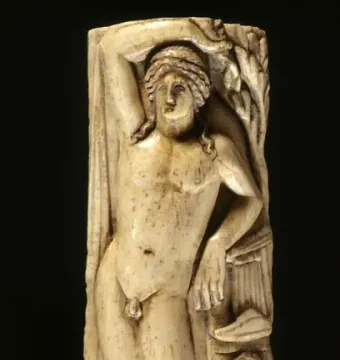
Apollino, also known as the Medici Apollo, is a Roman copy of a Hellenistic sculpture of the adolescent god Apollo of the Apollo Lykeios type. It is now in the Uffizi, Florence. The sculpture has been linked to Praxiteles on the basis of its proportions, though other scholars see it as a Roman eclectic creation. Its left arm may once have held a bow. Found complete in Rome in the 17th century, it was first in the Borghese collection and later moved to the Medici collection at Villa Medici. It remained in Rome until 1769–70, when it was removed to accompany the Medici Niobe Group. Restored by Lorenzo Bartolini after damage in 1840, it was long admired and widely copied.
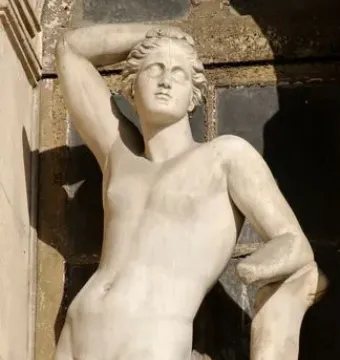
· CC BY 3.0
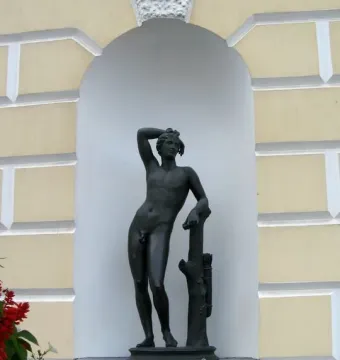
October 2016 © Екатерина Борисова · CC BY-SA 4.0
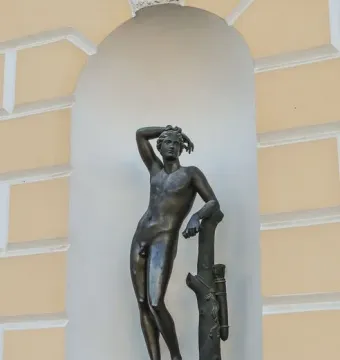
September 2017 © Александровы АГ · CC BY-SA 4.0
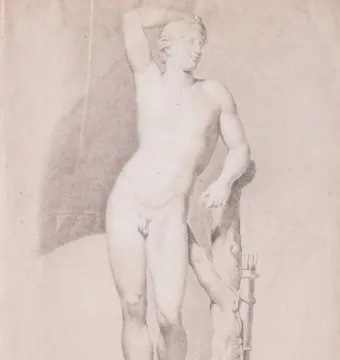
© Unknown authorUnknown author · Public domain
© Coptic · Public domain
Identification | |
| Title | Apollino |
| Alternative name | Apollo Medici |
Historical context | |
| Type | Roman copy of a Hellenistic Greek sculpture |
| Object type | Cast |
| Attribution hypothesis | Possibly based on a work by Praxiteles, or at least in Praxitelean style |
| Alternative interpretation | Eclectic Roman-era work mixing several styles of the Second Classicism |
Iconography and meaning | |
| Subject | Apollo |
| Sculptural type | Apollo Lykeios type |
| Possible attribute | The left arm may have held a bow |
Physical characteristics | |
| Form | Nude sculpture of a man |
| Head proportions | Similar to Praxiteles' Knidian Aphrodite |
Location and ownership | |
| Current location | Uffizi Gallery, Florence |
| Current collection | Uffizi Gallery collection |
| Observed by | Percy Bysshe Shelley in the Tribuna of the Uffizi |
Discovery and provenance | |
| Documented at Villa Medici | Recorded there in 1704 |
| Transfer to Florence | Taken to Florence in 1769–1770 with the Medici Niobe Group; not moved earlier by Cosimo III de' Medici |
| Initial ownership | Borghese collection |
| Later ownership | Medici collection at Villa Medici |
| Early provenance | Exact early provenance is obscure |
| Discovery | Found complete in Rome in the 17th century |
History and restoration | |
| Reputation | Highly praised through the 18th century, but its reputation later declined |
| Damage | Broken in 1840 at the Uffizi when a painting fell on it |
| Restored by | Lorenzo Bartolini |
| Restoration method | Bartolini covered the whole statue with a layer of paint to disguise the repairs |
Significance | |
| Historical significance | One of the most copied Roman sculptures |
| Copies made | Many 17th-, 18th-, and 19th-century copies exist |
Other | |
| Copy by | Jean-Baptiste Vietty |
| Location of copy by Jean-Baptiste Vietty | Musée des Beaux-Arts de Lyon |
| Related work | Apollino Milani in the National Archaeological Museum, Florence |
| Related copy | Copy carved by Niccolò Bazzanti at Museo Civico Revoltella, Trieste |