
Tomb of Bruno the Priest
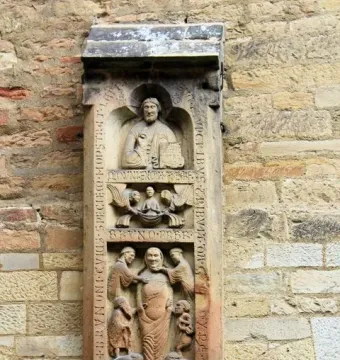
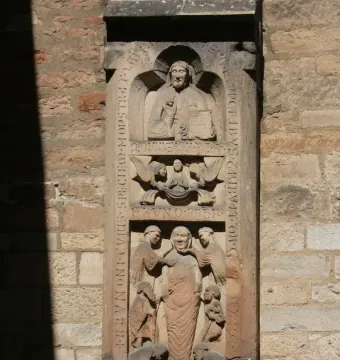
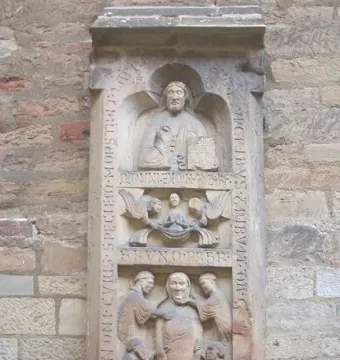
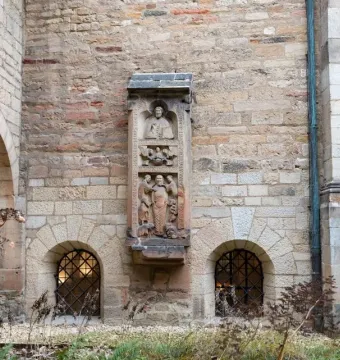
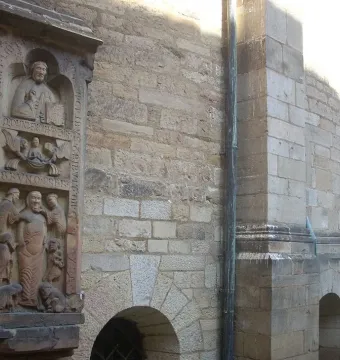
The Tomb of Bruno the Priest is an outstanding Romanesque grave monument distinguished by its image program and stone carving. It was created after 1194 and is located on the south wall of the choir of Hildesheim Cathedral, near the Thousand-Year Rosebush. Bruno is documented in charters from 1181 to 1194 as a member of the Hildesheim cathedral chapter, serving as cellarer and as a donor; little else is known about his life. The more than two-meter-high slab is divided into three figurative scenes. It shows the deceased, his soul carried by angels as a child, and Christ receiving him with a blessing gesture, accompanied by several Latin inscriptions.
June 2019 © Dguendel · CC BY-SA 4.0
August 2009 © Paulis · CC BY 3.0
© Rabanus Flavus · Public domain
December 2017 © Tilman2007 · CC BY-SA 4.0
© Rabanus Flavus · Public domain
Identification | |
| Title | Tomb of Bruno the Priest |
| German title | Das Grabmal des Priesters Bruno |
| Original language title | Il sepolcro del sacerdote Bruno |
| Type | Romanesque tomb monument / grave slab / funerary relief |
Historical context | |
| Date | after 1194 |
Creator | |
| Commemorated person | Bruno the Priest |
| Bruno's status | member of the Hildesheim Cathedral chapter |
| Bruno's office | cellerarius (steward) |
| Bruno's role as donor | recorded as a donor in documents from 1181–1194 |
| Bruno's biography | nothing else is known of his life |
Discovery and provenance | |
| Original / current location | South wall of the choir of Hildesheim Cathedral, near the Thousand-year Rose Tree |
Physical characteristics | |
| Height | more than 2 metres |
| Composition | divided into three pictorial fields |
| Form | large figural tomb slab |
Materials | |
| Material | stone |
Style | |
| Style | Romanesque; remarkable for its iconography and stonemasonry, with unusual liveliness and expressive power |
Appearance | |
| Upper field framing | a trefoil arch whose central roundel forms the cruciform nimbus of Christ |
| Poetic inscription form | two hexameters with end rhyme |
| Border inscription | +BRVNONI.CVIVS.SPECIEM.MONSTRAT.LAPIS.ISTEQVI.SVA.PAVPERIBVS.TRIBVIT.DA GAVDIA.CHRISTE — To Bruno, whose image this stone shows, who gave his own to the poor, grant the joys, O Christ |
| Additional inscription | Q(VO)D.VNI.EX.MI(NIMIS).M(EIS).FE(CISTIS).M(IH)I.F(ECISTIS) — What you did to one of my least brethren, you did to me (Matthew 25:40) |
| Christ inscription | VENITE.BENED(ICTI).PATRIS.MEI — Come, you blessed of my Father (Matthew 25:34) |
| Inscription for Bruno | BRVNO.PR[ES]B[YTE]R — Bruno, priest |
| Upper field subject | Christ as judge and redeemer receives the deceased with a gesture of blessing |
| Middle field figures | Two angels descending from the sides carry the soul to heaven in a cloth |
| Middle field subject | The soul of the deceased shown as a naked child with a blissful expression and open hands in prayer or adoration |
| Lower field figures | Two clerics lay him to rest; four poor and sick people, including a woman, take part in the burial and express gratitude and veneration by touch and kneeling |
| Lower field subject | The deceased Bruno lies in funeral garments with closed eyes and a smiling face, surrounded by six smaller figures mourning and bidding farewell |
Iconography and meaning | |
| Iconography | A funerary program combining the deceased body, the soul’s ascent, and Christ’s reception of the dead |
| Subject matter | burial, mourning, salvation, heavenly acceptance, and resurrection/soul-to-Heaven imagery |
Location and ownership | |
| Current location | South wall of the choir of Hildesheim Cathedral |
History and restoration | |
| Current preservation | preserved on the south wall of the choir of Hildesheim Cathedral |
Other | |
| Visual qualities | unusual liveliness and vitality |
| Additional inscriptions | further Latin inscriptions surround the images |