
Gemma Claudia
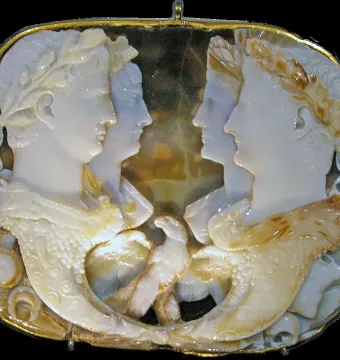
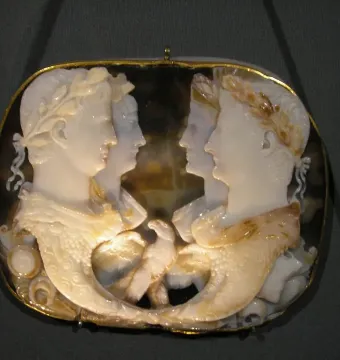
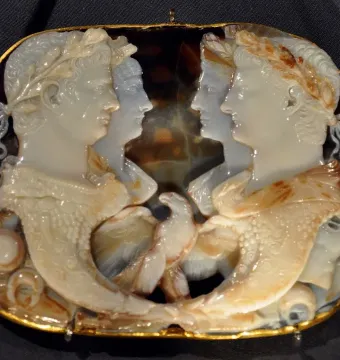
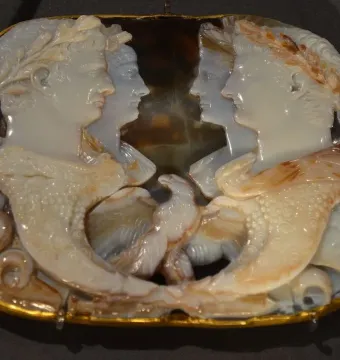
Gemma Claudia is an ancient cameo carved in about 49 CE from five-layer sardonyx, a variety of onyx with parallel reddish layers of carnelian. It depicts members of the Roman Julio-Claudian dynasty in a carefully balanced composition with two double cornucopias, an eagle, and four portraits emerging from the stone. Claudius and his fourth wife Agrippina the Younger appear on one side, while Germanicus and Agrippina the Elder are shown opposite. The work was likely made to commemorate the emperor’s wedding. It later belonged in the 17th century to the Habsburg Holy Roman Emperors and is now kept in the Kunsthistorisches Museum in Vienna, where it remains set in an 18th-century gold mounting.
June 2006 © Gryffindor · CC BY 2.5
June 2006 © Gryffindor · CC BY 2.5
October 2010 © Photo: Andreas Praefcke · Public domain
August 2015 © Carole Raddato · CC BY-SA 2.0
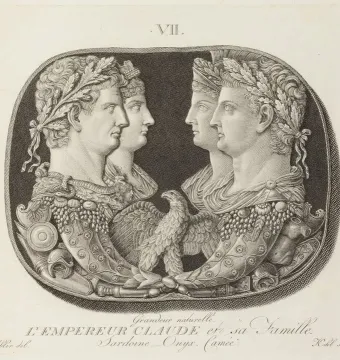
© Clemens Kohl (1754-1807) · Public domain
Identification | |
| Title | Gemma Claudia |
| Type | Roman cameo |
Historical context | |
| Date | AD 49, probably shortly after the marriage of Claudius and Agrippina the Younger in January 49 |
| Possible function | Possibly an official wedding gift for the imperial couple |
Creator | |
| Artist | Unknown |
Discovery and provenance | |
| Former owners | The Habsburg Holy Roman Emperors by the 17th century |
| Original owner | Emperor Claudius |
| Collection history | Later part of the Habsburg collections and the Kunsthistorisches Museum in Vienna |
| Inventory number | AS Inv. No. IX A 63 |
Physical characteristics | |
| Base thickness | 2 mm |
| Dimensions | 12 cm high, 15.2 cm wide |
| Mounting | Set in an 18th-century gold frame or mount |
Materials | |
| Material | Five-layer sardonyx |
Technique | |
| Carving technique | Masterfully carved from five alternating dark and light layers of stone |
| Workmanship | Great virtuosity; exceptionally fine carving in places |
| Material effect | The carving increased the transparency of the material by cutting very thin layers |
Appearance | |
| Alternative identifications | Some scholars have proposed other identifications for the pairs, including Claudius with Agrippina the Younger or Messalina, and on the opposite side Germanicus and Agrippina the Elder, Drusus the Elder and Antonia the Younger, Tiberius and Livia Drusilla, Britannicus and Octavia, or Augustus and Livia |
| Portrait features | Claudius is shown as an about sixty-year-old man with a thick chin and wrinkles on the forehead and around the mouth |
| Composition | Two cornucopias with an eagle between them, from which four portraits emerge in two facing pairs |
| Right pair | Germanicus and Agrippina the Elder |
| Left pair | Claudius and Agrippina the Younger |
| Depicted subjects | Members of the Roman imperial Julio-Claudian dynasty |
Iconography and meaning | |
| Agrippina the Younger | Depicted as Cybele, goddess of fertility |
| Headwear and attributes | Claudius and Germanicus wear the civic crown; the female figure wears a crown of ears of grain and poppies, and other figures are shown with triumphal symbols such as weapons, armor, and crowns |
| Symbolism | The cornucopias symbolize abundance and expectation of abundant benefits; the eagle and weapons allude to the emperor's military triumphs |
| Interpretation | Probably created in memory of Claudius's wedding to Agrippina the Younger, and possibly as an official marriage gift |
Location and ownership | |
| Current location | Kunsthistorisches Museum, Vienna |
| Current mounting | Gold setting |
History and restoration | |
| Scholarly note | According to a 1994 study, the cameo may result from the partial reworking of an earlier cameo |
Significance | |
| Art historical context | A relatively late member of the group of spectacular imperial engraved gems sometimes called State Cameos |
| Related examples | Gemma Augustea in Vienna, the Great Cameo of France in Paris, and the Blacas Cameo in London |
| Earlier group context | Earlier members were presumably created in the inner court circle of Augustus and were probably not presented to the general public |
| Earlier group imagery | They depict Augustus with divine attributes and, in some cases, erotic motifs that were politically sensitive and not for a wider audience |