
Ram in a Thicket
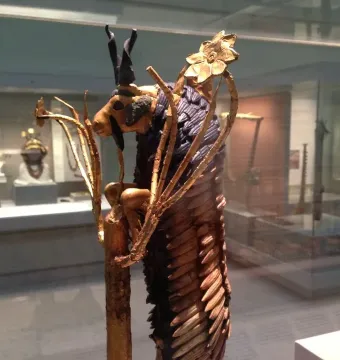
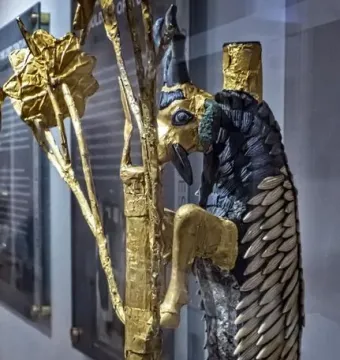
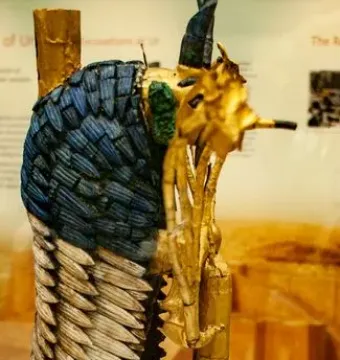
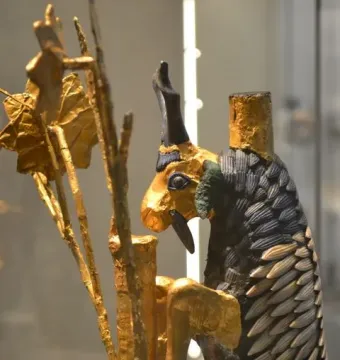
Ram in a Thicket is a figure from a pair excavated at Ur in southern Iraq, dating to around 2600–2400 BCE. The sculpture is now displayed in the Mesopotamia Gallery of the British Museum in London, while its companion piece is in the University of Pennsylvania Museum in Philadelphia. When discovered, the 42 cm figure had been crushed by the weight of the earth above it and its wooden core had decayed. It is made from gold leaf, copper, lapis lazuli, shell, bitumen, silver, and other materials, and stands on a rectangular base decorated with shell, red limestone, and lapis lazuli mosaic.
May 2013 © Nate Loper · CC BY 2.0
April 2016 © Mary Harrsch · CC BY 2.0
© Unknown artistUnknown artist · CC BY-SA 4.0
April 2018 © Torquatus · CC BY-SA 4.0
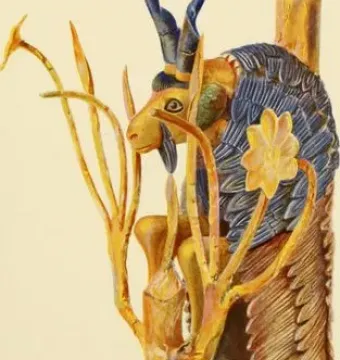
1900 © Joint Expedition of the British Museum and of the Museum of the University of Pennsylvania to Mesopotamia; Hall, H. R. (Harry Reginald), 1873-1930, ed; Woolley, Leonard, Sir, 1880-1960; Legrain, Leon, 1878- ed · No restrictions
Identification | |
| Title | Ram in a Thicket |
| Type | Composite figurine |
| Number of figures | Pair of figures |
| Alternative names | Goat browsing a shrub; Le Bélier dans un fourré; Carnero en un matorral |
Historical context | |
| Culture | Sumerian |
| Date | c. 2600–2400 BC |
Creator | |
| Discoverer | Leonard Woolley |
| Excavation project | Joint expedition of the British Museum and the University of Pennsylvania, begun in 1922 |
Discovery and provenance | |
| Identified as | Woolley named the figure as a ram, though it is more accurately a goat |
| Related figure location | University of Pennsylvania Museum of Archaeology and Anthropology, Philadelphia, United States |
| Discovery context | Found lying together as a pair |
| Discovery date | 1928–1929 excavation season |
| Discovery location | Ur, southern Iraq |
| Discovery site | The Great Death Pit (PG 1237), in the Royal Cemetery of Ur |
Physical characteristics | |
| Height | 42 cm |
| Condition at discovery | Crushed by the weight of the earth above it; the inner wooden core had decomposed |
| Original arrangement | The two figures are thought to have originally faced each other as confronting animals |
| Support tubes | Tubes rising from the shoulders were probably meant to support a vessel or similar object |
Materials | |
| Genitals | Gold |
| Attachment | Silver chains originally attached the figure to the flowering shrub around its fetlocks |
| Base | Shell, red limestone, and lapis lazuli mosaic on a small rectangular base |
| Tree or shrub | Gold leaf with gold flowers |
| Belly | Silver plate, now oxidised beyond restoration |
| Core | Wood |
| Body fleece | Shell attached to bitumen |
| Shoulders | Lapis lazuli |
| Horns | Lapis lazuli |
| Ears | Copper, now green with verdigris |
| Head and legs | Gold leaf over wood, fixed with bitumen |
History and restoration | |
| Restoration | Woolley used wax to hold the pieces together and gently pressed the figure back toward its original shape |
Appearance | |
| Original appearance | Polychrome, almost chryselephantine |
| Stylistic character | Elegant and light in form, with the goat's agility translated into art and a momentary poise frozen into permanence |
Iconography and meaning | |
| Biblical reference | The title alludes to Genesis 22, the Binding of Isaac, where Abraham is stopped by an angel and offered a ram caught in a thicket |
| Name origin | Woolley named the figure after the ram in the Genesis story |
Location and ownership | |
| Current location | Mesopotamia Gallery, British Museum, London, England |
Significance | |
| Associated interpretation | The title connects the figure to the biblical story of Abraham and Isaac |