
Priest-King
Priest-King is a steatite statue found in Mohenjo-Daro and now known only as a bust because the lower part is missing. Preserved to a height of 17.5 cm and about 11 cm wide, it is considered a major artwork of the Indus culture (2800–1800 BC). The figure shows a bearded man with a shaved upper lip, narrow eyes, a long damaged nose, shell-like ears, and a narrow forehead decorated with a headband. He wears a cloak with a cloverleaf pattern, once filled with red paste, and the eyes were originally inlaid with shell. Discovered in 1927 by K. N. Dikshit, the sculpture is often interpreted as a priest-king, though this reading remains speculative.
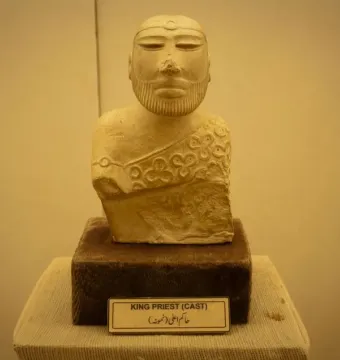
November 2014 © Umair Shaikh Shaikh · CC BY-SA 2.0
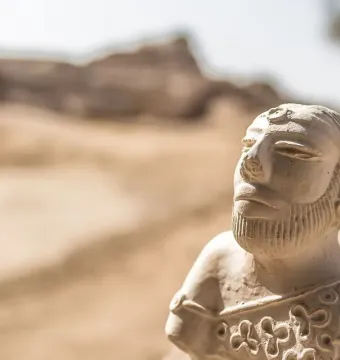
September 2014 © Soban · CC BY-SA 3.0
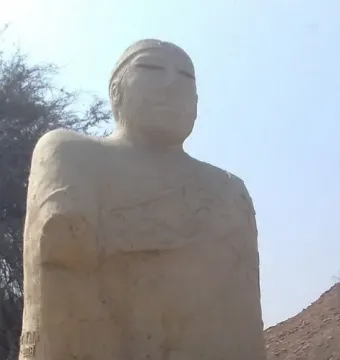
February 2010 © Nawabtanweer · CC BY-SA 4.0
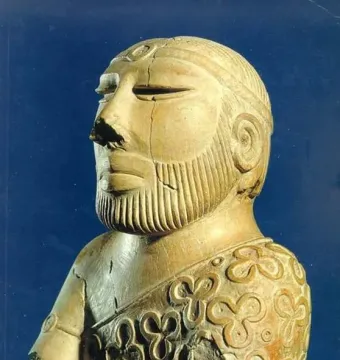
© Mamoon Mengal · CC BY-SA 1.0
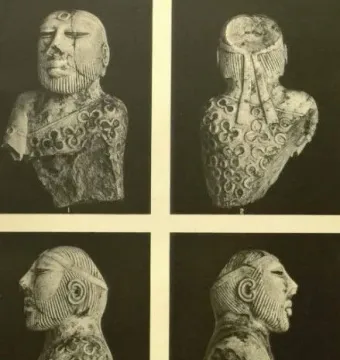
© Archaeological Survey of India · Public domain
Identification | |
| Title | Priest-King |
| Object type | Small male sculpture |
| Alternative names | King-Priest; hakim aala |
Discovery and provenance | |
| Discovery site | Mohenjo-daro, Sindh, now Pakistan |
| Discovery context | Found during excavations of the ruined Bronze Age city of Mohenjo-daro, in the lower city (chamber 1, block 2) |
| Discovery date | 1925 or 1926 |
| Discoverer | Ernest J. H. Mackay; K. N. Dikshit |
Historical context | |
| Culture | Indus Valley Civilization |
| Date | Approximately 2000–1900 BCE |
| Cultural period | Late period of Mohenjo-daro |
Creator | |
| Associated scholar | Marshall; Mackay; Mortimer Wheeler; Gregory Possehl; Benjamin Rowland; Jonathan Kenoyer |
Physical characteristics | |
| Width | about 11 cm |
| Preserved form | Only the upper part survives; the lower body is missing, so the sculpture is now a bust |
| Height | 17.5 cm |
Materials | |
| Material | Steatite (soapstone) |
| Hardening process | Fired or baked at over 1,000 °C to harden it |
Technique | |
| Surface treatment | The recessed areas were left rough to help the red filler adhere |
Appearance | |
| Original pose hypothesis | Probably originally a seated, kneeling, or full-length figure; some reconstructions suggest one knee raised and the other leg tucked under the body |
| Pose | The right bare arm rests on the right leg; the left hand is partly covered by the cloak and embraces the knee |
| Pigment and inlay | The motif recesses were originally filled with red material, probably paste; traces of blackish residue were noted around the motifs at excavation and may originally have given a green or blue background |
| Clothing | Toga-like cloak or robe covering one shoulder |
| Decoration | Cloak decorated with trefoil, single-circle, and double-circle motifs |
| Eye treatment | Eyes were probably inlaid with shell or stone pieces; they are now empty |
| Neck detail | Holes on both sides of the neck, possibly for a chain or necklace |
| Facial features | Broad lips; long nose partly broken off; eyes narrow and probably half-closed |
| Hair or headgear | Beard carefully worked with parallel lines; upper lip shaved and smooth; hair combed back; forehead narrow with a headband or fillet; crown of the head polished, beveled, and flat, possibly to receive a missing headdress or other element |
| Depicted figure | Bearded man |
| Ears | Simply formed, resembling shells |
History and restoration | |
| Condition | Incomplete and damaged; generally in good condition but with a crack in the face and a break at the bottom |
| Damage details | A long crack runs down the face; the tip of the nose is damaged; the lower part has an irregular break; the patterned robe continues farther down the back than the front below the break |
| Interpretation of damage | The damage may have been caused by firing, heat exposure, or a later impact; some archaeologists think the sculpture and others were deliberately broken and defaced after losing influence |
Iconography and meaning | |
| Comparative references | The sculpture was compared with similar figures from Mesopotamia, but no real connection has been proven; a silver cup from Kabul shows men in a similar pose and has been linked to harvest-festival imagery |
| Pattern significance | The trefoil motif is otherwise attested in the Indus culture, especially on beads, and also appears in Mesopotamia, Egypt, and Crete, where it had religious meaning |
| Possible function or identity | The identification as a priest-king is highly speculative and unsupported; other proposed interpretations include a priest, worshipper, ancestor figure, or commemorative figure of clan leaders or descendants |
| Symbolic observations | The eyes appear directed toward the tip of the nose, which has been taken as possible evidence of a religious personage and compared with yoga practice; the one-shoulder garment has also been compared with later Buddhist saṃghāti |
| Interpretation history | Marshall first thought Indus sculpture had Mesopotamian influence and used 'Indo-Sumerian civilization' in early reports; Mackay thought the figure might represent a priest; Marshall considered it possibly a king-priest; Mortimer Wheeler appears to have been the first to use the term 'Priest-King' |
Location and ownership | |
| Current location | National Museum of Pakistan |
| Inventory number | NMP 50-852 |
| Display status | A replica is usually displayed in the National Museum of Pakistan; the original is kept in storage for security |
Significance | |
| Importance | Considered the main artwork of the Indus culture and the most famous stone sculpture of the Indus Valley Civilization; widely admired for combining naturalistic detail with stylized forms |