
Toros de Costitx
Toros de Costitx are three bronze bull heads discovered in 1894 at Costitx, in the Predio de Son Corró sanctuary associated with a talaiotic settlement. The sanctuary consisted of a rectangular space with an apse, and decorated columns inside may have supported the bronze heads. Based on their size, the three heads are known as the larger, medium, and smaller. They were made using the lost-wax casting technique; the ears and horns were cast separately and later attached, while the eyebrows, eyes, and forehead hair were finished cold with chisel incisions. Glass paste was used for the eyes. The heads have been interpreted as divinities and are now kept at the National Archaeological Museum of Spain in Madrid as Conjunto 587.
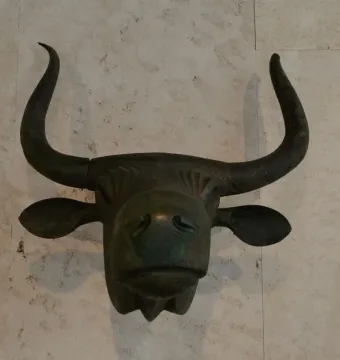
September 2015 © Dorieo · CC BY-SA 4.0
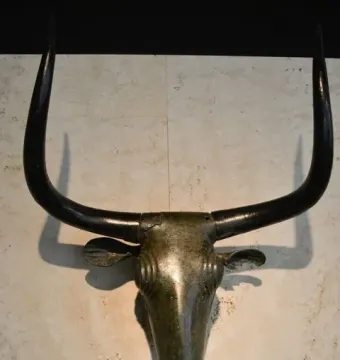
September 2015 © Dorieo · CC BY-SA 4.0
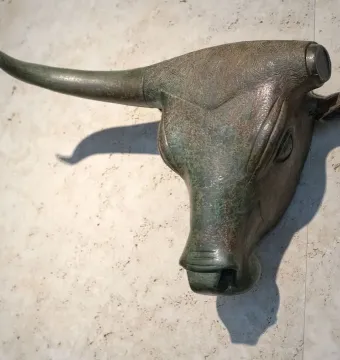
January 2016 © Ángel M. Felicísimo · CC BY 2.0
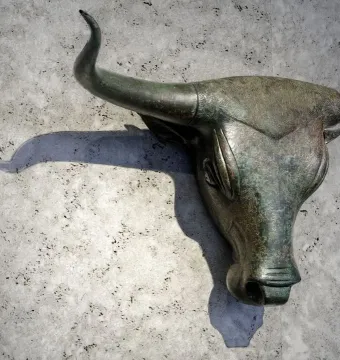
January 2015 © Ángel M. Felicísimo · CC BY-SA 4.0
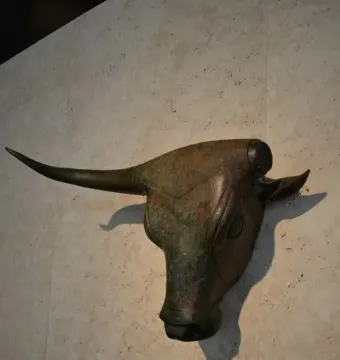
September 2015 © Dorieo · CC BY-SA 4.0
Identification | |
| Title | Toros de Costitx |
| Composition | Three pieces |
| Alternative name | bous de Costitx |
| Type | Three bronze bull heads |
Historical context | |
| Cultural context | Talayotic culture |
| Date | Around the 5th to 3rd centuries BC |
| Associated cult and sites | Associated with Talayotic temples and the bull cult in the ancient western Mediterranean |
Creator | |
| Origin | Unknown |
Discovery and provenance | |
| Discovery date | May 1895 |
| Discovery context | Discovered fortuitously during agricultural work in a Talaiotic settlement |
| Excavation after discovery | Bartomeu Ferrà Perelló and Gabriel Llabrès Quintana later excavated the site |
| Original ownership | By the law of the time, the finds belonged to Joan Vallespir Serra, owner of the finca where they were found |
| Sale price | 3,500 pesetas |
| Acquisition | Sold by Juan/Joan Vallespir to the National Archaeological Museum of Spain to prevent sale abroad |
| Transfer date to museum | 30 November 1895 |
| Discovery place | Son Corró sanctuary, Costitx, Mallorca, Balearic Islands, Spain |
Physical characteristics | |
| Features | Prominent muzzles, deep nostrils, very elevated lyre-shaped horns, hollow eye sockets, and wrinkles on the muzzle, neck, and dewlap |
| Details of the smallest head | Veins visible in the ears, lacrimal gland, eyelashes, and curly hair on the forehead |
| Construction | Hollow bronze heads of considerable size |
| Forms | One larger head, one medium head, and one smaller head |
| Number of objects | Three |
Materials | |
| Main material | Bronze |
| Eye inlay | Glass paste |
Technique | |
| Casting technique | Lost-wax casting |
| Assembly technique | Ears and horns were cast separately and attached with pins or rivets |
| Finishing technique | Eyebrows, eyes, forehead hair, and other details were finished cold with chisel incisions and burin strokes |
Appearance | |
| Naturalism | Highly detailed and strongly naturalistic |
| Possible original display | They may originally have been hung on the cylindrical stone blocks found in the sanctuary, which may have served as baetyls |
Iconography and meaning | |
| Interpretation | They have been interpreted as deities |
| Alternative interpretations | They may also have been war trophies brought to Mallorca or prow figures on ships |
| Symbolism | Associated with strength, fertility, power, and virility |
| Religious association | Linked with ancient astral rites and, when accompanied by a dove, with the goddess Tanit |
Location and ownership | |
| Current location | National Archaeological Museum of Spain, Madrid |
| Museum grouping | Conjunto 587 |
| Requests for return | The return of the three pieces has been repeatedly requested by local authorities in Mallorca and Costitx; a motion was submitted by Senator Pere Sampol in April 2008, approved in October 2008 by the Senate Committee on Culture with all parliamentary groups except the PSOE voting in favor |