
Efebo de Selinunte
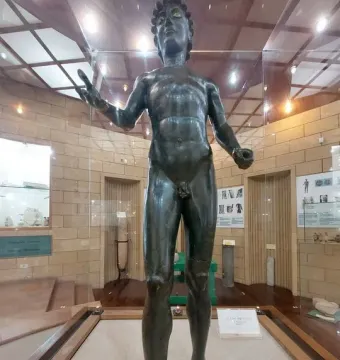
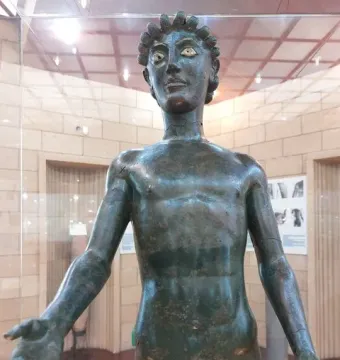
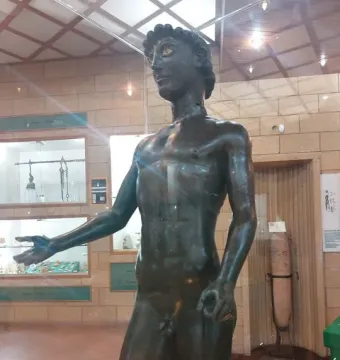
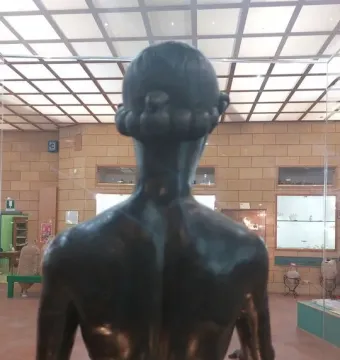
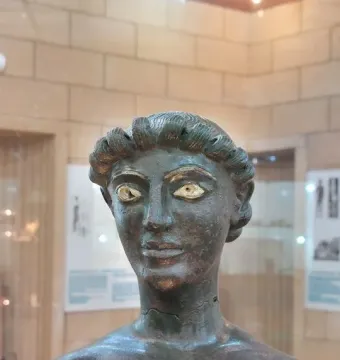
Efebo de Selinunte, also known as the Efebo de Castelvetrano and in Sicilian as Lu pupu di ponte Galera, is a bronze statue of a Greek athlete making a libation. It was created around 460 BC, in the second quarter of the 5th century BC, toward the end of the Archaic period. The sculpture measures about 85 cm tall and is the only bronze statue of this size found among Sicilian discoveries. Its hairstyle suggests Attic influence, while its execution has been described as rather awkward and probably the work of a local workshop. Discovered in Selinunte, it is now preserved in the Selinuntino-Castelvetrano Museum.
© HaguardDuNord · CC BY 4.0
© HaguardDuNord · CC BY 4.0
© HaguardDuNord · CC BY 4.0
© HaguardDuNord · CC BY 4.0
© HaguardDuNord · CC BY 4.0
Identification | |
| Title | Efebo de Selinunte |
| Type | Bronze statue |
| Alternative names | Efebo de Castelvetrano; Efebo di Selinunte; Ephèbe of Selinunte; Ephèbe of Castelvetrano; Lu pupu di ponte Galera; 'u pupu' |
Historical context | |
| Date | Late Archaic period, c. 460 BC (480–460 BC); some source fragments give only the 5th century BC or second quarter of an unspecified century |
| Historical period | Phase of the Greek colonization of Sicily |
Creator | |
| Execution quality | According to Pierre Lévêque, the execution is of uncertain quality; one description calls it rather clumsy and characteristic of a local workshop |
Discovery and provenance | |
| Initial display location | Local museum / newly established Museo Selinuntino |
| Return to Castelvetrano | Returned in 1933 by order of Minister Francesco Ercoli; later displayed in the office of the podestà on a marble pedestal and, since 1997, in a dedicated room of the new Museo Civico Selinuntino in Palazzo Maio |
| Later display location | Palermo, Museo Nazionale; Museo Salinas, Palermo; Regional Archaeological Museum Antonino Salinas, Palermo |
| Subsequent display location | Church of San Domenico |
| Discovered by | A nine-year-old pig herder, identified in one account as Benedetto Prussiano |
| Purchase price | 7,000 lire of the time |
| Acquisition by municipality | Acquired by the Municipality of Castelvetrano; one account gives a purchase price of 7,000 lire and another says the purchase date was 1895 |
| Discovery context | Found in an earthen sarcophagus; one source says it was first seen as a bronze arm, which was detached during excavation |
| Discovery location | Selinunte; near Selinunte; Ponte Galera, in the municipality of Castelvetrano; Gaggera, near Selinunte |
| Discovery date | 1882 |
History and restoration | |
| Recovery | Recovered in 1968 in Foligno after an operation led by Ugo Macera, with direct involvement of Rodolfo Siviero; the operation ended in a shootout and the arrest of four people |
| Ransom demand | 30 million lire |
| Reward for recovery | The municipality of Castelvetrano donated seven gold medals to the protagonists of the recovery operation |
| Stolen by | Francesco Messina Denaro, described as a Mafia boss and father of Matteo Messina Denaro |
| Theft | Stolen on the night of 30 October 1962; one fragment gives the theft date only as an unspecified night |
| Later restoration | Restored again in Rome at the Central Institute for Restoration |
| First restoration | 1927, at the Museo di Siracusa / Syracuse, directed by Paolo Orsi |
Physical characteristics | |
| Height | 85 cm |
| Condition | The front part of the right foot is missing; the head appears older than the body and seems to have been reworked |
| Pose | Standing on the left leg, with the right leg advanced and the right hip slightly lower than the left |
| Arms | Right arm extended forward with the palm open; left arm bent, with fingers clenched as if holding an object |
| Face | Prominent chin, small mouth and nose, slightly prominent cheekbones, and a low forehead |
| Eyes | Narrow and elongated, filled with a white substance, probably glass paste |
| Hair | Long hair pressed against the head, forming a crown; the hairstyle shows Attic influence |
| Other features | One account suggests the hand may have held a branch |
Materials | |
| Material | Bronze |
| Inlaid material | White substance in the eyes, probably glass paste |
Appearance | |
| Depicted figure | A young man, interpreted in some accounts as a Greek athlete or ephebe |
| Action depicted | Making a libation / pouring a libation |
Iconography and meaning | |
| Interpretation | No interpretation is certain |
| Probable identification | More recent research tends toward a personification of the river deity Selinon |
| Alternative identification | A young man performing a libation; recent studies also identify it as Dionysus Iakchos |
| Possible attribute | The branch in the hand may have been wild fennel |
| Civic symbolism | Wild fennel has been suggested as an emblem of the ancient city |
Significance | |
| Uniqueness | The only bronze statue of this size found among Sicilian discoveries |
| Stylistic comparison | Resembles the high reliefs of the metopes of Temple E at Selinunte, especially the face of Actaeon in the metope 'Actaeon torn to pieces by his own dogs in the presence of Artemis' |
Other | |
| Restoration evidence | The sculpture shows signs of later interventions; one source says antiquity restorations substantially altered its appearance, including a new head and unnaturally lengthened legs and torso |
| Source note | One cited source is Lezioni di archeologia by Daniele Manacorda, Editori Laterza |